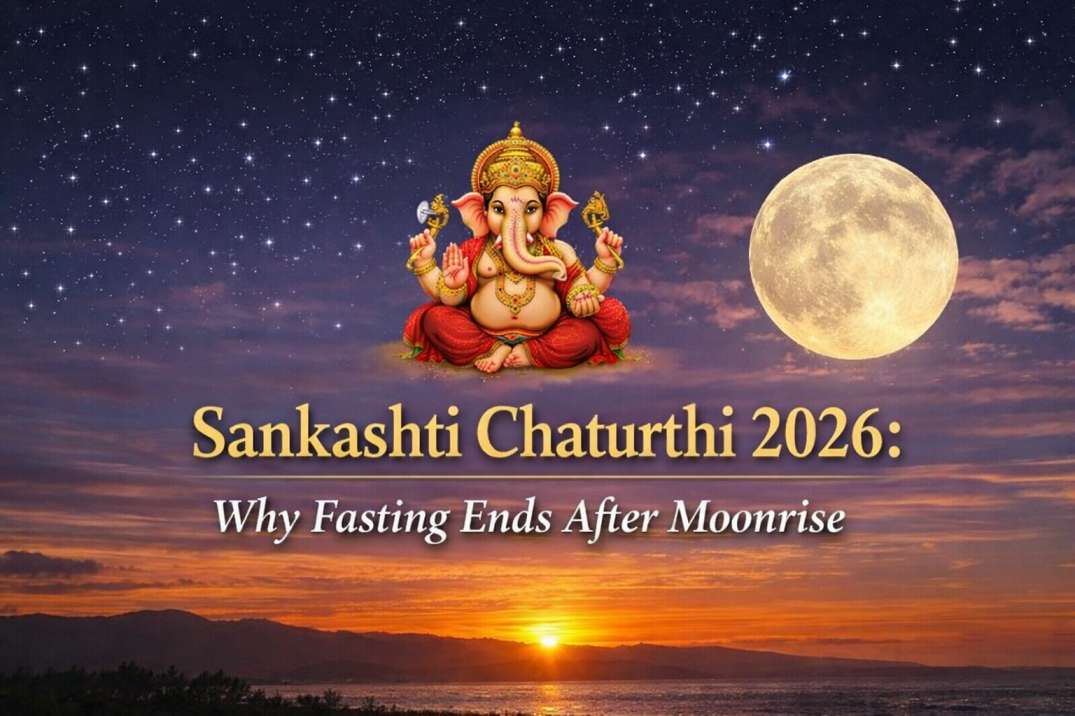
Sankashti Chaturthi is a monthly Hindu observance dedicated to Lord Ganesha, observed on the Krishna Paksha Chaturthi (fourth day after the full moon). In 2026, Sankashti Chaturthi continues to hold deep astrological importance for individuals seeking relief from obstacles, mental stress, karmic delays, and emotional instability.
The defining feature of this vrat is that fasting is broken only after moonrise, not at sunset like many other fasts. This practice often raises practical and spiritual questions, especially for working professionals and families. From a Vedic astrology perspective, this timing is not symbolic but planetary and psychological in nature.
In daily life, Sankashti Chaturthi is closely associated with problem-solving, emotional discipline, and clarity in decision-making; areas governed by both Moon (Chandra) and Ganesha, the remover of obstacles.
Why Sankashti Chaturthi Is Observed on Krishna Paksha Chaturthi
Lunar Phase and Its Astrological Impact
Sankashti Chaturthi falls during the waning moon phase, a period traditionally linked with:
- Letting go of mental burdens
- Resolving past karmic issues
- Inner reflection rather than outward expansion
In Vedic astrology, the Moon represents the mind (Manas). During Krishna Paksha, the Moon’s light decreases, symbolizing a phase where the mind becomes more vulnerable, introspective, and emotionally sensitive.
This makes Sankashti Chaturthi ideal for:
- Seeking mental stability
- Reducing anxiety and impulsive reactions
- Removing unseen psychological or karmic obstacles
The Core Question: Why Does Fasting End After Moonrise?
Astrological Logic Behind Moonrise Parana
The fast on Sankashti Chaturthi is broken only after the Moon is sighted, and this rule is consistent across scriptures and regional traditions.
The reasoning is threefold:
1. Moon as the Controller of the Mind
In astrology, the Moon governs:
- Emotions
- Memory
- Stress patterns
- Habitual thinking
Ending the fast after moonrise symbolically means regaining mental balance only after acknowledging the Moon, rather than suppressing emotional needs.
2. Ganesha’s Connection with Chandra
According to Puranic references, Lord Ganesha’s association with Chandra teaches humility, emotional control, and balance. Worship without acknowledging the Moon is considered incomplete for Sankashti vrat.
A commonly cited shloka reflects this balance-focused approach:
चन्द्राय नमः मनसो नियन्त्रे
विघ्नेश्वराय नमः दुःखनाशाय
(This highlights Moon as mind-regulator and Ganesha as obstacle-remover.)
3. Psychological Discipline Over Physical Austerity
Unlike extreme fasting traditions, Sankashti emphasizes mental discipline over physical hardship. Waiting until moonrise cultivates patience, awareness, and emotional restraint—qualities directly linked with long-term problem resolution.
Sankashti Chaturthi 2026: Moonrise Timing (IST)
Moonrise timings vary by location and date. In 2026, Sankashti Chaturthi moonrise typically occurs between:
- 8:30 PM to 10:30 PM IST, depending on the city
Devotees are advised to check local panchang or astronomical data for precise timings, especially for accurate vrat completion (parana).
Planetary and Zodiac Sign Relevance
Which Planets Are Most Affected?
- Moon (Chandra): Emotional health, sleep patterns, stress
- Ketu: Past karma, obstacles, detachment
- Mercury: Decision-making and clarity when Moon aspects Mercury
Zodiac Signs That Benefit Strongly
Sankashti Chaturthi is especially beneficial for:
- Cancer & Pisces: Emotional grounding and stability
- Virgo & Gemini: Mental clarity and anxiety relief
- Scorpio: Karmic cleansing and emotional release
From a house perspective, fasting helps when the 4th, 5th, or 8th house is afflicted in a birth chart.
Practical Remedies Associated with Sankashti Chaturthi
These remedies are simple, culturally rooted, and astrologically aligned:
- Offer Durva grass to Lord Ganesha (symbol of mental purity)
- Chant “ॐ गं गणपतये नमः” 108 times after moonrise
- Observe silence or reduced speech for a few hours on the vrat day
- Donate food or white items (rice, milk) the next morning
These practices work at a psychological and habitual level, reinforcing patience and emotional discipline.
Modern-Life Relevance of Ending the Fast After Moonrise
In contemporary life, Sankashti Chaturthi teaches:
- Delayed gratification
- Emotional regulation under stress
- Structured problem-solving rather than impulsive action
Ending the fast after moonrise aligns biological hunger with emotional closure, making the observance practical even for professionals and students.
Conclusion: What Sankashti Chaturthi 2026 Truly Teaches
Sankashti Chaturthi 2026 is not about hardship but about timing, awareness, and mental balance. Ending the fast after moonrise is astrologically designed to honor the Moon’s role in emotional health while seeking Lord Ganesha’s guidance for obstacle removal.
When practiced with understanding rather than fear, this vrat becomes a monthly reset—helping individuals manage stress, improve clarity, and navigate life’s challenges with patience. Observing it mindfully can quietly influence emotional resilience and long-term decision-making.
FAQs: Sankashti Chaturthi 2026
1. Why is Sankashti Chaturthi fast broken only after moonrise?
Because the Moon governs the mind, and moonrise symbolizes emotional balance before ending the fast.
The vrat focuses on mental discipline rather than physical endurance. Acknowledging the Moon completes the spiritual cycle of the day.
Tip: Avoid eating or drinking until moon दर्शन, even if tired.
2. Can Sankashti Chaturthi be observed without fasting?
Yes, mental discipline and prayer are more important than strict fasting.
Astrologically, intention and emotional restraint matter more than physical austerity.
Alternative: Light fasting, avoiding grains, or observing silence.
3. What if the moon is not visible due to clouds?
Moonrise time from panchang is considered valid even if the Moon is not visible.
Astrology relies on lunar timing, not visual confirmation alone.
Tip: Complete parana after the calculated moonrise time (IST).
4. Is Sankashti Chaturthi effective for career and job stress?
Yes, especially when stress is mentally driven or linked to decision fatigue.
Ganesha strengthens clarity, while Moon-related practices calm anxiety.
Remedy: Chant Ganesha mantra on Wednesdays or Chaturthi days.
5. Which mantra is best for Sankashti Chaturthi?
“ॐ गं गणपतये नमः” is the most universally recommended mantra.
It balances Mercury and Moon energies while invoking Ganesha’s guidance.
Practice: Chant 108 times after moonrise for best results.