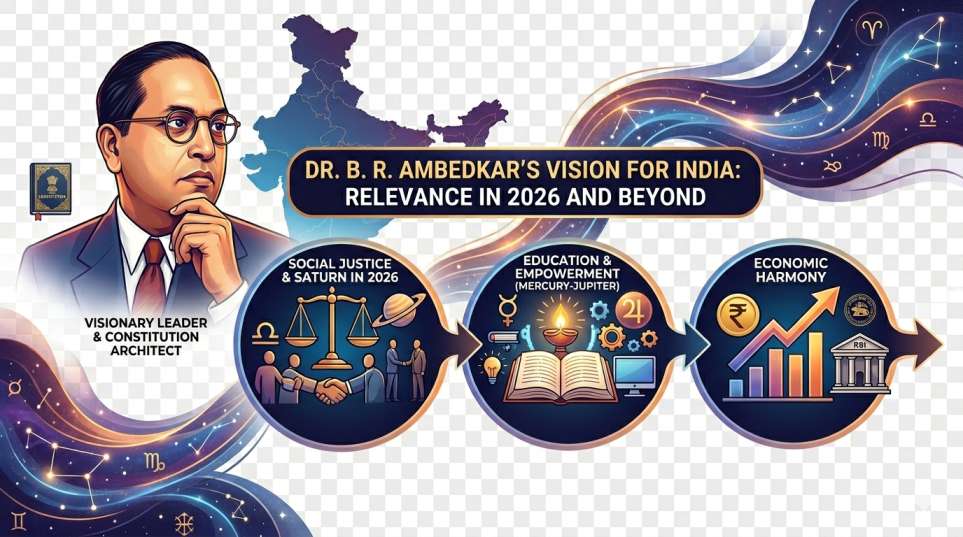
The vision of Dr. B.R. Ambedkar, the chief architect of the Indian Constitution, transcends mere political framework; it is a blueprint for a balanced and just society. As we approach 2026, India stands at a unique astrological juncture. In Vedic astrology, the progress of a nation is often mapped through its foundation chart and the movement of slow-moving planets like Saturn (Shani) and Jupiter (Guru).
Dr. Ambedkar’s core principles; Liberty, Equality, and Fraternity are not just legal concepts but resonate with the energy of a disciplined and righteous society. Understanding his vision in the context of upcoming planetary transits allows us to see how his ideals will be tested and reaffirmed in the modern era.
The Astrological Landscape of 2026: A Shift in Consciousness
In 2026, the transit of Saturn into Aries (Mesha Rashi) and Jupiter into Cancer (Karka Rashi) marks a significant “Double Transit” effect. Saturn, the planet of the masses, labor, and justice, will be in a sign of new beginnings, while Jupiter, the planet of wisdom and law, will be exalted.
Planetary Influences on Social Justice
- Saturn (Shani) in Aries: Saturn represents the marginalized sections of society, the very people Dr. Ambedkar fought for. Its movement into Aries suggests a period of intense activity and a “re-awakening” of rights and duties.
- Jupiter (Guru) in Cancer: Jupiter’s exaltation brings a focus on “Dharma” and the protection of the weak. This aligns perfectly with Ambedkar’s emphasis on moral consciousness over blind ritualism.
- Rahu-Ketu Axis: The transition of Rahu into Aquarius in early 2026 will emphasize collective goals and technological democratization, reflecting Ambedkar’s vision of education as a tool for liberation.
Education and Empowerment: The Mercury-Jupiter Connection
Dr. Ambedkar famously said, “Educate, Agitate, Organize.” Astrologically, education is governed by Mercury (Budha) for logic and Jupiter (Guru) for higher wisdom.
By 2026, India’s digital literacy is expected to hit a peak. The alignment of Mercury with transformative Pluto (in mundane astrology) indicates that the “Education” aspect of Ambedkar’s vision will move toward decentralization. Knowledge will no longer be the property of a few, but a shared resource, fulfilling the dream of intellectual equality.
Practical Insights for 2026
- Focus on Skill-Building: With Saturn in a martial sign like Aries, 2026 will reward those who focus on technical skills and “Karman” (hard work).
- Inclusivity in Tech: As Rahu influences the 11th house of the natural zodiac, ensure that technology serves the last person in the queue.
Remedies for Social Harmony and Personal Growth
To align oneself with the righteous energy Dr. Ambedkar represented—justice, discipline, and grit—one can follow these Vedic practices:
- Strengthen Jupiter: To promote wisdom and equality, honor mentors and contribute to the education of a child in need.
- Balance Saturn: Saturn thrives on discipline. To navigate the 2026 transits, practice “Shramdaan” (voluntary labor) or help those in the unorganized sector.
- Chant for Clarity: Reciting the following can help align the mind with truth and justice:
“ॐ शं शनैश्चराय नमः” (To instill discipline and resilience).
Ambedkar’s Economic Vision and the 2026 Market
Dr. Ambedkar was a trained economist. His vision for the Reserve Bank of India and his thoughts on the “Problem of the Rupee” remain relevant. Astrologically, the 2nd House (Wealth) and 11th House (Gains) of India’s chart will be under the influence of major shifts in 2026. This suggests a move toward more transparent financial systems and a crackdown on economic inequality, mirroring Ambedkar’s desire for a fair distribution of resources.
Conclusion: The Path Ahead
Dr. B.R. Ambedkar’s vision for India is a living document. As we move into 2026, the stars indicate a period of “Gyan” (Knowledge) and “Nyaya” (Justice). The heavy planetary transits suggest that while there may be friction, the end result will be a more resilient and inclusive India. By embracing education and maintaining the discipline of Shani, we can fulfill the constitutional morality that Babasaheb envisioned.
FAQs Section
1. How does astrology relate to Dr. Ambedkar’s vision?
Astrology maps the collective consciousness and timing of events, indicating when society is most receptive to justice and reform. Planetary movements, especially those of Saturn and Jupiter—reflect shifts toward social equality and empowerment, aligning with the transformative ideals championed by Dr. Ambedkar.
2. What is the significance of Saturn’s transit in 2026 for India?
Saturn’s transition into Aries in 2026 marks a period of bold beginnings and decisive action for the rights of the common people. It signifies a shift from passive observation to active participation in nation-building and reform.
Key influences:
- Encourages discipline and responsibility
- Promotes support for grassroots movements
- Emphasizes staying grounded in facts and truth
3. Will 2026 be a year of social change according to Vedic Astrology?
Yes, 2026 is expected to be a transformative year. The exaltation of Jupiter, combined with Saturn beginning a new cycle, indicates a major shift in perspectives on law, ethics, and social structures. This period may revive interest in Ambedkarite philosophy as a solution to modern societal challenges.
4. How can I improve my “Mercury” to better understand complex social issues?
Mercury governs intellect, communication, and analytical thinking—essential for understanding legal and social frameworks. Strengthening Mercury can enhance clarity and critical thinking.
Simple remedies:
- Wear green on Wednesdays
- Donate books or stationery
- Engage in logical discussions and debates
- Read diverse and thought-provoking literature
- Practice mindful and clear communication
5. What is the “Double Transit” of 2026 and why does it matter?
The “Double Transit” occurs when both Saturn and Jupiter simultaneously influence a particular house or sign. This alignment triggers significant and long-lasting events, both personally and collectively.
In 2026, this transit emphasizes the need to balance traditional values with progressive reforms, mirroring the foundational principles of justice, equality, and adaptability in modern society.