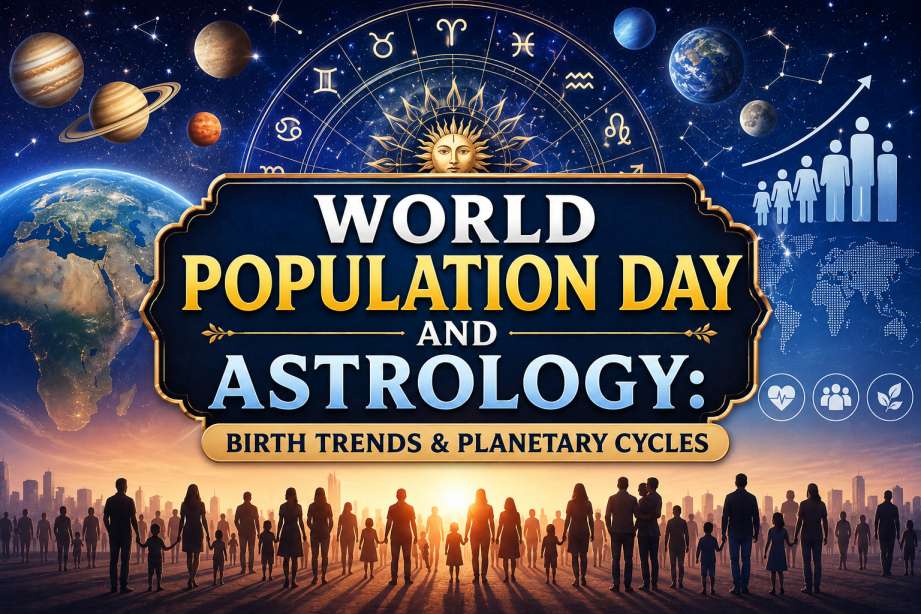
Every year, World Population Day, observed on 11 July, encourages discussions about population growth, reproductive health, sustainable development, and the future of humanity. While population studies primarily rely on demographics, economics, healthcare, and social sciences, many people also wonder whether astrology has anything to say about birth trends and changing generations.
In Vedic astrology, the birth of an individual is considered unique because it reflects the planetary positions at the exact moment of birth. However, astrology traditionally focuses on individual birth charts rather than predicting global population growth. Still, some astrologers study long-term planetary cycles, collective trends, and historical periods to understand how celestial movements may symbolically coincide with social changes. This article explores these ideas with a balanced and analytical approach while acknowledging the distinction between traditional astrological beliefs and scientific population research. All time references mentioned are in IST (Indian Standard Time).
Understanding World Population Day
World Population Day highlights issues such as:
- Population growth
- Family planning
- Maternal healthcare
- Sustainable development
- Gender equality
- Resource management
The observance encourages governments, researchers, and communities to promote informed decisions that contribute to long-term social well-being.
Astrology approaches these topics differently by focusing on individual life paths, family karma, and planetary symbolism rather than statistical population forecasts.
Does Vedic Astrology Predict Population Growth?
Individual Charts vs Collective Cycles
Traditional Vedic astrology is primarily designed to analyze an individual’s horoscope.
It studies:
- Personality
- Career
- Relationships
- Health
- Family
- Spiritual growth
Population growth, however, is influenced by numerous measurable factors such as healthcare improvements, economic development, education, migration, and public policy.
Some modern astrologers explore whether slow-moving planetary cycles coincide with major historical trends, but these observations are symbolic rather than scientifically established.
Planetary Cycles and Collective Trends
Jupiter – Expansion and Growth
Jupiter represents:
- Expansion
- Wisdom
- Prosperity
- Education
- Family growth
In symbolic astrology, Jupiter is often associated with abundance and optimism. Some astrologers observe that favorable Jupiter cycles may coincide with periods of social progress or increased family formation, though such interpretations should not be viewed as direct causes of demographic change.
Saturn – Responsibility and Structure
Saturn governs:
- Discipline
- Delayed outcomes
- Social systems
- Long-term planning
Periods strongly influenced by Saturn are traditionally linked with responsibility, careful planning, and structural reforms. These symbolic themes may align with discussions around sustainable development and responsible resource management.
Rahu and Ketu – Transformation and Change
The lunar nodes, Rahu and Ketu, are associated with:
- Technological advancement
- Social transformation
- Global shifts
- Unconventional thinking
Astrologers sometimes relate these planets to periods of rapid societal change, including advancements in healthcare, communication, and globalization.
Houses Associated With Family and Birth
The 5th House
The 5th house represents:
- Children
- Creativity
- Education
- Future generations
In individual horoscopes, astrologers study this house when discussing childbirth and family expansion.
The 4th House
The 4th house symbolizes:
- Home
- Family life
- Emotional security
- Domestic happiness
A strong 4th house often reflects a stable family environment.
The 9th House
The 9th house represents:
- Dharma
- Blessings
- Family traditions
- Higher values
It also reflects the continuation of cultural and spiritual heritage across generations.
Can Birth Trends Be Connected to Astrology?
Some astrologers observe that people born during similar planetary periods may share common generational characteristics.
For example, they may discuss:
- Similar career aspirations
- Shared social values
- Technological adaptability
- Spiritual interests
However, these observations describe symbolic patterns rather than direct evidence that planetary movements determine birth rates or population size.
Scientific demographic studies continue to attribute birth trends primarily to social, economic, cultural, and healthcare factors.
Astrology and Responsible Family Life
One valuable perspective offered by Vedic philosophy is the importance of conscious decision-making.
Traditional teachings encourage:
- Responsible parenting
- Ethical living
- Education
- Compassion
- Respect for nature
A well-known Sanskrit verse from the Bhagavad Gita emphasizes performing one’s responsibilities with sincerity:
कर्मण्येवाधिकारस्ते मा फलेषु कदाचन॥
“You have a right to perform your duties, but not to the fruits of your actions.”
This teaching reminds individuals to approach family life with responsibility rather than fear or superstition.
Practical Astrological Practices for Family Harmony
Astrological practices are generally viewed as supportive spiritual disciplines.
Some commonly followed traditions include:
Strengthen Jupiter
- Respect teachers and elders.
- Donate educational materials.
- Study spiritual literature.
- Practice gratitude.
Worship Lord Vishnu
Many devotees chant:
ॐ नमो भगवते वासुदेवाय॥
This mantra is traditionally associated with peace, wisdom, and family harmony.
Promote Positive Karma
Simple daily practices include:
- Supporting children’s education.
- Helping those in need.
- Caring for parents and elders.
- Protecting the environment.
These actions align both with Vedic values and the broader goals highlighted on World Population Day.
A Balanced Perspective
It is important to distinguish between symbolism and measurable evidence.
Astrology can:
- Encourage self-reflection.
- Offer insight into personal tendencies.
- Support spiritual practices.
- Inspire responsible living.
It does not replace:
- Medical advice
- Population research
- Public policy
- Scientific demographic analysis
A balanced understanding respects both traditional wisdom and modern evidence.
Conclusion
World Population Day reminds us that population growth affects healthcare, education, sustainability, and the future of our societies. Vedic astrology approaches these themes by emphasizing individual karma, family values, and planetary symbolism rather than making direct predictions about global demographics.
While Jupiter, Saturn, Rahu, and other planetary cycles may be interpreted symbolically in discussions about social change, there is no established scientific evidence that they directly determine population growth or birth rates. Combining traditional astrological reflection with informed decision-making, education, and responsible citizenship offers a thoughtful way to appreciate both ancient wisdom and modern knowledge. Ultimately, building a healthy future depends on compassion, awareness, and responsible choices made by individuals and communities alike.
FAQs
1. Does Vedic astrology predict world population growth?
No, traditional Vedic astrology focuses on individual birth charts rather than forecasting global population growth.
Astrologers may interpret long-term planetary cycles symbolically, but demographic changes are primarily studied through scientific research, census data, healthcare trends, and economic factors.
Key points:
- Astrology emphasizes individual life paths.
- Population studies rely on measurable data.
- Both perspectives serve different purposes.
2. Which planet is associated with family growth in astrology?
Jupiter is traditionally considered the primary planet associated with expansion, wisdom, and family growth.
In Vedic astrology, Jupiter is linked with blessings, children, education, and prosperity. Its influence is always assessed alongside the complete birth chart.
Traditional practices:
- Respect mentors and elders.
- Study spiritual knowledge.
- Perform charitable acts.
3. Can planetary cycles influence birth trends?
Some astrologers interpret planetary cycles as symbolic indicators of social change, but there is no scientific proof that they directly influence birth rates.
Generational patterns discussed in astrology should be viewed as philosophical observations rather than measurable demographic predictions.
Balanced approach:
- Appreciate symbolic interpretations.
- Rely on scientific data for population research.
- Avoid drawing absolute conclusions.
4. What is the significance of the 5th house in Vedic astrology?
The 5th house represents children, creativity, education, and future generations.
Astrologers analyze this house while studying childbirth, learning, and family-related themes. Other houses and planetary combinations are also considered before making any interpretation.
Related factors include:
- Jupiter’s placement
- Strength of the 5th lord
- Overall horoscope analysis
5. Can astrology help improve family harmony?
Astrology may offer guidance for personal growth and harmonious relationships, but lasting family happiness depends on communication, respect, and shared responsibility.
Many traditional remedies encourage mindfulness, gratitude, charity, and spiritual discipline, all of which can positively influence family life when combined with practical efforts.
Helpful practices:
- Chant peaceful mantras regularly.
- Spend quality time with family.
- Practice patience and empathy.
- Support education and community welfare.