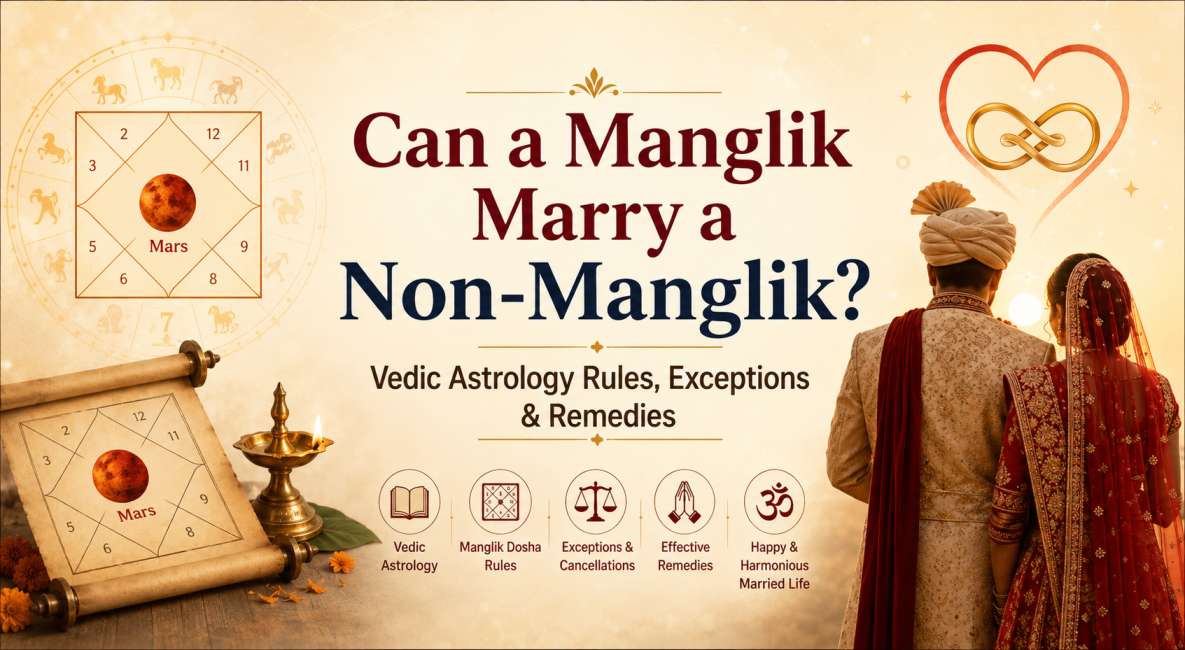
Can a Manglik marry a non-Manglik? This is one of the most common questions asked during marriage matching in Vedic astrology. Manglik Dosha, also called Mangal Dosha or Kuja Dosha, is traditionally associated with the placement of Mars in specific houses of a person’s birth chart.
In popular belief, a Manglik and a non-Manglik are sometimes considered incompatible. However, Vedic astrology does not recommend judging marriage compatibility from Manglik Dosha alone. The complete Kundli, strength of Mars, house ownership, aspects, Navamsa chart, planetary combinations, and overall Guna Milan should be examined before reaching a conclusion.
Therefore, a Manglik can marry a non-Manglik in many circumstances, particularly when the Dosha is weak, cancelled, balanced by the partner’s chart, or supported by favourable marriage combinations.
What Is Manglik Dosha?
Manglik Dosha occurs when Mars occupies certain houses in the birth chart. Traditionally, astrologers examine Mars from the Lagna, and many practitioners also consider its position from the Moon and Venus.
The commonly considered houses are:
- 1st house
- 2nd house
- 4th house
- 7th house
- 8th house
- 12th house
The 7th house is particularly important because it represents marriage, spouse, partnerships, and marital interaction.
However, the mere presence of Mars in one of these houses does not automatically mean that a marriage will fail. Mars can behave differently depending on its zodiac sign, dignity, house lordship, aspects, conjunctions, and overall planetary strength.
Can a Manglik Marry a Non-Manglik?
Yes, Marriage Is Possible
A Manglik can marry a non-Manglik when the complete horoscope shows supportive combinations.
Traditional Vedic astrology treats Manglik Dosha as one factor among several, rather than an independent verdict on marriage.
An astrologer may examine:
- Strength and placement of Mars
- 7th house and 7th lord
- Venus and Jupiter
- Moon and emotional compatibility
- Navamsa or D9 chart
- Guna Milan
- Presence or cancellation of Mangal Dosha
- Mahadasha and Antardasha
- Planetary aspects on marriage-related houses
If these factors are favourable, the presence of Manglik Dosha may have considerably less significance.
Important Manglik Dosha Exceptions
Mars in Its Own or Exalted Sign
Mars becomes particularly strong in Aries and Scorpio, its own signs, and is traditionally considered exalted in Capricorn.
A strong Mars does not automatically mean a problematic marriage. Its strength and functional role in the particular Kundli must be evaluated.
Beneficial Planetary Influences
Jupiter’s favourable influence on Mars, the 7th house, or the 7th lord can modify the results. Venus and a strong Moon can also contribute to relationship stability and emotional understanding.
The exact outcome depends on the complete horoscope rather than a single aspect.
Manglik–Manglik Matching
When both partners have significant Mangal Dosha, traditional astrology considers the Doshas potentially capable of balancing one another.
This is commonly called Mangal Dosha matching or Dosha Samya. However, even in such cases, other marriage compatibility factors should be examined.
Cancellation or Reduction of Dosha
Different classical traditions describe circumstances under which the effects of Mangal Dosha may be reduced or cancelled. These rules can vary between astrological schools.
For this reason, a blanket statement such as “Mars in the 7th house always causes divorce” is not consistent with a complete Kundli-based approach.
Why the 7th House Matters
The 7th house is the primary house of marriage and long-term partnership. Mars represents energy, courage, assertion, passion, competition, and sometimes aggression.
When strongly connected with the 7th house, Mars may indicate a relationship requiring careful management of:
- Anger and impatience
- Dominance or control
- Arguments
- Strong expectations
- Differences in decision-making
- Physical and emotional intensity
At the same time, Mars can also provide courage, loyalty, initiative, protection, and determination.
Therefore, its influence should not automatically be interpreted negatively.
Role of Navamsa Chart in Marriage Analysis
The Navamsa (D9) chart is an important divisional chart used in Vedic astrology for assessing marriage, spouse-related matters, and the deeper strength of planets.
A birth chart may show a particular Mars influence, while the Navamsa can provide additional context regarding marital potential.
For a serious marriage assessment, astrologers may therefore compare:
- Birth chart or D1
- Navamsa or D9
- 7th house and 7th lord
- Venus and Jupiter
- Mars placement
- Moon compatibility
- Dashas
- Guna Milan
This approach provides a more balanced assessment than simply labelling someone “Manglik” or “non-Manglik.”
Traditional Remedies for Manglik Dosha
Remedies should be viewed as spiritual and traditional practices, not guaranteed solutions to relationship problems.
Depending on the horoscope, commonly followed remedies include:
- Reciting “Om Angarakaya Namah” with devotion.
- Offering prayers to Lord Hanuman, particularly on Tuesdays.
- Reading Hanuman Chalisa regularly.
- Practising anger management and mindful communication.
- Donating appropriate items on Tuesdays according to one’s tradition.
- Seeking guidance from a qualified astrologer before performing specialised rituals such as Mangal Shanti Puja.
The most useful “remedy” in practical life is often developing patience, respectful communication, and emotional maturity between partners.
Practical Advice Before Marriage
If one partner is Manglik and the other is non-Manglik, couples should avoid making a marriage decision based solely on this label.
Instead, consider:
- Complete Kundli compatibility
- Emotional understanding
- Financial expectations
- Family compatibility
- Career priorities
- Communication style
- Long-term relationship goals
- Personal values and mutual respect
Astrology can provide a traditional framework for reflection, but real-life compatibility also depends on the choices and behaviour of both partners.
Conclusion
A Manglik can marry a non-Manglik, and Manglik Dosha alone should not be treated as an automatic reason to reject a marriage proposal. Vedic astrology requires a broader assessment involving Mars, the 7th house, Venus, Jupiter, Moon, Navamsa, planetary aspects, dashas, and overall compatibility.
The effects of Manglik Dosha can also vary because of cancellation or modification principles found in traditional astrology. Rather than relying on fear-based interpretations, couples should seek a complete and contextual Kundli analysis.
Ultimately, a successful marriage depends not only on planetary combinations but also on trust, communication, respect, patience, and shared responsibility.
FAQs
1. Can a Manglik marry a non-Manglik?
Yes, a Manglik can marry a non-Manglik if the overall Kundli shows compatible and supportive combinations.
Manglik Dosha is only one component of marriage analysis. The 7th house, 7th lord, Mars, Venus, Jupiter, Moon, Navamsa, dashas, and other compatibility factors should also be examined.
Related guidance:
- Check the complete Kundli.
- Examine Mangal Dosha from relevant reference points.
- Assess the Navamsa chart.
- Consider emotional and practical compatibility.
2. Is Manglik Dosha always harmful for marriage?
No, Manglik Dosha is not automatically harmful in every horoscope.
The result depends on Mars’s sign, house, dignity, aspects, conjunctions, house lordship, and the strength of other marriage-related planets. Some traditional combinations can reduce or modify its effects.
Helpful approach:
- Avoid judging from Mars placement alone.
- Check cancellation or reduction factors.
- Examine the complete marriage horoscope.
3. What happens if only one partner is Manglik?
There is no single outcome because the effect depends on the individual horoscopes of both partners.
A non-Manglik partner’s chart may contain favourable combinations that support marital stability. Conversely, other difficult combinations can be more significant than Manglik Dosha itself.
Before deciding:
- Compare both Kundlis.
- Check the 7th houses and lords.
- Examine D9 compatibility.
- Review planetary periods.
4. Can Manglik Dosha be cancelled?
Yes, traditional Vedic astrology describes several conditions that can reduce or cancel the effects attributed to Manglik Dosha.
The exact rules differ among astrological traditions, so cancellation should be evaluated in the context of the entire horoscope rather than through a generic checklist.
Consider:
- Mars’s sign and strength.
- Beneficial planetary aspects.
- Relevant house placements.
- Dosha balance between both charts.
5. Should a Manglik marry another Manglik?
Manglik-Manglik matching is traditionally considered capable of balancing Mangal Dosha, but it is not the only factor in compatibility.
Two Manglik charts can still have other challenging combinations. Similarly, a Manglik and non-Manglik couple can have a harmonious marriage when their overall horoscopes are supportive.
Remember:
- Compare the complete Kundlis.
- Assess Guna Milan and other compatibility factors.
- Do not make the decision solely on Manglik status.
6. Which remedy is considered useful for Manglik Dosha?
Traditional remedies may include Hanuman worship, Tuesday prayers, mantra recitation, and Mangal Shanti practices depending on the horoscope.
Remedies are traditionally intended as spiritual practices and should not be presented as guaranteed ways to change a relationship’s outcome.
Common practices include:
- Reciting Om Angarakaya Namah.
- Reading Hanuman Chalisa.
- Offering prayers on Tuesdays.
- Practising patience and constructive communication.