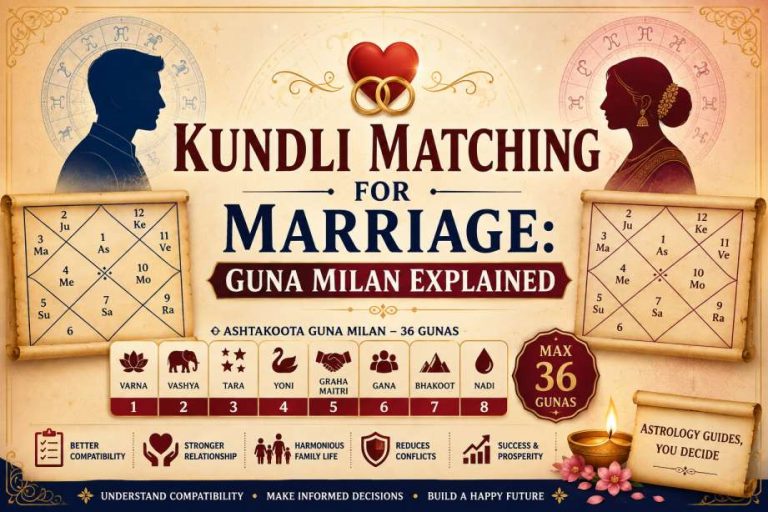
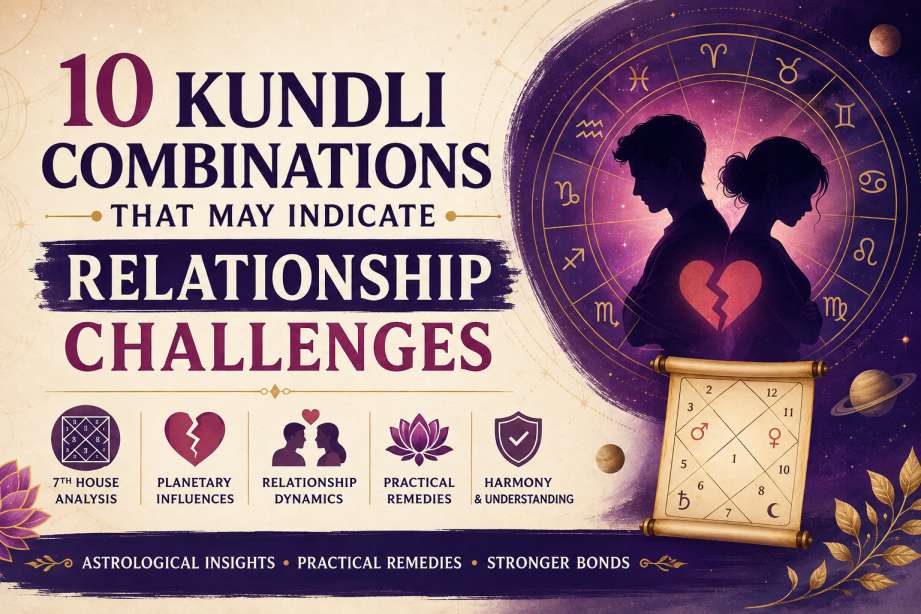
In Vedic astrology, a Kundli is not used only to predict marriage timing. It can also offer insights into emotional compatibility, communication patterns, attachment, conflict, and the overall dynamics between partners. Certain planetary combinations may indicate periods of relationship challenges, but they should never be interpreted as a definite prediction of separation or divorce.
Relationship analysis generally considers the 7th house, 7th lord, Venus, Jupiter, Moon, Mars, Rahu, Ketu, Navamsa (D9) chart, and relevant Mahadasha and Antardasha. The strength, dignity, aspects, conjunctions, and benefic support received by these factors are equally important.
Understanding these combinations can help a person identify potential areas of difficulty and work on them consciously. Astrology can therefore be approached as a traditional framework for self-reflection rather than a substitute for communication, mutual respect, or professional relationship guidance.
1. Affliction to the 7th House
The 7th house is one of the primary houses examined for marriage, partnerships, and one-to-one relationships. Malefic influences involving Saturn, Mars, Rahu, or Ketu may sometimes indicate areas requiring greater patience.
However, an afflicted 7th house does not automatically mean an unhappy marriage. Beneficial aspects from Jupiter or a strong 7th lord can significantly modify the interpretation.
What to examine:
- Planets occupying the 7th house
- Aspects received by the 7th house
- Strength of the 7th lord
- Support from the Navamsa chart
2. Weak or Afflicted 7th Lord
The condition of the 7th lord is another important factor in relationship analysis. If it is debilitated, severely afflicted, combust, or placed in challenging circumstances, traditional astrology may associate it with difficulties in maintaining relationship stability.
The complete chart must be examined before drawing conclusions. A strong Navamsa placement, benefic aspect, or supportive planetary period may reduce the intensity of such indications.
3. Venus Under Strong Malefic Influence
Venus (Shukra) represents affection, attraction, romance, pleasure, and relationship harmony. Strong affliction to Venus can traditionally be associated with dissatisfaction, misunderstandings, unrealistic expectations, or fluctuations in romantic bonding.
This interpretation varies according to the sign, house, dignity, conjunctions, and aspects involving Venus.
Practical approach: Instead of assuming relationship failure, observe whether the chart reflects issues such as emotional expectations, communication gaps, or difficulty expressing affection.
4. Mars Influencing the 7th House
Mars represents energy, assertion, courage, and conflict. Its strong influence on the 7th house, 7th lord, or Venus is sometimes examined under the broader concept of Manglik Dosha.
Mars does not necessarily create an unsuccessful marriage. Traditional Jyotish also considers cancellation factors, Mars’ dignity, the complete horoscope, and compatibility between both charts.
Healthy ways to manage Mars-like tendencies include:
- Practising calm communication
- Avoiding impulsive reactions
- Exercising regularly
- Giving each partner adequate personal space
5. Saturn’s Influence on Marriage Indicators
Saturn represents responsibility, delay, discipline, endurance, and long-term karma. Its connection with the 7th house or Venus may sometimes indicate a relationship that develops slowly or requires considerable maturity.
In some charts, Saturn can actually support long-lasting relationships because it encourages commitment and responsibility.
The key distinction is between delay and denial. A Saturn influence should not automatically be interpreted as marital failure.
6. Rahu Affecting Venus or the 7th House
Rahu is associated with unconventional desires, ambition, experimentation, and amplification. Its influence on Venus or the 7th house may sometimes correspond with unusual relationship circumstances or intense attractions.
Depending on the chart, this can include relationships across different cultures or backgrounds, sudden attractions, unrealistic expectations, or emotional confusion.
Because Rahu tends to magnify what it touches, conscious decision-making becomes particularly important.
7. Ketu’s Connection With Relationship Factors
Ketu is traditionally associated with detachment, introspection, spirituality, and reduced worldly attachment. When strongly connected with Venus, the 7th house, or its lord, it may sometimes indicate emotional distance or difficulty sustaining romantic involvement.
This does not necessarily mean a lack of love. In some cases, the person may simply express affection differently or require greater emotional and personal space.
Helpful practice: Openly discuss emotional needs rather than assuming that silence means disinterest.
8. Moon Under Severe Affliction
The Moon represents the mind, emotions, sensitivity, and psychological responses. Relationship harmony can become difficult when the Moon is severely afflicted because emotional reactions and insecurity may influence communication.
Traditional analysis considers:
- Moon’s sign and house
- Aspects from malefic planets
- Moon’s association with Rahu or Ketu
- Strength of the Moon
- Placement in the Navamsa
Emotional awareness and healthy communication can be especially useful when the horoscope shows a sensitive Moon.
9. Difficult Combinations Involving Venus and Mars
Venus represents attraction and harmony, while Mars represents passion and assertiveness. Their relationship in a Kundli can therefore be significant when studying romantic dynamics.
A challenging Venus-Mars association may sometimes correspond with strong attraction accompanied by disagreements, competitiveness, impatience, or fluctuating emotional intensity.
At the same time, Venus-Mars connections can also create chemistry and mutual attraction. The result depends heavily on planetary strength and the rest of the horoscope.
10. Challenging Dasha Periods
A promising Kundli may still experience temporary relationship difficulties during particular Mahadasha or Antardasha periods.
Astrologers commonly examine the periods of planets connected with:
- The 7th house
- The 7th lord
- Venus
- The 2nd house of family
- The 8th house of marital longevity
- The 12th house of intimacy and separation themes
A challenging Dasha does not guarantee an adverse event. It may simply bring existing relationship patterns to the surface and create an opportunity to address them.
Why One Combination Is Never Enough
One of the most important principles in responsible Kundli analysis is confirmation through multiple factors.
For example, Saturn in the 7th house alone should not be labelled as a sign of an unhappy marriage. An astrologer should also evaluate:
- Strength and dignity of the 7th lord
- Condition of Venus
- Jupiter’s influence
- Moon and emotional compatibility
- Navamsa (D9) chart
- Current Mahadasha and Antardasha
- Transits, where relevant
- Compatibility between both partners’ charts
This holistic approach prevents fear-based interpretations.
Practical Astrological Remedies
Traditional remedies should be viewed as supportive spiritual practices rather than guaranteed solutions.
Depending on the horoscope, commonly suggested practices may include:
- Friday: Maintain cleanliness and offer prayers to Goddess Lakshmi or seek Venus-related spiritual practices.
- Monday: Practise meditation or offer prayers to Lord Shiva to encourage emotional calm.
- Tuesday: Channel Mars energy through physical exercise, discipline, and Hanuman worship where culturally appropriate.
- Saturday: Practise service, charity, and disciplined routines for Saturn-related concerns.
- Recite appropriate mantras only after understanding their traditional context.
- Most importantly, combine spiritual practices with honest communication and practical relationship efforts.
Conclusion
The 10 Kundli combinations that may indicate relationship challenges should be understood as potential tendencies rather than fixed outcomes. The 7th house, 7th lord, Venus, Moon, Mars, Saturn, Rahu, Ketu, Navamsa, and planetary periods all contribute to a balanced interpretation.
A challenging combination may describe a need for patience, emotional maturity, better communication, or conscious relationship management. Conversely, benefic influences can provide protection and stability even when one or more difficult combinations are present.
Vedic astrology is most useful when it encourages awareness rather than fear. Before making major relationship decisions based on a Kundli, consider the complete horoscope and, equally importantly, the actual behaviour, communication, values, and mutual respect within the relationship.
FAQs
1. Can Kundli predict relationship problems?
Yes, Kundli can indicate potential relationship challenges, but it cannot guarantee that problems will occur.
Vedic astrology evaluates planetary patterns associated with marriage, communication, emotions, and partnership. These are interpreted as tendencies rather than unavoidable events.
Related tips:
- Examine the complete horoscope.
- Consider both partners’ Kundlis.
- Avoid judging a relationship from one placement.
2. Which house represents relationships in Kundli?
The 7th house is the primary house associated with marriage and committed partnerships.
Astrologers also examine the 2nd house for family life, the 5th house for romance, the 8th house for marital bonding and longevity, and the 12th house for intimacy and private life.
Key factors include:
- 7th house
- 7th lord
- Venus
- Jupiter
- Navamsa chart
3. Does Saturn in the 7th house mean divorce?
No, Saturn in the 7th house does not automatically mean divorce.
Saturn can indicate delay, responsibility, maturity, or a serious approach to relationships. Its final interpretation depends on dignity, aspects, conjunctions, the 7th lord, Venus, Navamsa, and planetary periods.
Remember: Saturn can represent commitment as well as delay.
4. Does Manglik Dosha always create marriage problems?
No, Manglik Dosha does not automatically lead to an unsuccessful marriage.
Mars-related compatibility requires a complete horoscope analysis, including the placement and strength of Mars, cancellation or reduction factors, both partners’ charts, and the Navamsa.
Traditional considerations include:
- Mars’ sign and house
- Strength of Mars
- Dosha cancellation factors
- Matching of both Kundlis
5. Can Rahu cause relationship instability?
Rahu may indicate unconventional or confusing relationship patterns when it strongly influences Venus or marriage-related factors.
Rahu can intensify desires and expectations, but its results depend on the sign, house, lordship, aspects, conjunctions, and planetary periods involved.
Helpful practices:
- Avoid impulsive decisions.
- Communicate expectations clearly.
- Give relationships time before making major commitments.
6. Can remedies remove relationship problems completely?
Traditional remedies are generally considered supportive practices, not guaranteed methods of removing relationship problems.
Prayer, mantra, charity, meditation, and disciplined behaviour may help cultivate qualities associated with balance and emotional stability. Practical efforts remain essential.
A balanced approach includes:
- Spiritual practice
- Self-reflection
- Open communication
- Mutual respect
- Professional counselling when appropriate