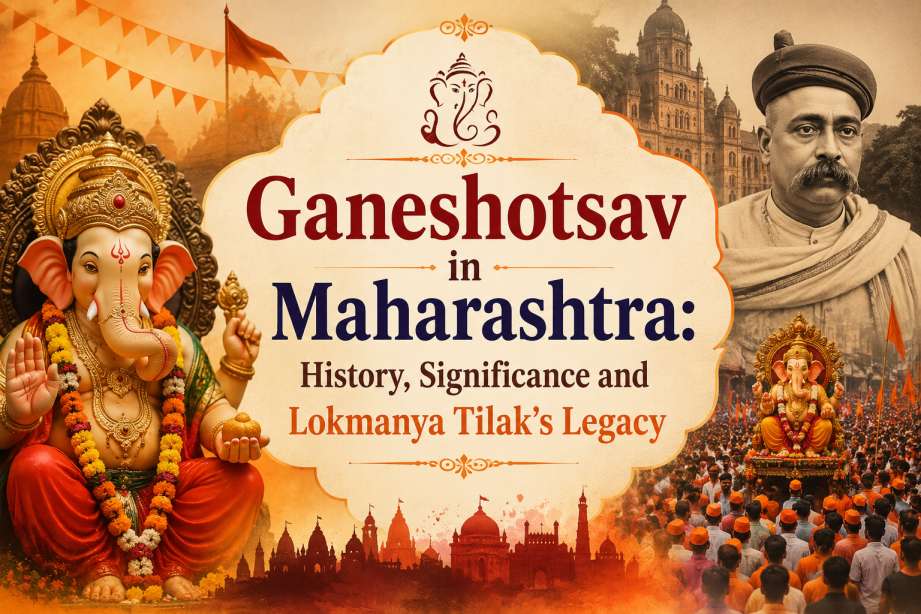
Ganeshotsav in Maharashtra is more than a religious celebration. It is a unique blend of devotion, history, community participation, art and social consciousness. Celebrated during Bhadrapada Shukla Chaturthi, the festival honours Lord Ganesha, traditionally revered as the remover of obstacles, bestower of wisdom and auspicious beginnings.
The festival became especially significant in Maharashtra when Lokmanya Bal Gangadhar Tilak helped transform Ganapati worship into a large-scale public celebration during the late 19th century. Public Ganeshotsav created a shared cultural space where people could gather, discuss social issues and strengthen community bonds.
From a Vedic astrology perspective, Ganesha worship is traditionally associated with intellect, discrimination, learning and overcoming obstacles. Thus, Ganeshotsav can also be viewed as an opportunity to cultivate discipline, clarity and positive action in everyday life.
History of Ganeshotsav in Maharashtra
From Household Worship to Public Celebration
Ganapati worship has ancient roots, and Maharashtra has a long-standing cultural connection with Lord Ganesha. The modern public form of the festival, however, developed in the late 19th century.
The Maharashtra Department of Tourism notes that public Ganesh celebrations existed before Tilak and that Lokmanya Tilak gave Ganesh Chaturthi a major public and organised character in 1893.
Pune also became an important centre of this transformation. Maharashtra Tourism records the city’s connection with the inception of public Ganeshotsav and its role in nationalist mobilisation.
Lokmanya Tilak’s Legacy
Tilak recognised that a popular religious festival could become a platform for social interaction. At a time when political gatherings faced restrictions under British rule, public celebrations provided an opportunity for people from different sections of society to meet.
His contribution was therefore not simply about increasing the scale of Ganapati worship. It was about creating a shared public institution around culture and community participation.
The legacy of Tilak can still be seen in Maharashtra’s public Ganesh mandals, cultural programmes, music, processions and social-service initiatives.
Why Ganeshotsav Is Spiritually Significant
Lord Ganesha is traditionally worshipped before beginning important activities. He is associated with Vighnaharta, the remover of obstacles, and Buddhiprada, the giver of wisdom.
Ganesh Chaturthi falls on Shukla Chaturthi of Bhadrapada. The celebration generally continues for several days and traditionally culminates with immersion on Anant Chaturdashi.
The familiar prayer—
“ॐ गं गणपतये नमः”
—is a simple Ganesha mantra traditionally used for focused worship and contemplation.
Rather than treating such practices as guaranteed solutions to problems, devotees can use them as tools for mindfulness, discipline, gratitude and positive intention.
Ganeshotsav and Vedic Astrology
Ganesha and Mercury-like Qualities
In popular Jyotish traditions, Ganesha is often connected symbolically with qualities associated with Budha (Mercury)—intelligence, communication, learning, reasoning and analytical ability. This should be understood as a traditional spiritual association rather than a scientifically established planetary effect.
Ganesh worship can therefore be particularly meaningful when someone wants to cultivate:
- Better concentration and decision-making
- Learning and academic discipline
- Clear communication
- Logical thinking
- Patience before taking major decisions
Houses and Practical Astrology
For an individual horoscope, the 2nd, 4th and 5th houses can provide useful astrological context when discussing speech, education, mental stability and learning respectively. The 10th house may be considered when analysing professional responsibilities and public reputation.
However, there is no single “Ganeshotsav yoga” that guarantees success. A proper Vedic astrology assessment should consider the Lagna, planetary strength, Mahadasha, Antardasha and relevant house connections.
Simple Ganeshotsav Remedies
Traditional remedies should be approached with faith and practicality rather than fear.
For Education and Concentration
Students can offer durva and modak to Lord Ganesha and spend a few minutes in silent prayer before studying.
For New Beginnings
Before starting a major project, chant “Om Gan Ganapataye Namah” with a calm and focused mind.
For Family Harmony
Participate in Ganesh puja together as a family. The shared ritual can encourage communication, gratitude and togetherness.
For Social Responsibility
Follow the broader spirit of Ganeshotsav by participating in community service, helping those in need or supporting local environmental initiatives.
Eco-Friendly Ganeshotsav
Modern Ganeshotsav increasingly includes environmental awareness. Maharashtra Tourism highlights the importance of environmental consciousness alongside devotion and community celebration.
Practical choices include:
- Choosing a natural clay or Shadu Mati idol
- Avoiding unnecessary plastic decoration
- Using reusable lights and décor
- Limiting excessive noise
- Following designated immersion arrangements
- Supporting community cleanliness drives
This approach preserves the cultural spirit of Ganeshotsav while reducing avoidable environmental impact.
Ganeshotsav in Modern Maharashtra
Today, Ganeshotsav connects tradition with contemporary urban life. Mumbai, Pune and many other parts of Maharashtra witness elaborate public celebrations, while homes continue to observe intimate family rituals.
The festival also supports local artists, musicians, decorators, artisans and community organisations. Public mandals increasingly combine devotion with blood-donation drives, educational activities, cleanliness campaigns and other forms of social service.
This evolution reflects the strongest part of Tilak’s legacy: a festival can preserve religious tradition while also creating social connection and collective responsibility.
Conclusion
Ganeshotsav in Maharashtra represents a remarkable meeting point of faith, history, astrology, culture and community life. Its spiritual foundation lies in Lord Ganesha’s association with wisdom and the removal of obstacles, while its modern public identity is deeply connected with Lokmanya Tilak and Maharashtra’s social history.
From a practical perspective, the festival can inspire better habits—clear thinking, disciplined action, family participation and service to society. Astrologically, Ganesha worship may be approached as a traditional spiritual practice for cultivating Budha-like qualities such as intelligence and communication, without making exaggerated promises.
The deeper message of Ganeshotsav remains simple: begin with clarity, act responsibly and overcome obstacles with patience and wisdom.
FAQs
1. Why is Ganeshotsav so important in Maharashtra?
Ganeshotsav is important because it combines religious devotion with Maharashtra’s cultural and social history.
The festival has deep roots in Ganapati worship and became especially prominent as a public celebration in the late 19th century. Lokmanya Tilak’s efforts helped turn it into a platform for community participation and nationalist consciousness.
Related tip: Celebrate through family prayer, community participation and responsible environmental practices.
2. What was Lokmanya Tilak’s role in Ganeshotsav?
Lokmanya Tilak played a major role in popularising organised public Ganeshotsav in Maharashtra from 1893.
He recognised the ability of a popular cultural festival to bring people together in a shared public space. This helped strengthen community interaction and contributed to the wider social and nationalist movement of the period.
Key takeaway: Tilak’s legacy is closely associated with the public and community-oriented character of modern Ganeshotsav.
3. What is the astrological significance of Lord Ganesha?
In traditional Hindu and Jyotish-related symbolism, Ganesha represents wisdom, intellect, learning and the removal of obstacles.
Ganesha worship is therefore commonly associated with developing clarity before beginning important activities. Budha or Mercury is also symbolically connected with intellect, communication and analytical ability, although such associations should not be treated as scientifically proven planetary effects.
Simple practice: Chant “Om Gan Ganapataye Namah” and spend a few quiet minutes focusing on your intention.
4. Which houses can be considered when analysing education and intellect in Vedic astrology?
The 2nd, 4th and 5th houses are commonly considered when assessing areas such as speech, education, mental faculties and learning.
The exact interpretation depends on the Lagna, house lords, planetary placements, aspects, yogas and running Mahadasha-Antardasha. Therefore, one placement alone should not be used to predict educational or professional outcomes.
Astrology tip: Consider the complete birth chart rather than relying on a single planet or house.
5. How can Ganeshotsav be celebrated in an eco-friendly way?
Using a natural clay idol and reducing plastic, excessive decoration and waste are simple ways to make Ganeshotsav more environmentally responsible.
Devotees can also follow authorised immersion arrangements and support local environmental or cleanliness initiatives. Maharashtra Tourism similarly highlights environmental awareness as an important part of contemporary Ganesh Chaturthi celebrations.
Easy checklist:
- Choose a Shadu Mati or natural clay idol.
- Reuse decorations.
- Avoid unnecessary plastic.
- Follow local immersion guidelines.
- Participate in community cleanliness drives.