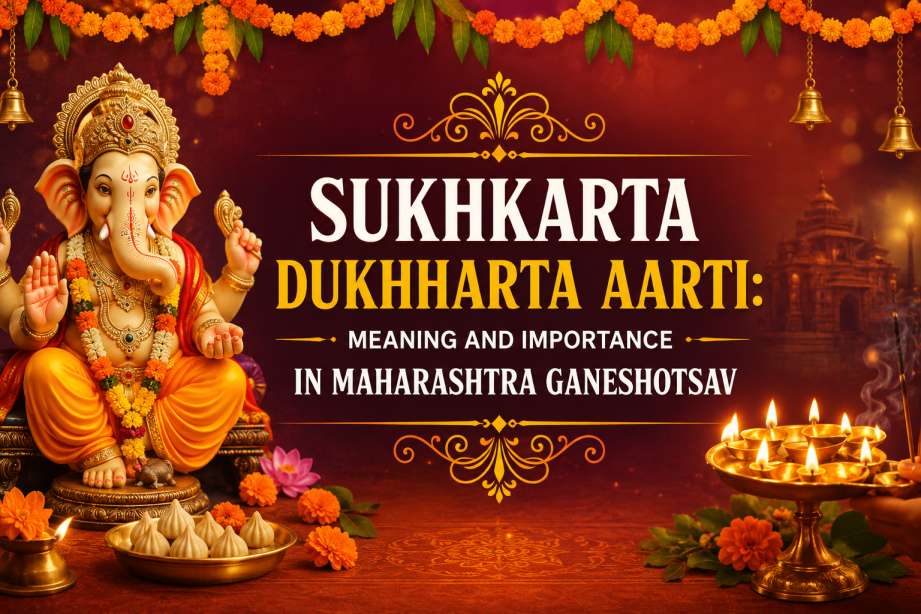
Sukhkarta Dukhharta Aarti is one of the most familiar Marathi devotional prayers dedicated to Lord Ganesha. Its opening words describe Ganesha as the giver of happiness and remover of sorrow, making the aarti especially meaningful during Maharashtra’s Ganeshotsav. It is traditionally attributed to the 17th-century saint-poet Samarth Ramdas and has become an integral part of Ganesh worship in homes, temples and public mandals.
During Ganesh Chaturthi, devotees commonly sing the aarti as part of the puja ritual. Maharashtra Tourism also notes that the familiar chant of “Sukhkarta Dukhharta” forms an important part of daily Ganeshotsav celebrations.
Beyond devotion, the prayer carries themes of removing obstacles, seeking grace, developing inner discipline and beginning important activities with a positive mindset. In a traditional astrological framework, Ganesha worship is also associated with wisdom, discrimination and the smooth beginning of auspicious activities.
What Does Sukhkarta Dukhharta Mean?
The famous opening verse begins:
“सुखकर्ता दुःखहर्ता, वार्ता विघ्नाची”
The phrase can be understood as “the one who brings happiness and removes sorrow and obstacles.”
The first stanza presents a beautiful image of Lord Ganesha decorated with shendur (vermilion) and a pearl necklace. The devotional imagery is not merely ornamental. It creates a mental picture of the deity and encourages the devotee to focus the mind before prayer.
The recurring “Jai Dev Jai Dev Jai Mangal Murti” expresses reverence for Ganesha as an auspicious divine form. The following idea of darshan and fulfilment of heartfelt wishes should traditionally be understood as an expression of faith rather than a guarantee that every desire will automatically come true.
Why Is It Important in Maharashtra Ganeshotsav?
A Symbol of Maharashtrian Tradition
Ganeshotsav in Maharashtra combines religion, family customs, music, community participation and cultural expression. Homes and public pandals perform Ganesh puja and aarti, making devotional singing a shared part of the festival.
Sukhkarta Dukhharta has therefore become more than a prayer. For many families, its familiar melody creates a sense of continuity between generations.
A Prayer Before New Beginnings
Ganesha is traditionally worshipped before important beginnings and is popularly regarded as Vighnaharta, the remover of obstacles. This makes the aarti particularly relevant when starting a new project, business, examination preparation, ceremony or important family occasion.
Its deeper message can be interpreted practically: before dealing with external obstacles, a person should develop clarity, patience and disciplined action.
Sukhkarta Dukhharta and Vedic Astrology
Astrology and devotional practice belong to different interpretive frameworks, so the aarti should not be presented as a guaranteed astrological remedy. However, traditional Hindu practice often connects Ganesha worship with qualities such as intelligence, learning, discrimination and successful beginnings.
From an astrological perspective, these qualities can be discussed alongside Budha (Mercury), which represents communication, reasoning, learning, analytical ability and decision-making.
This does not mean that chanting the aarti automatically changes Mercury’s placement in a birth chart. Rather, regular prayer may serve as a spiritual discipline that supports concentration, calmness and constructive thinking.
Who May Find Ganesha Worship Meaningful?
People traditionally turn toward Ganesha worship when seeking support with:
- Education and learning
- Communication and decision-making
- Starting a new venture
- Removing delays and mental hesitation
- Maintaining discipline during difficult periods
- Creating a peaceful atmosphere at home
For personalised astrological guidance, the relevant Lagna, houses, planetary placements, Mahadasha and Antardasha should be assessed rather than prescribing the same remedy to everyone.
How to Perform Sukhkarta Dukhharta Aarti at Home
A simple Ganesh aarti does not require elaborate arrangements.
Basic Puja Steps
- Clean the puja space and place the Ganesha idol respectfully.
- Offer flowers, durva grass and a suitable naivedya such as modak.
- Light a diya and incense if appropriate.
- Offer water and perform the Ganesh puja according to your family tradition.
- Sing Sukhkarta Dukhharta Aarti with attention and devotion.
- Conclude with prayers for wisdom, peace and responsible action.
During Ganeshotsav, families may follow their established morning or evening puja schedule. If a specific muhurta is being followed, use the local Panchang and consider timings in IST (Indian Standard Time).
Simple Spiritual Remedies
Instead of treating aarti as a magical solution, it can be incorporated into a consistent spiritual routine.
- Chant “Om Gan Ganapataye Namah” with concentration.
- Offer durva to Ganesha according to family tradition.
- Keep study and workspaces organised.
- Avoid beginning important tasks in anger or confusion.
- Practise truthful and respectful communication.
- During Ganeshotsav, participate in community service or charitable activities.
- Before making major decisions, combine prayer with practical planning.
These practices connect the symbolic message of Ganesha worship with everyday behaviour.
Conclusion
Sukhkarta Dukhharta Aarti represents devotion, auspicious beginnings and the traditional image of Lord Ganesha as a remover of obstacles. In Maharashtra Ganeshotsav, its importance extends beyond the words of the prayer because families and communities use it to create a shared atmosphere of faith and celebration.
From an astrological viewpoint, Ganesha worship can be approached as a spiritual practice supporting qualities such as clarity, learning, discipline and thoughtful decision-making, rather than as a substitute for proper horoscope analysis. The most meaningful way to recite the aarti is with understanding, sincerity and responsible action in daily life.
FAQs
1. What does Sukhkarta Dukhharta mean?
Sukhkarta Dukhharta means Lord Ganesha is the giver of happiness and remover of sorrow and obstacles.
The opening words establish the central devotional theme of the aarti: devotees approach Ganesha for grace, auspiciousness and strength while facing life’s difficulties. The prayer is traditionally attributed to Samarth Ramdas.
Related tips:
- Recite with concentration.
- Understand the meaning rather than chanting mechanically.
- Combine prayer with practical effort.
2. Who composed Sukhkarta Dukhharta Aarti?
The aarti is traditionally attributed to the Marathi saint-poet Samarth Ramdas of the 17th century.
It became deeply associated with Maharashtrian Ganesh worship and is now widely recognised beyond Maharashtra as well.
Traditional practice: Follow the version used by your family or local Ganesh mandal, as minor variations in orally transmitted devotional texts can occur.
3. When is Sukhkarta Dukhharta Aarti performed?
It is commonly performed during Ganesh puja, particularly during Ganesh Chaturthi and Maharashtra Ganeshotsav celebrations.
Many households perform Ganesh aarti as part of their regular worship, while public mandals may conduct collective aarti during the festival.
Practical tip: Follow your family’s traditional puja schedule or the local Panchang when a specific muhurta is required.
4. Is Sukhkarta Dukhharta Aarti an astrological remedy?
It can be used as a traditional spiritual practice, but it should not be treated as a guaranteed astrological remedy.
Ganesha worship is traditionally connected with wisdom, auspicious beginnings and removal of obstacles. In astrology, these themes can be discussed alongside Mercury-related qualities such as learning and communication, but an individual’s horoscope requires separate analysis.
For a balanced approach:
- Examine the birth chart.
- Consider Mahadasha and Antardasha.
- Assess relevant houses and planetary influences.
- Combine spiritual practice with practical action.
5. Can children recite Sukhkarta Dukhharta Aarti?
Yes, children can learn and recite the aarti as part of family and cultural practice.
Its simple Marathi verses and repetitive structure make it suitable for learning through family participation. Teaching children the meaning of important words can also help them understand the cultural significance rather than simply memorising the prayer.
Helpful approach:
- Teach a few lines at a time.
- Explain the meaning in simple language.
- Encourage participation without pressure.
6. What can be offered to Lord Ganesha during the aarti?
Flowers, durva grass and traditional naivedya such as modak are commonly offered during Ganesh worship.
Offerings vary according to regional and family traditions. Maharashtra Tourism identifies modak as one of the most iconic foods associated with Ganesh Chaturthi.
Simple practice: Keep the offering clean and respectful, and prioritise sincerity over elaborate arrangements.