Choosing a baby boy’s name is an important decision in Indian families. In Vedic culture, a name is not only an identity but can also carry spiritual, cultural, and symbolic meaning. Lord Shiva, one of the principal deities in Hindu tradition, is associated with transformation, wisdom, strength, compassion, meditation, and inner balance.
Shiva-inspired baby names are especially popular among parents looking for names connected with Sanatan traditions, Sanskrit heritage, and spiritual values. Many names associated with Shiva describe his attributes, forms, weapons, symbols, or qualities.
From an astrological perspective, some families also select a child’s name according to the Janma Nakshatra and its recommended syllables. Therefore, a meaningful Shiva name can be combined with traditional naming practices for a more personalised choice.
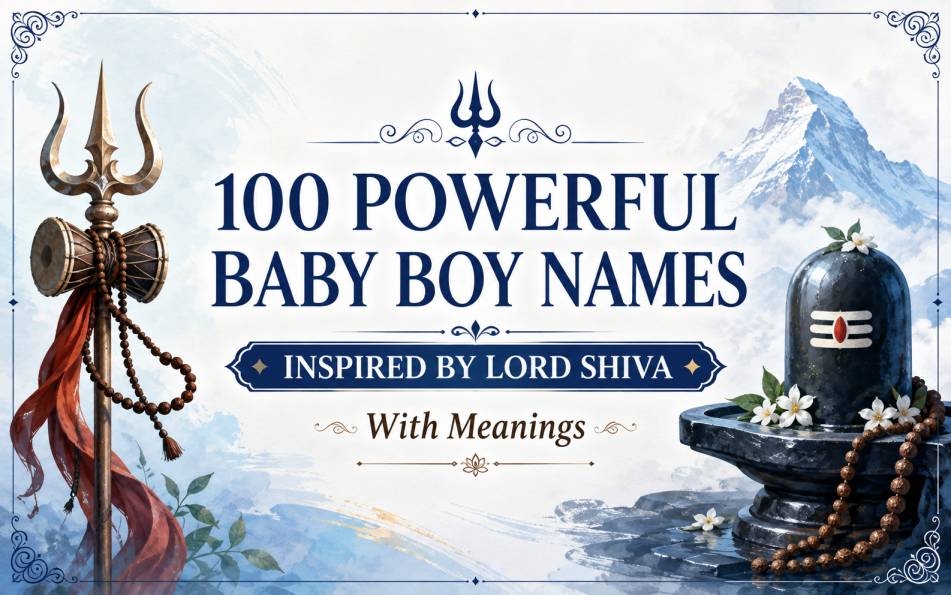
100 Lord Shiva-Inspired Baby Boy Names With Meanings
Below is a curated list of traditional and modern names associated with Lord Shiva or his attributes.
Names 1–25
| No. | Baby Boy Name | Meaning |
| 1 | Shiv | Auspicious; Lord Shiva |
| 2 | Shivaay | Of Shiva; connected with Lord Shiva |
| 3 | Shivansh | A part of Shiva |
| 4 | Shivam | Auspicious; divine |
| 5 | Shivendra | Lord Shiva; divine ruler |
| 6 | Shivraj | Kingly form of Shiva |
| 7 | Shivanshu | Ray or part of Shiva |
| 8 | Shivank | Mark or blessing of Shiva |
| 9 | Shivendra | Divine and powerful |
| 10 | Shankar | One who brings happiness; Shiva |
| 11 | Shambhu | Benevolent one; Shiva |
| 12 | Shambhav | Born of Shambhu |
| 13 | Shambhavi | Associated with Shambhu |
| 14 | Mahesh | Great Lord |
| 15 | Maheshwar | Supreme Lord |
| 16 | Mahadev | Great God; Shiva |
| 17 | Mahakal | Lord beyond time |
| 18 | Mrityunjay | Conqueror of death |
| 19 | Rudra | Fierce form of Shiva |
| 20 | Rudransh | A part of Rudra |
| 21 | Rudraksh | Sacred seed associated with Shiva |
| 22 | Rudresh | Lord Rudra |
| 23 | Rudran | Associated with Rudra |
| 24 | Neelkanth | Blue-throated one |
| 25 | Neelesh | Lord of the blue hue |
Names 26–50
| No. | Baby Boy Name | Meaning |
| 26 | Somesh | Lord of the Moon |
| 27 | Somnath | Lord of the Moon |
| 28 | Chandrashekhar | One who wears the Moon on his head |
| 29 | Chandramouli | Moon-crested Lord |
| 30 | Shashank | Moon; associated with Shiva |
| 31 | Gangadhar | Bearer of the Ganga |
| 32 | Gangesh | Lord associated with Ganga |
| 33 | Jatadhari | One with matted hair |
| 34 | Jatadhar | Bearer of matted locks |
| 35 | Kapali | One who bears a skull; Shiva |
| 36 | Kapard | One with matted hair |
| 37 | Pashupati | Lord of living beings |
| 38 | Pashupatinath | Lord of all creatures |
| 39 | Bholenath | Simple and compassionate Lord |
| 40 | Bhairav | Fierce manifestation associated with Shiva |
| 41 | Bhairava | Terrifying or powerful form |
| 42 | Kaalbhairav | Form of Shiva associated with time |
| 43 | Trilochan | Three-eyed Lord |
| 44 | Trinetra | Three-eyed one |
| 45 | Tryambak | Three-eyed Lord |
| 46 | Trilokesh | Lord of the three worlds |
| 47 | Trilokinath | Lord of the three worlds |
| 48 | Pinaki | Bearer of the Pinaka bow |
| 49 | Shulpan | One who carries a trident |
| 50 | Trishul | Shiva’s iconic trident |
Names 51–75
| No. | Baby Boy Name | Meaning |
| 51 | Shoolin | Bearer of the trident |
| 52 | Pinnakin | One who holds the Pinaka bow |
| 53 | Har | Remover; Shiva |
| 54 | Hara | One who removes negativity |
| 55 | Harish | Traditionally associated with Shiva and Vishnu |
| 56 | Ishan | Shiva; ruler or guardian |
| 57 | Ishwar | Supreme Lord |
| 58 | Ishaan | Lord Shiva; divine ruler |
| 59 | Ish | Supreme being |
| 60 | Umapati | Husband of Uma |
| 61 | Umesh | Lord of Uma |
| 62 | Umakant | Beloved of Uma |
| 63 | Girijapati | Husband of Girija |
| 64 | Girisha | Lord of the mountains |
| 65 | Girijesh | Lord associated with Girija |
| 66 | Kedarnath | Lord of Kedara |
| 67 | Vishwanath | Lord of the universe |
| 68 | Vishvesh | Lord of the universe |
| 69 | Vishveshwar | Supreme Lord of the universe |
| 70 | Avinash | Imperishable; eternal |
| 71 | Aghor | One who is beyond fear and aversion |
| 72 | Aghora | Benevolent aspect of Shiva |
| 73 | Sthanu | Immovable; eternal |
| 74 | Sthir | Steady and firm |
| 75 | Dakshinamurthy | Shiva as the divine teacher |
Names 76–100
| No. | Baby Boy Name | Meaning |
| 76 | Adiyogi | The first yogi |
| 77 | Yogesh | Lord of Yoga |
| 78 | Yogiraj | King among yogis |
| 79 | Yogeshwar | Lord of Yoga |
| 80 | Dhyanesh | Lord associated with meditation |
| 81 | Tandav | Cosmic dance of Shiva |
| 82 | Nataraj | King of dance |
| 83 | Natesh | Lord of dance |
| 84 | Nateshwar | Lord of dance |
| 85 | Kailash | Sacred mountain associated with Shiva |
| 86 | Kailashnath | Lord of Mount Kailash |
| 87 | Kailashesh | Lord of Kailash |
| 88 | Bhootnath | Lord of beings |
| 89 | Bhutesh | Lord of beings |
| 90 | Sarvesh | Lord of all |
| 91 | Sarveshwar | Supreme Lord of all |
| 92 | Sadashiv | Eternal Shiva |
| 93 | Sadasiva | The eternally auspicious one |
| 94 | Aja | Unborn; eternal |
| 95 | Anant | Infinite; endless |
| 96 | Anand | Bliss; joy |
| 97 | Aashutosh | One who is easily pleased |
| 98 | Ashutosh | Compassionate Shiva |
| 99 | Vamdev | A traditional form of Shiva |
| 100 | Virabhadra | Powerful warrior form associated with Shiva |
Choosing a Shiva Name Through Vedic Astrology
In traditional Hindu naming practices, parents may consider the child’s Janma Nakshatra, Rashi, and recommended starting syllable before finalising a name.
The Moon’s position at birth determines the Janma Nakshatra in Vedic astrology. Each Nakshatra has traditionally prescribed syllables for naming.
For example, if the recommended syllable does not naturally match a preferred Shiva name, parents can look for another Shiva-inspired name beginning with the appropriate sound.
Why Nakshatra-Based Naming Matters
The purpose is not to guarantee a particular destiny. Rather, it provides a traditional framework for connecting the child’s name with their birth chart and family customs.
Parents can consider:
- Baby’s birth date and exact time
- Birthplace
- Janma Nakshatra
- Moon sign or Rashi
- Recommended naming syllable
- Meaning and pronunciation
- Family and cultural traditions
Shiva Names and Their Symbolism
Different Shiva names represent different qualities that parents may wish to associate with their child’s identity.
- Rudra – strength and transformative energy
- Shankar – auspiciousness and welfare
- Ashutosh – simplicity and compassion
- Neelkanth – endurance and sacrifice
- Trilochan – awareness and wisdom
- Gangadhar – responsibility and balance
- Dakshinamurthy – knowledge and teaching
- Adiyogi – discipline and spiritual awareness
- Pashupati – compassion toward living beings
- Mahakal – awareness of time and impermanence
These meanings can provide a deeper personal connection to the name without treating astrology as a guaranteed predictor of personality.
Traditional Remedies for Shiva Worship
Parents who follow Shaiva traditions may introduce simple devotional practices after consulting their family customs.
Common practices include:
- Chanting “Om Namah Shivaya” respectfully.
- Offering water to a Shiva Lingam according to local temple or family tradition.
- Observing Monday worship if it is part of the family’s practice.
- Reading or listening to Shiva-related prayers.
- Practising kindness, self-discipline, and compassion—qualities traditionally associated with Shiva.
Remedies should be viewed as spiritual or cultural practices, rather than guaranteed solutions to planetary problems.
Conclusion
A Lord Shiva-inspired baby boy name can combine beautiful meaning, Sanskrit heritage, spirituality, and cultural identity. Names such as Shiv, Rudra, Shankar, Mahadev, Ishan, Neelkanth, Ashutosh, Adiyogi, and Trilochan each reflect a different aspect of Shiva’s symbolism.
For parents who follow Vedic astrology, the final choice can also be aligned with the baby’s Janma Nakshatra and recommended starting syllable. The most meaningful name is ultimately one that is easy to pronounce, culturally appropriate, meaningful to the family, and connected with values parents hope to nurture.
FAQs
1. Which is the best Lord Shiva name for a baby boy?
Shiv, Rudra, Shankar, Ishan, and Ashutosh are among the popular Shiva-inspired choices.
The “best” name depends on the family’s preferred meaning, pronunciation, tradition, and cultural background. Parents following Vedic naming customs may additionally check the baby’s Nakshatra syllable.
Tips: Prioritise meaning, simplicity, family tradition, and the recommended Nakshatra sound if applicable.
2. Which Shiva name means powerful?
Rudra, Mahakal, Bhairav, and Virabhadra carry strong associations with Shiva’s powerful or fierce manifestations.
Rudra is an ancient name associated with a fierce and transformative aspect of Shiva. Virabhadra is traditionally described as a powerful warrior manifestation.
Tips: Choose according to the quality you want the name to symbolise rather than assuming it determines the child’s personality.
3. Which Shiva name is suitable according to Nakshatra?
A Shiva name beginning with the baby’s prescribed Nakshatra syllable can be selected as part of traditional Vedic naming.
The appropriate syllable depends on the baby’s exact birth details. Therefore, parents should calculate the Janma Nakshatra first rather than selecting a syllable based only on the Rashi.
Tips: Check birth date, exact birth time, birthplace, Janma Nakshatra, and Pada before finalising the name.
4. What are modern baby boy names related to Lord Shiva?
Shivansh, Shivaay, Rudransh, Ishan, Adiyogi, and Shivam are contemporary-friendly choices with Shiva-related associations.
Modern parents often prefer shorter names that retain traditional Sanskrit or Shaiva connections. Pronunciation and meaning should remain clear across family and social settings.
Tips: Consider spelling, pronunciation, nickname possibilities, and how the name sounds with the family surname.
5. What does the name Ashutosh mean in relation to Lord Shiva?
Ashutosh traditionally refers to Lord Shiva as one who is easily pleased.
The name reflects Shiva’s compassionate and accessible nature in Hindu devotional tradition. It is therefore associated with simplicity, benevolence, and devotion.
Tips: Ashutosh is a good choice for families seeking a traditional name with a positive spiritual meaning.
6. Is Rudraksh a Lord Shiva-inspired baby name?
Yes, Rudraksha is traditionally associated with Lord Shiva and the sacred rudraksha seeds used in Shaiva practices.
The name has strong cultural and spiritual associations in Hindu tradition. It is also widely recognised as a contemporary Indian boy’s name.
Tips: Understand the traditional meaning and pronunciation before choosing the spelling you prefer.