Panchang is a traditional Hindu calendar system used to understand the movement of time through five important elements: Tithi, Nakshatra, Yoga, Karana and Vara (weekday). The word Panchang comes from Pancha, meaning five, and Anga, meaning limbs or components.
In Vedic astrology and Hindu traditions, Panchang helps determine the nature of a particular day and identify suitable timings for activities such as marriage, housewarming, travel, religious ceremonies, business beginnings and festivals.
Unlike an ordinary calendar that mainly tells us the date and weekday, a Panchang considers astronomical relationships involving the Sun, Moon and zodiac. This makes it an important part of Muhurat Shastra and traditional Indian timekeeping.
Panchang calculations can vary slightly according to location, sunrise and regional calendar traditions. Therefore, timings should generally be checked for the specific city and date, with all times understood in IST (Indian Standard Time) when referring to Indian locations.
What Are the Five Parts of Panchang?
The five components of Panchang are:
- Vara – the weekday
- Tithi – the lunar day
- Nakshatra – the Moon’s constellation
- Yoga – a calculation based on the Sun and Moon’s longitudes
- Karana – half of a Tithi
Together, these elements provide a traditional framework for evaluating the quality and character of time.
1. Tithi: The Lunar Day
A Tithi is a lunar day calculated from the angular distance between the Sun and Moon. The lunar cycle is divided into 30 Tithis, distributed across two Pakshas:
- Shukla Paksha – the waxing Moon
- Krishna Paksha – the waning Moon
Each Paksha contains 15 Tithis, from Pratipada to Purnima or Amavasya.
Why Is Tithi Important?
Tithi is widely used for determining festivals, fasting days, religious observances and auspicious activities. For example, Ekadashi is traditionally associated with the 11th Tithi of each Paksha.
Different Tithis are traditionally considered more suitable for different activities. However, Tithi should not be interpreted in isolation. Nakshatra, Yoga, Karana, weekday and other Muhurat factors may also influence the final selection.
Practical insight: Before starting an important ceremony, check the complete Panchang rather than selecting a date only because its Tithi appears favourable.
2. Nakshatra: The Moon’s Constellation
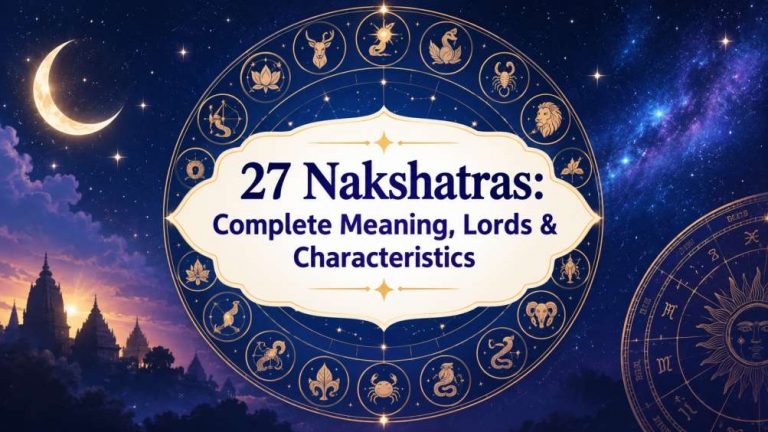
The zodiac is traditionally divided into 27 Nakshatras, with each covering 13°20′ of the zodiac. Since the Moon moves relatively quickly, it usually passes through approximately one Nakshatra each day.
Some well-known Nakshatras include:
- Ashwini
- Rohini
- Pushya
- Magha
- Hasta
- Anuradha
- Shatabhisha
- Revati
How Does Nakshatra Influence Astrology?
In Vedic astrology, the Moon’s Nakshatra is particularly important for understanding mental tendencies, emotional patterns and timing.
Nakshatras are also considered while selecting Muhurat for activities such as marriage, travel, naming ceremonies and property-related work.
For example, Pushya Nakshatra has traditionally been regarded as favourable for several constructive activities, although its suitability depends on the specific purpose and complete horoscope or Muhurat analysis.
3. Yoga: A Sun-Moon Calculation
In Panchang, Yoga is not the same as the yogas found in a birth chart. Panchang Yoga is calculated using the combined longitudinal positions of the Sun and Moon.
There are 27 Nitya Yogas, including Vishkumbha, Preeti, Ayushman, Saubhagya, Shobhana and others.
Why Does Yoga Matter?
Traditional Muhurat practices consider Nitya Yoga when evaluating the nature of a particular time period. Some Yogas are generally considered supportive for constructive activities, while others may be approached with greater caution.
The important point is that a Yoga should be interpreted in combination with the other Panchang elements, rather than treated as an independent prediction.
4. Karana: Half of a Tithi
A Karana represents half of a Tithi. Since there are 30 Tithis in a lunar month, there are 60 Karanas in a complete lunar cycle.
There are traditionally 11 Karanas, divided into:
- 7 movable (Chara) Karanas
- 4 fixed (Sthira) Karanas
The movable Karanas repeat through most of the lunar month, while the fixed Karanas occur at specific points in the cycle.
Role of Karana in Muhurat
Karana is considered when determining whether a particular period is suitable for a specific activity. Traditional Panchang interpretation associates different Karanas with different types of work.
For practical purposes, users generally do not need to memorize all 11 Karanas. A reliable Panchang can provide the Karana automatically for the selected date and location.
5. Vara: The Weekday
The fifth limb of Panchang is Vara, or weekday.
The seven days are associated traditionally with the seven visible planetary influences:
- Sunday – Sun
- Monday – Moon
- Tuesday – Mars
- Wednesday – Mercury
- Thursday – Jupiter
- Friday – Venus
- Saturday – Saturn
These planetary associations are important in Muhurat and Vedic astrology. For example, Thursday is traditionally associated with Jupiter and is often considered significant for learning, spiritual activities and certain auspicious undertakings.
How Panchang Is Used in Daily Life
Panchang can be useful for both religious and practical planning.
Common applications include:
- Selecting Shubh Muhurat
- Checking Ekadashi, Purnima and Amavasya
- Determining festival dates
- Planning religious ceremonies
- Checking Rahu Kalam and other traditional time periods
- Selecting marriage or housewarming dates
- Understanding Nakshatra changes
- Planning spiritual practices and fasting
For important events, it is better to use a location-specific Panchang, because sunrise, sunset and planetary calculations can change according to geographical location.
Practical Remedies Based on Panchang
Panchang is primarily a timekeeping and Muhurat system, but traditional astrology also recommends simple practices based on the day’s planetary association.
For example:
- Monday: Spend time in meditation or offer water to Shiva as part of traditional practice.
- Tuesday: Practise disciplined physical activity and avoid unnecessary arguments.
- Wednesday: Focus on communication, learning and organised work.
- Thursday: Dedicate time to learning, teaching or charitable activities.
- Friday: Maintain cleanliness and cultivate gratitude in relationships.
- Saturday: Practise patience, service and responsible use of resources.
- Sunday: Begin the day with sunlight, discipline and positive intention.
These practices should be understood as traditional spiritual or cultural remedies, not guaranteed solutions to personal problems.
Panchang and Vedic Astrology: The Bigger Picture
Panchang describes the quality of a particular time, while a birth chart describes an individual’s planetary configuration.
For personalised astrology, factors such as Lagna, Moon sign, planetary positions, houses, Dashas and transits are examined along with relevant Panchang factors.
This distinction is important. A generally favourable Panchang does not automatically mean that every activity will produce the same result for every person. Similarly, an apparently challenging time may still be appropriate for a particular purpose when the complete Muhurat is considered.
Conclusion
Panchang is much more than a traditional Hindu calendar. Its five components—Vara, Tithi, Nakshatra, Yoga and Karana—provide a structured way to understand lunar and solar time and are deeply connected with Vedic astrology and Muhurat traditions.
For everyday use, Panchang can help you understand festival dates, lunar phases, religious observances and auspicious timings. For major decisions such as marriage, property purchase or important ceremonies, a location-specific Panchang combined with proper Muhurat analysis offers a more complete approach.
Rather than viewing Panchang as a source of guaranteed predictions, it is better understood as a traditional framework for choosing time thoughtfully and aligning important activities with established astrological principles.
FAQs
1. What is Panchang in Vedic astrology?
Panchang is a traditional Hindu calendar that describes five aspects of time: Vara, Tithi, Nakshatra, Yoga and Karana.
It is commonly used in Vedic astrology, Hindu festivals, religious observances and Muhurat selection. It combines astronomical calculations with traditional astrological interpretation.
Related tip: Always check Panchang according to the relevant location and date.
2. What are the five elements of Panchang?
The five elements are Vara, Tithi, Nakshatra, Yoga and Karana.
Vara represents the weekday, Tithi represents the lunar day, Nakshatra represents the Moon’s position among 27 lunar constellations, Yoga is calculated from the Sun and Moon, and Karana represents half of a Tithi.
Remember: For Muhurat, all five components should ideally be evaluated together.
3. Why is Tithi important in Panchang?
Tithi is important because many Hindu festivals, fasts and religious observances are determined according to lunar Tithis.
There are 30 Tithis divided between Shukla Paksha and Krishna Paksha. Ekadashi, Purnima and Amavasya are among the most commonly observed lunar dates.
Practical tip: Do not assume that a festival always falls on the same Gregorian calendar date every year.
4. What is Nakshatra and why does it matter?
Nakshatra is the section of the zodiac occupied by the Moon, with the traditional system containing 27 Nakshatras.
In Vedic astrology, the Moon’s Nakshatra is associated with emotional tendencies and is also considered in various Muhurat calculations.
Practical tip: For important ceremonies, consider Nakshatra together with Tithi, Yoga, Karana and the purpose of the event.
5. What is Karana in Panchang?
Karana is half of a Tithi and is one of the five limbs of Panchang.
There are 11 traditional Karanas, consisting of seven repeating movable Karanas and four fixed Karanas. Their nature is considered while assessing the suitability of particular activities.
Tip: A Panchang app or calendar can automatically show the active Karana for a particular time.
6. Is Panchang the same as a horoscope?
No, Panchang and a horoscope serve different purposes.
Panchang describes the characteristics of a particular time, whereas a horoscope is calculated from an individual’s birth details and examines factors such as Lagna, planets, houses and Dashas.
In practice: Panchang is especially useful for timing an activity, while a horoscope is used for personalised astrological analysis.