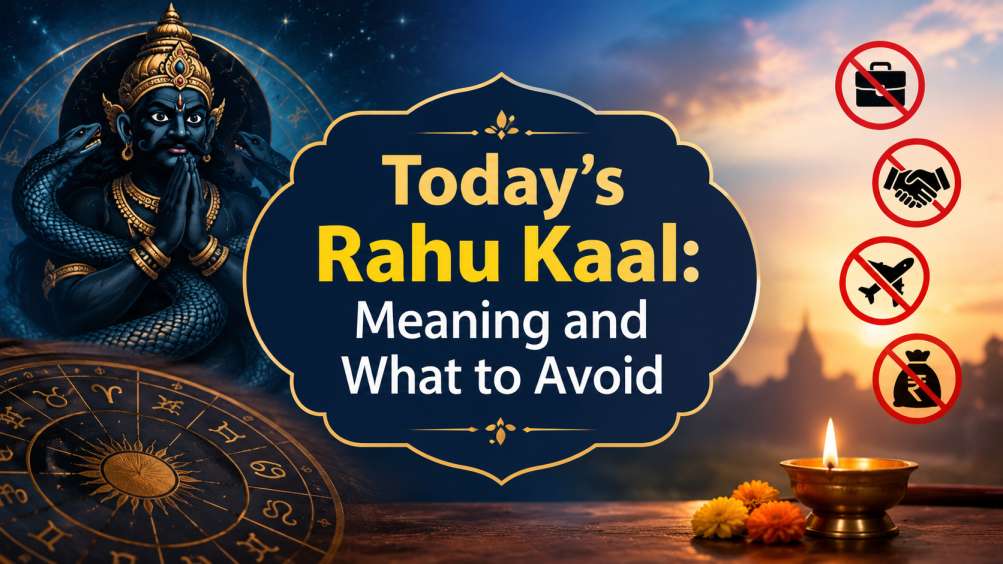
Rahu Kaal is a daily period traditionally considered unsuitable for beginning important or auspicious activities in Vedic astrology. It is associated with Rahu, one of the nine Navagrahas, and is calculated according to the local sunrise and sunset along with the weekday.
For Sunday, 6 September 2026, Rahu Kaal timings depend on the location because sunrise and sunset vary across India. Therefore, the exact Rahu Kaal should always be checked according to the local Panchang and city rather than applying one fixed time nationwide.
Rahu Kaal does not mean that every activity performed during this period will produce negative results. Instead, the traditional guidance is mainly to avoid starting significant new ventures, particularly when an activity can easily be postponed.
What Is Rahu Kaal?
Rahu Kaal, also called Rahu Kalam, is approximately one-eighth of the daylight period on a given day. Its position changes with the weekday.
In traditional Jyotish, Rahu represents qualities such as uncertainty, unconventional thinking, confusion, sudden changes and strong worldly desires. Because of this symbolism, Rahu Kaal is traditionally treated as a period requiring greater caution when initiating important work.
How Is Rahu Kaal Calculated?
The daytime period from sunrise to sunset is divided into eight approximately equal sections. One of these sections is assigned to Rahu according to the weekday.
The traditional weekday sequence is:
- Sunday: 8th daytime segment
- Monday: 2nd daytime segment
- Tuesday: 7th daytime segment
- Wednesday: 5th daytime segment
- Thursday: 6th daytime segment
- Friday: 4th daytime segment
- Saturday: 3rd daytime segment
Because daylight duration changes throughout the year and differs from city to city, Rahu Kaal timings are location-specific.
Why Is Rahu Kaal Considered Important?
Rahu is traditionally associated with ambiguity and unexpected developments. In Muhurta traditions, starting an important activity during Rahu Kaal is therefore generally avoided when another suitable time is available.
However, it is important to understand the distinction between starting an activity and continuing one.
For example, if you have an established job, regular business operations or a daily responsibility, there is generally no practical need to stop everything during Rahu Kaal.
The traditional caution is primarily about initiating major undertakings.
What Should You Avoid During Rahu Kaal?
When possible, traditionally avoid starting the following activities during Rahu Kaal:
1. Starting a New Business
Signing the first major agreement, opening a new business or formally launching an important venture may be postponed to a more suitable Muhurta.
2. Important Financial Decisions
Major investments, large purchases or significant financial commitments can preferably be scheduled outside Rahu Kaal, especially when there is no urgency.
This does not mean ordinary banking or routine transactions must stop.
3. Beginning a Journey
Traditional Muhurta practices often recommend avoiding the start of an important journey during Rahu Kaal when an alternative departure time is easily available.
4. Auspicious Ceremonies
Activities such as marriage-related ceremonies, housewarming, property registration or other major auspicious beginnings are generally planned using a broader Muhurta calculation rather than Rahu Kaal alone.
5. Signing Major Agreements
If a contract or partnership agreement can be signed later without difficulty, choosing a suitable time may provide greater alignment with traditional astrological practice.
What Can You Do During Rahu Kaal?
Rahu Kaal is not a period during which you need to remain inactive.
Routine and unavoidable activities can continue normally. You can use the period for:
- Completing ongoing work
- Administrative tasks
- Research and analysis
- Planning future projects
- Reviewing documents
- Meditation or prayer
- Learning and self-reflection
- Organising pending responsibilities
The practical principle is simple: avoid unnecessary new beginnings, rather than fearing the entire period.
Traditional Remedies for Rahu Kaal
Vedic traditions prescribe several simple spiritual practices associated with Rahu. These should be understood as cultural and devotional practices rather than guaranteed solutions to specific problems.
Chanting
Some practitioners recite Rahu-related mantras, such as:
“ॐ रां राहवे नमः”
It may be chanted with a calm and focused mind according to one’s spiritual practice.
Worship and Prayer
Devotees may pray to Lord Shiva, perform meditation or recite suitable stotras during Rahu Kaal.
Avoid Impulsive Decisions
One of the most practical “remedies” is to slow down. Avoid making decisions driven by fear, confusion, excessive desire or sudden emotional reactions.
Follow Your Local Panchang
Rahu Kaal should be calculated using the local sunrise and sunset, preferably from a reliable regional Panchang. This is particularly important when travelling between cities or states.
Rahu Kaal and Your Birth Chart
Rahu Kaal is a daily Muhurta consideration, while the effect of Rahu in an individual’s horoscope is a separate matter.
A birth chart analysis considers Rahu’s:
- House placement
- Zodiac sign
- Nakshatra
- Conjunctions
- Planetary aspects
- Mahadasha and Antardasha
- Relationship with the Lagna and its lord
Therefore, it would be inaccurate to conclude that Rahu Kaal will affect everyone in exactly the same way.
For personalised decisions, a complete Kundli and Muhurta analysis is more meaningful than looking at Rahu Kaal alone.
Conclusion
Rahu Kaal is an important traditional concept in Hindu Panchang and Vedic astrology. It is primarily used as a period during which people may avoid initiating important or auspicious activities, particularly when the activity can be comfortably postponed.
It should not be viewed as a period of guaranteed misfortune or as a reason to stop routine life. Understanding the difference between traditional Muhurta guidance and superstition allows Rahu Kaal to be used more thoughtfully.
For today’s exact Rahu Kaal, always check the local city-specific Panchang and sunrise-sunset timings in IST. When planning an important event, consider the complete Muhurta rather than Rahu Kaal alone.
Reflection: Instead of fearing Rahu Kaal, use it as a reminder to pause, review your plans and make important decisions with greater awareness.
FAQs
1. What is Rahu Kaal?
Rahu Kaal is a daily period traditionally considered unsuitable for beginning important activities.
It is calculated from the local sunrise and sunset and changes according to the weekday. Its duration is approximately one-eighth of the daylight period.
Related tips:
- Check your local Panchang.
- Focus mainly on avoiding major new beginnings.
- Do not unnecessarily stop routine activities.
2. Can I do regular work during Rahu Kaal?
Yes, regular and ongoing work can generally continue during Rahu Kaal.
The traditional restriction is primarily concerned with initiating important activities rather than stopping everything during the period.
You can: complete existing work, study, plan, research and handle routine responsibilities.
3. Should I avoid starting a journey during Rahu Kaal?
Traditionally, the beginning of an important journey is preferably avoided during Rahu Kaal when another departure time is available.
If travel is urgent or unavoidable, there is no practical reason to create unnecessary anxiety. Muhurta traditions also consider factors beyond Rahu Kaal.
Tip: For important travel, consider the complete travel Muhurta rather than Rahu Kaal alone.
4. Is Rahu Kaal the same every day?
No, Rahu Kaal changes every day and varies by location.
Its calculation depends on the weekday and the duration between local sunrise and sunset. Consequently, Delhi, Mumbai, Kolkata and other cities can have different Rahu Kaal timings.
Tip: Always use location-specific Panchang timings in IST.
5. Can I pray during Rahu Kaal?
Yes, prayer, meditation and spiritual practices can be performed during Rahu Kaal.
Many traditional practitioners use this time for worship, mantra recitation and introspection rather than treating the period as completely inactive.
Simple practices:
- Chant a suitable Rahu mantra.
- Meditate peacefully.
- Pray according to your tradition.
- Avoid fear-driven thinking.
6. Does Rahu Kaal affect everyone equally?
No, Rahu Kaal is a general daily Muhurta consideration and does not determine an individual’s complete astrological experience.
Personal interpretation requires examining the birth chart, including Rahu’s house, sign, Nakshatra, conjunctions and current planetary periods.
For personalised astrology: consider the complete Kundli and relevant Dasha before making major conclusions.