In astrology, the Sun sign, Moon sign, and Ascendant (Lagna) are three important reference points for understanding a birth chart. While Western astrology often gives greater attention to the Sun sign, Vedic astrology (Jyotish) generally considers the Lagna and Moon sign along with the positions of all planets and houses.
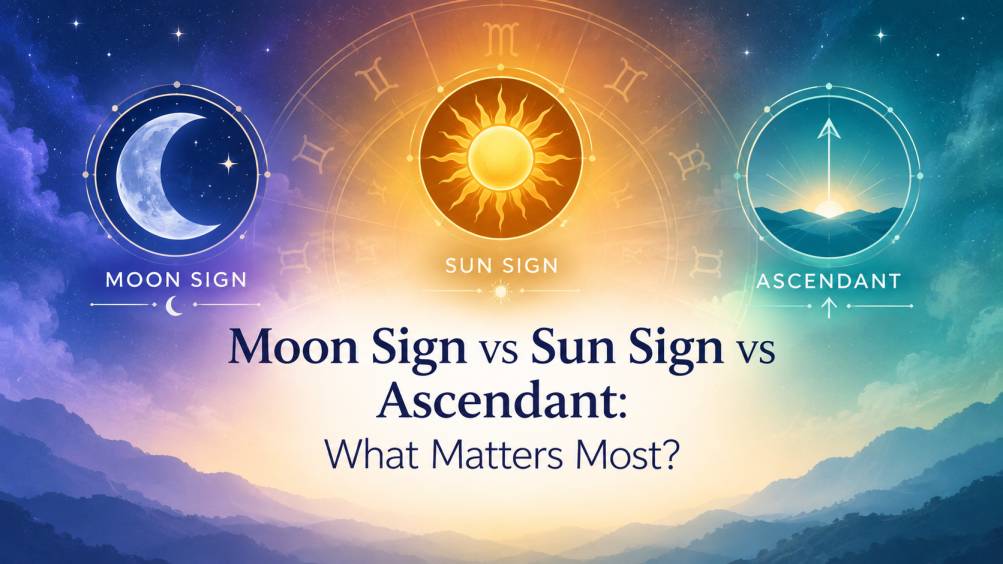
So, which matters most: Moon sign vs Sun sign vs Ascendant?
There is no single answer for every situation. Each represents a different dimension of life. The Ascendant relates to the physical personality, approach to life, and house framework. The Moon reflects the mind, emotions, habits, and subjective experience. The Sun is associated with vitality, confidence, identity, authority, and purpose.
Understanding these three together can provide a more balanced interpretation than relying on one sign alone.
What Is the Ascendant or Lagna?
The Ascendant, or Lagna, is the zodiac sign rising on the eastern horizon at the exact time and place of birth. Because it changes relatively quickly, an accurate birth time is important when calculating it.
In Vedic astrology, the Ascendant is particularly significant because it establishes the 12 houses of the birth chart.
What Does the Ascendant Represent?
The Lagna is traditionally associated with:
- Physical appearance and constitution
- General personality and behaviour
- Approach to new situations
- Sense of individuality
- Overall life direction
- The framework used to examine the 12 houses
For example, someone with Aries rising may traditionally be interpreted as direct and action-oriented, while Taurus rising may be associated with stability and practicality. These are broad astrological interpretations rather than fixed descriptions of personality.
What Is the Moon Sign?
The Moon sign (Chandra Rashi) is the zodiac sign occupied by the Moon at birth. In Jyotish, the Moon receives considerable attention because it is traditionally connected with Manas, or the mind.
Why Is the Moon Sign Important?
The Moon sign is commonly examined for:
- Emotional responses
- Mental tendencies
- Comfort and security
- Habits and routines
- Perception of experiences
- Emotional relationships
- Day-to-day psychological patterns
The Moon is also central to the Nakshatra system, in which the 27 lunar constellations provide another layer of interpretation.
This is one reason Moon sign calculations are often used in traditional Indian astrology for understanding mental tendencies and certain timing techniques.
What Is the Sun Sign?
The Sun sign is the zodiac sign occupied by the Sun at birth. In Jyotish, the Sun is traditionally associated with Atman, vitality, authority, confidence, individuality, and leadership.
What Does the Sun Sign Show?
Astrological interpretations commonly connect the Sun with:
- Self-expression
- Confidence
- Personal authority
- Leadership tendencies
- Vitality
- Relationship with authority figures
- Purpose and individuality
The Sun can therefore add important context to a person’s identity, especially when considered with its house placement, dignity, aspects, conjunctions, and relationship with the Ascendant lord.
Moon Sign vs Sun Sign vs Ascendant
Rather than asking which one is universally “best” or most important, it is more useful to understand what each represents.
| Factor | Traditional Focus | Practical Relevance |
| Ascendant/Lagna | Body, personality, life approach | How you engage with life |
| Moon Sign | Mind, emotions, habits | How you experience situations |
| Sun Sign | Vitality, identity, authority | How you express individuality |
Which One Matters Most in Vedic Astrology?
In Vedic astrology, the Ascendant is often a major starting point because it determines the house structure of the chart. The Moon is also highly important, particularly for mental tendencies, Nakshatra analysis, and several traditional predictive methods.
The Sun remains significant, but interpreting it independently can provide only a partial picture.
A complete reading normally considers the Lagna, Moon, Sun, planetary placements, houses, aspects (Drishti), planetary strength, Nakshatras, Dashas, and relevant Yogas together.
Why the Same Person Can Have Three Different Signs
It is completely normal for a person to have different Sun, Moon, and Ascendant signs.
For example, a birth chart might have:
In traditional astrology, these placements would describe different dimensions rather than contradicting one another. The Sun could indicate one style of self-expression, the Moon another emotional pattern, and Libra rising another way of approaching the outside world.
This explains why reading only a Sun-sign horoscope may sometimes feel incomplete.
How to Use Your Big Three in Daily Life
You can use the three placements as a framework for self-reflection rather than treating them as fixed predictions.
For Personality
Start with the Ascendant and its lord. Examine the first house, planets placed there, and influences on the Lagna.
For Emotional Patterns
Study the Moon sign, Moon’s house, Nakshatra, and planetary influences on the Moon.
For Identity and Confidence
Consider the Sun’s sign, house, strength, and relationship with other planets.
For Timing
Traditional Jyotish may use systems such as Vimshottari Dasha and planetary transits. These require a complete birth chart rather than simply knowing a Sun or Moon sign.
Practical Astrological Remedies
Traditional Jyotish recommends remedies according to the condition of particular planets and the individual’s birth chart. Remedies should therefore not be treated as universal solutions.
For general spiritual practice, people may choose simple, non-harmful practices such as:
- Maintaining a consistent sleep and daily routine
- Practising meditation or quiet reflection
- Reciting a traditional prayer that is meaningful to them
- Showing respect and gratitude toward parents, teachers, and elders
- Donating food or useful items as an act of charity
- Spending time outdoors and maintaining healthy routines
For specific planetary remedies, a qualified practitioner should ideally examine the complete birth chart before recommending gemstones, mantras, fasting, or other specialised practices.
Traditional Context and E-E-A-T
Classical Jyotish literature gives different planets and chart factors specific interpretive roles. Texts traditionally associated with Vedic astrology, such as Brihat Parashara Hora Shastra and Phaladeepika, form part of the broader classical tradition.
However, astrology is a traditional interpretive system rather than a scientifically established method for predicting personality or future events. A responsible astrology article should distinguish traditional interpretations from scientifically demonstrated facts.
Conclusion
When comparing Moon sign vs Sun sign vs Ascendant, each has a different purpose in traditional astrology. The Ascendant provides the framework of the birth chart and is closely associated with personality, physical constitution, and life approach. The Moon focuses more on the mind, emotions, habits, and subjective experience, while the Sun relates to vitality, identity, authority, and individuality.
Rather than choosing one placement in isolation, Vedic astrology generally becomes more meaningful when these factors are interpreted together with houses, planetary strength, Nakshatras, Dashas, transits, and Yogas.
If you know your birth date, exact birth time, and birthplace, exploring all three placements can give you a broader framework for understanding your birth chart.
FAQs
1. Is the Moon sign more important than the Sun sign?
In Vedic astrology, the Moon sign is considered highly significant, but it should not be interpreted separately from the Ascendant and Sun.
The Moon represents the mind and emotional tendencies, while the Sun represents vitality, identity, and authority. Their importance can also vary depending on their house placement and planetary strength.
Related tips:
- Check the Moon’s Nakshatra.
- Examine the Moon’s house and aspects.
- Consider the Sun’s house and strength as well.
2. Why is the Ascendant important in Vedic astrology?
The Ascendant is important because it establishes the first house and the house framework of the entire birth chart.
The Lagna is traditionally used to study personality, physical constitution, life approach, and the twelve houses. Its lord, known as the Lagna Lord, is also an important factor in chart interpretation.
Related tips:
- Confirm your birth time as accurately as possible.
- Identify your Ascendant and Lagna Lord.
- Examine planets influencing the first house.
3. Can my Moon sign and Sun sign be different?
Yes, your Moon sign and Sun sign can easily be different because the Sun and Moon occupy different zodiac positions at birth.
For example, a person may have a Gemini Sun and Scorpio Moon. Traditional astrology interprets these as different layers of the same birth chart rather than conflicting identities.
Related tips:
- Calculate both signs using the same astrological system.
- Check your Ascendant as well.
- Avoid judging personality from one placement alone.
4. Which sign should I read for a daily horoscope?
In Vedic astrology, the Moon sign is commonly used for many transit-based daily horoscope interpretations, although the Ascendant can provide additional chart-specific context.
Daily horoscope interpretations are general because they do not account for every planetary position in an individual’s complete birth chart. For personalised analysis, astrologers traditionally examine the entire chart.
Related tips:
- Know your Moon sign and Nakshatra.
- Consider your Ascendant for broader chart analysis.
- Treat general horoscopes as broad guidance rather than certainty.
5. Does the Ascendant change more quickly than the Moon and Sun signs?
Yes, the Ascendant changes much more quickly than the Sun or Moon signs, making an accurate birth time particularly important for calculating it.
The Sun generally remains in one zodiac sign for roughly a month, while the Moon moves much faster through the zodiac. The Ascendant can change within a few hours, although the exact rate varies with location and astronomical factors.
Related tips:
- Use the correct birth location.
- Use the most accurate birth time available.
- Recheck the chart if your recorded birth time is uncertain.