Ahoi Ashtami is an important Hindu fasting festival observed mainly by mothers for the well-being, happiness, and long life of their children. It falls during Krishna Paksha Ashtami in the Hindu month of Kartik, approximately eight days before Diwali in many regional calendars. In 2026, families observing this traditional vrat will gather for Ahoi Mata Puja, listen to the vrat katha, and offer prayers to the stars in the evening.
The festival holds cultural and spiritual significance in North India, especially among families in Uttar Pradesh, Rajasthan, Delhi, Haryana, and Madhya Pradesh. Although Ahoi Ashtami is primarily a religious observance rather than an astrological remedy, its timing follows the Hindu lunar calendar. Knowing the correct date, puja muhurat, and तारों को देखने का समय helps devotees plan their fast according to local traditions.
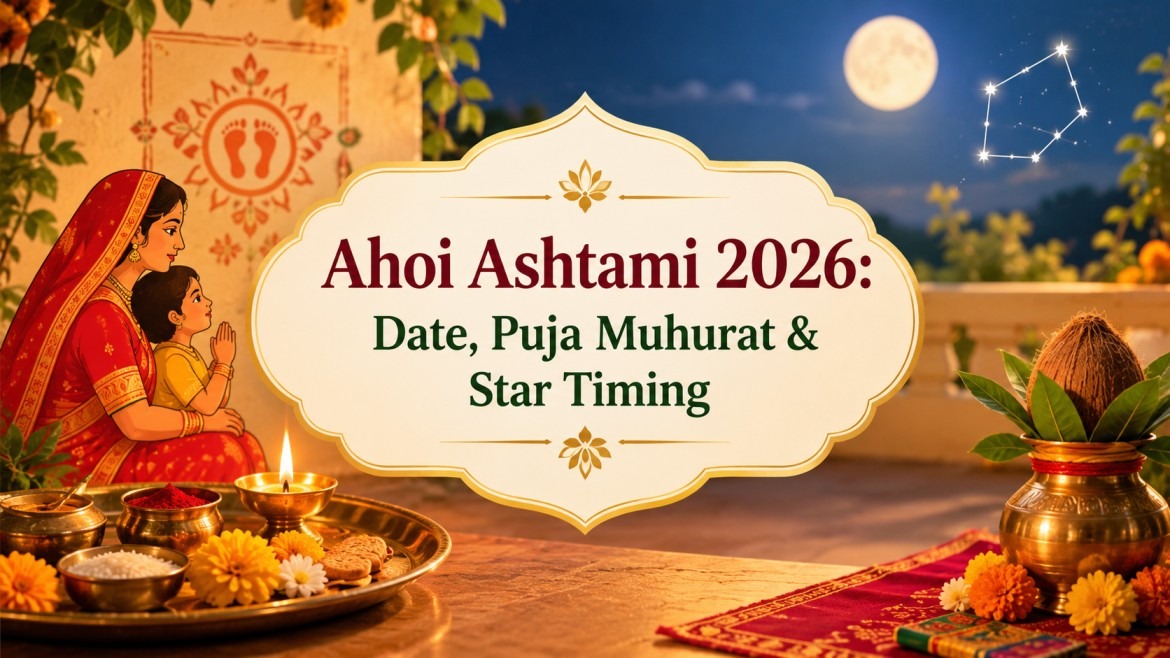
Ahoi Ashtami 2026: Date and Puja Muhurat
Ahoi Ashtami is observed on the Ashtami Tithi of Krishna Paksha in Kartik month. Since the Hindu calendar follows lunar calculations, the festival date and timings should be confirmed using a reliable local Panchang.
- Festival: Ahoi Ashtami 2026
- Date: Sunday, 1 November 2026
- Observance: Ahoi Mata Puja and fasting for children’s well-being
- Puja time: Evening, during the locally prescribed muhurat
- Star-viewing time: After sunset, when stars become visible
- Time zone: Indian Standard Time (IST)
Important: Confirm the final puja window and star-viewing time for your city before observing the vrat. The exact muhurat depends on local sunrise, sunset, and Panchang calculations. Avoid relying on a single nationwide timing for every location.
Ahoi Ashtami 2026: तारों को देखने का समय
One of the most important parts of Ahoi Ashtami is offering prayers to the stars in the evening. Traditionally, many women observe a fast throughout the day and conclude it after seeing the stars and offering water, although customs vary between families.
The तारों को देखने का समय is not identical across India. Sunset and the appearance of visible stars vary according to location and weather conditions.
How to observe the evening ritual
- Complete your household preparations and Ahoi Mata Puja before the family’s customary evening prayer.
- Wait until stars are visible in the local sky.
- Offer water to the stars according to your family tradition.
- Pray for the health, happiness, and prosperity of your children.
- Conclude the fast according to your customary rules.
Cloudy skies can make stars difficult to see. If that happens, follow the practice advised by your family elders or trusted religious guide rather than feeling anxious about the observance.
Ahoi Ashtami Vrat Vidhi: Step-by-Step Rituals
Ahoi Ashtami vrat vidhi differs slightly by region and household, but the central practices remain similar.
1. Morning preparation
Wake up early, bathe, and take a sankalp to observe the fast. Some devotees abstain from food and water, while others follow a modified fast based on their health and family customs.
2. Prepare the puja space
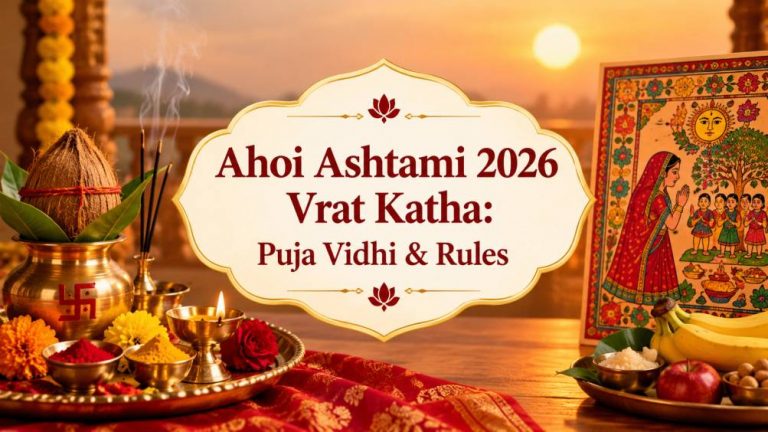
Clean the place of worship and arrange an image or traditional drawing of Ahoi Mata. Depending on local custom, the image may include symbols associated with her story and the protection of children.
3. Arrange the puja samagri
Common puja items include:
- Ahoi Mata image or drawing
- Roli, kumkum, rice, and flowers
- A diya and incense
- Water in a kalash or suitable vessel
- Fruits, sweets, and other traditional offerings
- Ahoi Ashtami vrat katha
The exact list can differ by community, so use the items customary in your home.
4. Perform Ahoi Mata Puja
Light the diya, offer flowers and other puja items, and pray for the well-being of your children. Read or listen to the Ahoi Ashtami vrat katha, reflecting on its traditional message of devotion, responsibility, and compassion.
5. Offer prayers to the stars
In the evening, offer water and prayers when stars are visible, following your family’s established practice. Some families use a sieve or a particular vessel as part of their ritual.
6. Complete the fast
Break the fast according to your tradition after the prescribed prayers. There is no need to compare your observance with others; sincerity and safe practice are more important than performing every regional custom identically.
Ahoi Ashtami Vrat Katha and Its Significance
The traditional Ahoi Ashtami vrat katha tells of a woman who unintentionally harms a young animal while digging earth and subsequently experiences distress related to her children. Through repentance, devotion, and prayers, she seeks forgiveness and divine grace.
Details of the story differ across oral and regional versions. Its broader lesson is to act responsibly toward living beings, acknowledge mistakes, and approach family life with compassion.
For devotees, the story provides a spiritual framework for praying for their children’s welfare. It should not be interpreted as proof that a ritual guarantees a particular outcome in family life.
Astrological Significance of Ahoi Ashtami
Ahoi Ashtami is rooted in lunar-calendar observance and religious tradition. In Vedic astrology, the Moon represents the mind, emotions, and nurturing tendencies, while Jupiter is traditionally associated with wisdom, guidance, and children.
These associations help explain why devotees may connect the festival with family welfare and emotional well-being. However, they are traditional astrological interpretations, not scientifically established explanations of a child’s health or future.
Practical spiritual observances
Devotees may choose to:
- Offer prayers to Ahoi Mata with a calm and focused mind.
- Spend quality time with their children and listen to their concerns.
- Donate food, clothes, or educational supplies to families in need.
- Practise gratitude and resolve family disagreements peacefully.
- Consult a qualified astrologer if seeking a traditional interpretation of a birth chart, while making practical decisions using reliable evidence.
No gemstone, planetary ritual, or fast should be treated as a substitute for medical care, education, emotional support, or responsible parenting.
Fasting Rules and Important Precautions
Traditional fasting rules can be strict, but health needs differ from person to person. Some families observe a nirjala fast, while others allow water or food.
Keep these points in mind:
- Choose a fasting practice compatible with your health.
- Pregnant or breastfeeding women and people with diabetes or other medical conditions should seek appropriate medical advice before fasting.
- Do not delay prescribed medicines or necessary meals solely to follow a ritual.
- Keep children away from open flames, incense, and hot offerings.
- Verify local Panchang timings instead of assuming that every city follows the same muhurat.
Conclusion
Ahoi Ashtami 2026 is an opportunity for devotees to honour Ahoi Mata, pray for their children’s well-being, and reconnect with family traditions. The main observances include the morning sankalp, evening puja, vrat katha, and prayers to the stars. Because local sunset and Panchang calculations affect the exact timing, confirm the puja muhurat and तारों को देखने का समय for your city before beginning the fast.
The festival’s deeper message extends beyond rituals: compassion, responsibility, gratitude, and care for children are meaningful throughout the year. Observe the vrat according to your family’s tradition, prioritise health and safety, and treat astrological interpretations as cultural or spiritual guidance rather than guaranteed predictions.
Ahoi Ashtami 2026: City-Wise Star Sighting Time
The approximate star-sighting times below can help with planning. Actual visibility depends on the sky, and local Panchang guidance should take priority.
| City | Approx. star-sighting time (IST) |
| Delhi | 6:01 PM |
| Mumbai | 6:28 PM |
| Kolkata | 5:22 PM |
| Chennai | 6:04 PM |
| Bengaluru | 6:15 PM |
| Pune | 6:24 PM |
| Jaipur | 6:08 PM |
| Bhopal | 6:05 PM |
| Indore | 6:12 PM |
These are indicative timings published for the respective cities, not a guarantee of when stars will become visible.
FAQs About Ahoi Ashtami 2026
1. When is Ahoi Ashtami in 2026?
Ahoi Ashtami will be observed on Sunday, 1 November 2026.
It falls on Kartik Krishna Ashtami according to the Purnimanta calendar. The Ashtami Tithi begins at approximately 2:51 PM on 1 November and ends at approximately 1:10 PM on 2 November in the New Delhi Panchang.
2. What is the Ahoi Ashtami 2026 puja muhurat in Delhi?
The Ahoi Ashtami puja muhurat in Delhi is approximately 5:36 PM to 6:54 PM IST.
This evening period is traditionally used to worship Ahoi Mata and listen to the vrat katha. Timings can differ between Panchang sources because of calculation methods.
- Arrange puja samagri in advance.
- Complete the ritual during the locally recommended window.
- Follow your family’s established customs.
3. What is the तारों को देखने का समय on Ahoi Ashtami 2026?
In Delhi, stars are expected to become visible at approximately 6:01 PM IST, although actual visibility depends on weather conditions.
Traditionally, devotees offer water to the stars and pray for their children’s well-being before concluding the fast. The timing differs across cities.
- Check the local evening sky.
- Follow the prescribed family ritual.
- Consult a local Panchang for city-specific guidance.
4. Can Ahoi Ashtami vrat be observed for daughters as well as sons?
Yes, many families now observe Ahoi Ashtami vrat for the well-being of all their children, including daughters and sons.
Although some older customs emphasised sons, contemporary observance often focuses on the health, happiness, and prosperity of every child.
- Pray for all children’s well-being.
- Encourage kindness and family harmony.
- Follow your household’s tradition without discrimination.
5. What should be included in Ahoi Ashtami puja samagri?
Common Ahoi Ashtami puja samagri includes an image of Ahoi Mata, roli, rice, flowers, a diya, water, fruits, sweets, and the vrat katha.
The precise items vary by region and family tradition. Prepare everything beforehand to make the evening worship more convenient.
- Keep the puja area clean.
- Arrange safe lighting and offerings.
- Use traditional items according to your family’s practice.
6. Is it compulsory to observe a nirjala fast on Ahoi Ashtami?
No single fasting practice is suitable for everyone; the traditional nirjala fast is followed by some devotees, while others observe modified fasts.
Health and safety should come first. People with diabetes, pregnancy-related needs, or other medical conditions should consult a healthcare professional before fasting.
- Do not stop prescribed medication without medical advice.
- Choose a safe fasting method.
- Resume eating and drinking appropriately after the observance.
7. What is the astrological significance of Ahoi Ashtami?
Ahoi Ashtami’s astrological significance comes mainly from its lunar-calendar timing and traditional associations with family welfare and children.
In Vedic astrology, Jupiter is associated with wisdom and children, while the Moon is linked with emotions and nurturing. These are traditional interpretations, not scientifically proven predictions.
- Use the festival for prayer and reflection.
- Practise gratitude and compassion.
- Do not treat rituals as guarantees of specific outcomes.