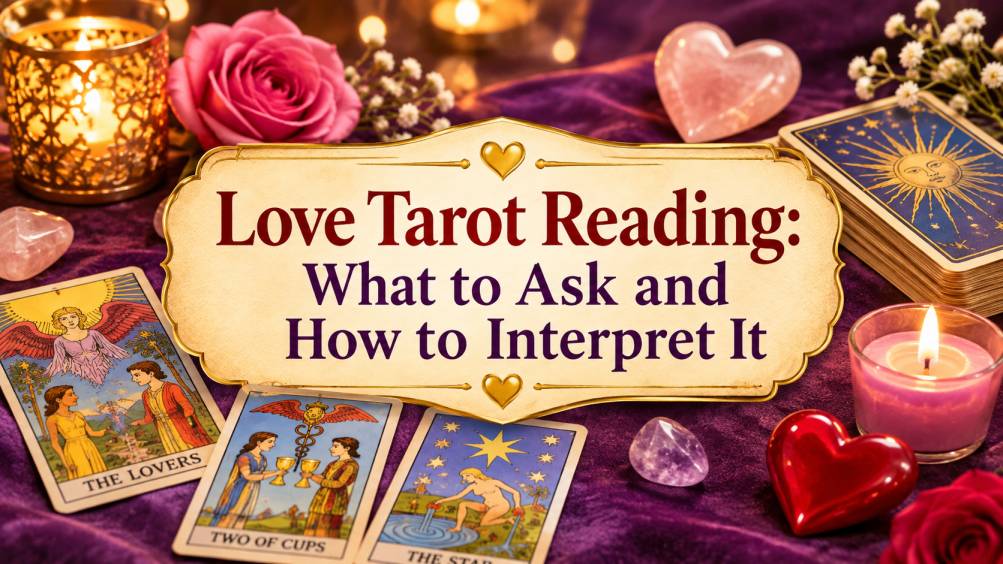
Love and relationships often bring questions about emotional compatibility, commitment, communication, and the future. A love tarot reading is a traditional card-based guidance practice that people use to reflect on their romantic lives and understand relationship patterns. Whether you are single, dating, married, or experiencing relationship difficulties, tarot cards can offer symbolic perspectives on emotions and personal choices.
Unlike Vedic astrology, which studies planetary positions, zodiac signs, and birth charts, tarot uses a deck of 78 cards to explore different aspects of life. Love tarot readings focus on emotional connections, relationship expectations, and possible challenges. Understanding what to ask and how to interpret the cards can make a reading more meaningful without treating it as a guaranteed prediction of the future.
What Is a Love Tarot Reading?
A love tarot reading is a focused tarot session that explores romantic relationships, emotional connections, and personal expectations. It uses symbolic card meanings to encourage self-reflection and help individuals consider different perspectives.
A standard tarot deck contains:
- 22 Major Arcana cards: Represent significant life themes, personal growth, and important transitions.
- 56 Minor Arcana cards: Represent everyday experiences, emotions, communication, and practical situations.
In love readings, the Cups suit is particularly relevant because it represents emotions, affection, and relationships. However, other suits also provide useful insights into romantic situations.
What Questions Should You Ask During a Love Tarot Reading?
The quality of a tarot reading often depends on the questions you ask. Open-ended questions generally provide more useful insights than simple yes-or-no questions.
1. Questions About Your Current Relationship
If you are already in a relationship, tarot can help you reflect on communication, emotional needs, and compatibility.
Consider asking:
- What is the current emotional energy of my relationship?
- How can my partner and I improve communication?
- What challenges should we address together?
- What can I do to build greater trust?
- Are our expectations and long-term goals aligned?
These questions encourage understanding rather than creating unnecessary doubts about your partner.
2. Questions About New Love
For singles, love tarot can explore readiness for a relationship and personal expectations.
Useful questions include:
- What should I understand about my current love life?
- Am I emotionally ready for a new relationship?
- What qualities should I look for in a partner?
- What patterns might be affecting my romantic decisions?
- How can I become more open to meaningful connections?
3. Questions About Marriage and Commitment
People considering marriage or long-term commitment may ask:
- What should I consider before committing to this relationship?
- Are we prepared for long-term responsibilities?
- Which areas of our relationship need improvement?
- How can we develop a stronger emotional connection?
Tarot should complement honest conversations and practical compatibility assessments, not replace them.
Understanding the Most Important Love Tarot Cards
Every tarot card carries symbolic meanings. Its interpretation depends on the question, surrounding cards, and whether it appears upright or reversed.
- The Lovers
Represents attraction, emotional connection, compatibility, and important relationship choices. It can indicate the importance of shared values and mutual understanding.
- Two of Cups
Symbolises mutual affection, partnership, emotional balance, and cooperation. It is commonly associated with meaningful romantic connection
- The Empress
Represents nurturing, affection, comfort, and emotional abundance. In relationships, it highlights care and the importance of creating a supportive environment.
- Three of Swords
Symbolises emotional pain, disappointment, or unresolved conflicts. It encourages honest communication and emotional healing.
- Ten of Cups
Represents emotional fulfilment, harmony, family happiness, and shared aspirations. It highlights the value of a stable and supportive relationship.
How to Interpret a Love Tarot Reading
Interpreting tarot requires understanding the overall message rather than focusing on one card.
Step 1: Understand the Question
Start by identifying the relationship concern you want to explore. A specific question makes the reading easier to interpret.
Step 2: Consider the Card Position
In a tarot spread, each position has a purpose. For example, a three-card spread may represent:
- Past: Previous experiences or relationship patterns.
- Present: Current emotional circumstances.
- Future: Possible developments or areas requiring attention.
Step 3: Look at Upright and Reversed Meanings
An upright card generally represents its traditional themes, while a reversed card may suggest delays, internal conflicts, blocked emotions, or an alternative expression of its meaning.
However, reversed cards are not automatically negative.
Step 4: Consider the Combination of Cards
For example, The Lovers alongside the Two of Cups may emphasise mutual attraction and partnership. However, the Three of Swords alongside these cards could suggest unresolved emotional concerns that need attention.
Interpret the complete spread instead of making conclusions from a single card.
How Vedic Astrology Can Complement Love Tarot
Vedic astrology and tarot are different systems, but some people use them together for broader relationship reflection.
In Vedic astrology, romantic relationships and marriage are traditionally examined through several planetary placements and houses.
| Planet or House | Relationship Significance |
| Venus (Shukra) | Love, attraction, romance and harmony |
| Moon (Chandra) | Emotions and mental compatibility |
| Mars (Mangal) | Passion, energy and relationship dynamics |
| Jupiter (Guru) | Wisdom, commitment and traditional marriage significations |
| 5th House | Romance, attraction and love affairs |
| 7th House | Marriage and partnerships |
For example, Venus is traditionally associated with affection and romantic attraction, while the seventh house is examined for marriage and partnerships.
Kundli matching also considers factors such as Guna Milan, Manglik Dosha, and planetary compatibility. These traditional methods should be interpreted in the context of the complete birth chart rather than through isolated placements.
Practical Tips for a Positive Love Tarot Experience
A tarot reading becomes more useful when approached with patience and realistic expectations.
Consider these suggestions:
- Ask clear and open-ended questions.
- Avoid repeating the same question until you receive a preferred answer.
- Do not make major relationship decisions based only on tarot cards.
- Discuss misunderstandings directly with your partner.
- Focus on emotional growth rather than trying to control another person’s choices.
- Maintain healthy boundaries and mutual respect.
Simple Remedies for Emotional Balance
Alongside spiritual reflection, simple practices can support emotional well-being.
- Practise meditation or mindful breathing regularly.
- Spend quality time with your partner without distractions.
- Maintain honest and respectful communication.
- In Vedic traditions, Friday is associated with Venus (Shukra). Some devotees offer prayers to Goddess Lakshmi on this day.
- Keep a gratitude journal to recognise positive aspects of your relationship.
These practices are intended for reflection and spiritual comfort, not as guaranteed ways to attract love or change another person’s feelings.
Conclusion
A love tarot reading can provide an interesting way to explore romantic feelings, relationship expectations, and emotional challenges. Asking thoughtful questions and understanding the symbolic meanings of cards such as The Lovers, Two of Cups, and Ten of Cups can make the experience more meaningful.
However, tarot should be viewed as a tool for reflection rather than a fixed prediction of your romantic future. Healthy relationships depend on communication, trust, compatibility, and mutual effort. Vedic astrology can offer another traditional perspective through planetary placements and relationship houses. Ultimately, use spiritual guidance to understand yourself better while allowing real-life actions and informed decisions to shape your love life.
Frequently Asked Questions (FAQs)
1. What is the best tarot card for love?
The Two of Cups is commonly considered one of the most positive tarot cards for romantic relationships.
It represents mutual affection, emotional connection, partnership, and understanding. The Lovers is another important card associated with romantic attraction and meaningful choices.
Related tips:
- Consider surrounding cards before interpreting a reading.
- Focus on mutual understanding and emotional compatibility.
2. Can love tarot predict marriage?
Love tarot can explore themes related to commitment and long-term relationships, but it cannot reliably guarantee marriage.
Cards such as the Hierophant, Four of Wands, and Ten of Cups are traditionally associated with commitment, celebration, and family life.
Related tips:
- Discuss marriage expectations openly.
- Consider practical compatibility alongside spiritual guidance.
3. How often should I get a love tarot reading?
There is no fixed frequency, but occasional readings are generally more useful than repeatedly asking the same question.
Allow time for reflection and real-life developments before exploring the same relationship concern again.
Related tips:
- Avoid becoming dependent on repeated readings.
- Focus on personal growth and practical solutions.
4. Can tarot tell me if someone loves me?
Tarot cannot verify another person’s private thoughts or feelings.
It may offer symbolic perspectives on your understanding of a relationship, but genuine affection is better recognised through consistent actions, communication, and mutual respect.
Related tips:
- Observe how the person treats you.
- Communicate your feelings honestly.
- Respect personal boundaries.
5. What does The Lovers card mean in a relationship reading?
The Lovers card represents attraction, partnership, shared values, and important emotional choices.
Depending on the surrounding cards, it may highlight a meaningful connection or the need to make a thoughtful relationship decision.
Related tips:
- Evaluate emotional compatibility.
- Consider long-term values and expectations.
6. What does the Three of Swords mean in a love tarot reading?
The Three of Swords traditionally represents heartbreak, disappointment, emotional pain, or unresolved conflicts.
It does not necessarily predict separation. Instead, it can encourage individuals to acknowledge difficult emotions and work towards healing.
Related tips:
- Address misunderstandings calmly.
- Avoid making decisions during emotional distress.
- Seek professional support when relationship difficulties become overwhelming.
7. Is love tarot different from Vedic astrology?
Yes, love tarot uses symbolic card interpretations, while Vedic astrology examines planetary positions, zodiac signs, houses, and birth charts.
Both have different traditional methods and can be used for personal reflection, but neither should replace communication and practical relationship decisions.
Related tips:
- Use tarot for exploring emotional perspectives.
- Consult a knowledgeable Vedic astrologer for traditional Kundli analysis.
- Keep expectations realistic.