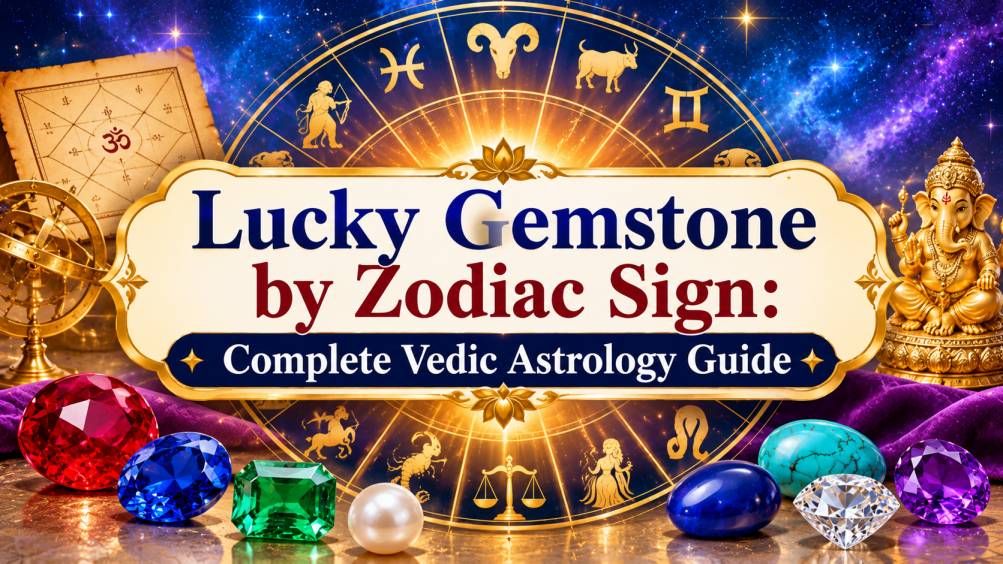
Gemstones have an important place in Vedic astrology, where they are traditionally associated with the nine planets (Navagrahas). According to astrological beliefs, specific gemstones represent planetary energies and are sometimes recommended to strengthen favourable planetary influences in an individual’s birth chart. From Ruby (Manik) for the Sun to Blue Sapphire (Neelam) for Saturn, every gemstone has a distinct planetary association.
Finding the lucky gemstone by zodiac sign can help people understand traditional gemstone recommendations based on their Rashi. However, selecting the right gemstone requires more than knowing your zodiac sign. Your Ascendant (Lagna), planetary placements, house ownership, and Mahadasha also matter. This guide explains the traditional gemstone associations for all 12 zodiac signs, along with important precautions.
How Are Gemstones Connected to Vedic Astrology?
In Vedic astrology, gemstones are associated with the nine planetary influences of the Navagrahas. Traditional astrological texts and gemstone practices discuss their symbolic relationship with planetary strength.
Nine Planets and Their Associated Gemstones
| Planet | Gemstone | Traditional Colour |
| Sun (Surya) | Ruby (Manik) | Red |
| Moon (Chandra) | Pearl (Moti) | White |
| Mars (Mangal) | Red Coral (Moonga) | Red |
| Mercury (Budh) | Emerald (Panna) | Green |
| Jupiter (Guru) | Yellow Sapphire (Pukhraj) | Yellow |
| Venus (Shukra) | Diamond (Heera) | White |
| Saturn (Shani) | Blue Sapphire (Neelam) | Blue |
| Rahu | Hessonite (Gomed) | Honey-brown |
| Ketu | Cat’s Eye (Lehsunia) | Yellowish-green |
Traditionally, gemstones are believed to represent their associated planetary influences. However, these beliefs are not scientifically established, and wearing a gemstone does not guarantee wealth, health, marriage, or career success.
Lucky Gemstone for Each Zodiac Sign
The following recommendations are general traditional associations, not personalised gemstone prescriptions.
1. Aries (Mesh Rashi) – Red Coral
Aries is ruled by Mars, which represents courage, determination, energy, and action.
- Lucky Gemstone: Red Coral (Moonga)
- Associated Planet: Mars
- Traditional Significance: Courage, confidence, and determination.
Red Coral is traditionally associated with strengthening Mars-related qualities. It is sometimes recommended for people seeking greater motivation and assertiveness.
2. Taurus (Vrishabh Rashi) – Diamond
Taurus is ruled by Venus, which represents beauty, luxury, relationships, and creativity.
- Lucky Gemstone: Diamond (Heera)
- Associated Planet: Venus
- Traditional Significance: Creativity, relationships, and comfort.
Diamond is associated with Venus and is traditionally connected with artistic expression, refinement, and harmony.
3. Gemini (Mithun Rashi) – Emerald
Gemini is ruled by Mercury, the planet of communication, intelligence, learning, and business.
- Lucky Gemstone: Emerald (Panna)
- Associated Planet: Mercury
- Traditional Significance: Communication, analytical thinking, and learning.
Emerald is traditionally associated with Mercury’s intellectual and communication-related qualities.
4. Cancer (Karka Rashi) – Pearl
Cancer is ruled by the Moon, which represents emotions, intuition, and mental well-being.
- Lucky Gemstone: Pearl (Moti)
- Associated Planet: Moon
- Traditional Significance: Emotional balance and calmness.
Pearl is traditionally associated with lunar energy and is considered in astrological practices related to emotional stability.
5. Leo (Simha Rashi) – Ruby
Leo is ruled by the Sun, which represents leadership, authority, confidence, and recognition.
- Lucky Gemstone: Ruby (Manik)
- Associated Planet: Sun
- Traditional Significance: Leadership, confidence, and vitality.
Ruby is associated with the Sun and traditionally symbolises authority, self-expression, and personal strength.
6. Virgo (Kanya Rashi) – Emerald
Virgo is ruled by Mercury and is associated with organisation, logic, precision, and practical intelligence.
- Lucky Gemstone: Emerald (Panna)
- Associated Planet: Mercury
- Traditional Significance: Analytical thinking and communication.
Emerald is traditionally linked with Mercury and is associated with intellectual development and clarity.
7. Libra (Tula Rashi) – Diamond
Libra is ruled by Venus, representing beauty, relationships, harmony, and artistic abilities.
- Lucky Gemstone: Diamond (Heera)
- Associated Planet: Venus
- Traditional Significance: Harmony, creativity, and refinement.
Diamond is traditionally associated with Venus and its qualities of beauty, attraction, and artistic expression.
8. Scorpio (Vrishchik Rashi) – Red Coral
Scorpio is ruled by Mars in classical Vedic astrology and is associated with determination, courage, and transformation.
- Lucky Gemstone: Red Coral (Moonga)
- Associated Planet: Mars
- Traditional Significance: Courage, strength, and determination.
Red Coral is traditionally connected with Mars and is considered in astrological practices focused on action and perseverance.
9. Sagittarius (Dhanu Rashi) – Yellow Sapphire
Sagittarius is ruled by Jupiter, which represents wisdom, education, spirituality, and expansion.
- Lucky Gemstone: Yellow Sapphire (Pukhraj)
- Associated Planet: Jupiter
- Traditional Significance: Knowledge, wisdom, and prosperity.
Yellow Sapphire is traditionally associated with Jupiter and is connected with education, guidance, and spiritual development.
10. Capricorn (Makar Rashi) – Blue Sapphire
Capricorn is ruled by Saturn, representing discipline, responsibility, patience, and long-term progress.
- Lucky Gemstone: Blue Sapphire (Neelam)
- Associated Planet: Saturn
- Traditional Significance: Discipline, patience, and perseverance.
Blue Sapphire is traditionally associated with Saturn. However, it is not automatically suitable for every Capricorn native.
11. Aquarius (Kumbh Rashi) – Blue Sapphire
Aquarius is traditionally ruled by Saturn in Vedic astrology and represents innovation, responsibility, and independent thinking.
- Lucky Gemstone: Blue Sapphire (Neelam)
- Associated Planet: Saturn
- Traditional Significance: Discipline, stability, and responsibility.
Blue Sapphire is associated with Saturn, but its suitability depends on the complete birth chart.
12. Pisces (Meen Rashi) – Yellow Sapphire
Pisces is ruled by Jupiter, which represents wisdom, compassion, spirituality, and knowledge.
- Lucky Gemstone: Yellow Sapphire (Pukhraj)
- Associated Planet: Jupiter
- Traditional Significance: Wisdom, learning, and spiritual growth.
Yellow Sapphire is traditionally connected with Jupiter and is considered in astrological practices related to knowledge and personal development.
Important Things to Check Before Wearing a Gemstone
Choosing a gemstone only according to your zodiac sign may not be sufficient. In Vedic astrology, an astrologer generally examines:
- Ascendant (Lagna): Determines planetary house ownership and functional benefic or malefic status.
- Planetary Placement: Evaluates the planet’s sign, house, dignity, and aspects.
- Mahadasha and Antardasha: Helps assess the planetary periods operating in the birth chart.
- Navamsha Chart: Provides additional information about planetary strength and dignity.
- Gemstone Quality: Natural origin, authenticity, treatments, and suitability for jewellery should be checked.
Simple Planetary Remedies Without Gemstones
If you do not wish to wear gemstones, traditional alternatives include:
- Offering water to the Sun on Sundays.
- Praying to Lord Shiva on Mondays.
- Reciting Hanuman Chalisa on Tuesdays.
- Worshipping Lord Ganesha on Wednesdays.
- Respecting teachers and supporting education on Thursdays.
- Offering prayers to Goddess Lakshmi on Fridays.
- Helping underprivileged people on Saturdays.
These practices can be followed as expressions of faith and discipline without assuming guaranteed astrological results.
Conclusion
The lucky gemstone for each zodiac sign is traditionally determined through its ruling planet and associated planetary symbolism. Ruby, Pearl, Red Coral, Emerald, Yellow Sapphire, Diamond, and Blue Sapphire are among the commonly discussed gemstones in Vedic astrology.
However, a gemstone suitable for one person may not be appropriate for another person with the same zodiac sign. Individual Kundli analysis is important before selecting a gemstone, particularly expensive stones such as Blue Sapphire, Yellow Sapphire, and Diamond. Understand the planetary associations, verify gemstone authenticity, and seek informed guidance before making a purchase. Astrology can offer a traditional perspective, but practical decisions and personal effort remain essential.
Frequently Asked Questions (FAQs)
1. Which gemstone is best according to my zodiac sign?
The traditionally recommended gemstone depends on the ruling planet of your zodiac sign, although individual Kundli analysis is necessary before choosing one.
For example, Ruby is associated with Leo, Emerald with Gemini and Virgo, and Yellow Sapphire with Sagittarius and Pisces.
Tips:
- Identify your Rashi and Ascendant.
- Check the ruling planet’s placement.
- Seek personalised guidance before wearing a gemstone.
2. Can I wear a gemstone according to my Moon sign?
Yes, you can explore traditional gemstone associations through your Moon sign, but the Moon sign alone is not sufficient to determine suitability.
Vedic astrologers generally examine the Ascendant, planetary strength, house ownership, and running planetary periods before recommending gemstones.
Tips:
- Check your birth chart.
- Consider your Moon sign and Ascendant.
- Avoid selecting expensive gemstones based only on general zodiac recommendations.
3. Which gemstone is considered most powerful in Vedic astrology?
Blue Sapphire (Neelam), Yellow Sapphire (Pukhraj), Ruby (Manik), and Emerald (Panna) are among the prominent gemstones discussed in traditional Vedic astrology.
Their astrological significance depends on the planet they represent and the individual’s birth chart. No gemstone is universally the most powerful or suitable for everyone.
Tips:
- Understand the associated planet.
- Check the gemstone’s suitability.
- Verify its authenticity before purchasing.
4. Can I wear two gemstones together?
Two gemstones may be worn together in certain traditional astrological practices, but their planetary associations and compatibility should be evaluated first.
Some planets are considered naturally friendly, while others have traditionally described inimical relationships. Functional planetary roles in an individual’s Kundli also matter.
Tips:
- Check the relationship between the associated planets.
- Examine your complete Kundli.
- Avoid combining gemstones based on general internet recommendations.
5. Is Blue Sapphire suitable for everyone born under Capricorn or Aquarius?
No, Blue Sapphire is not automatically suitable for every Capricorn or Aquarius native, even though both signs are traditionally ruled by Saturn.
Saturn’s house ownership, placement, dignity, aspects, and planetary periods should be considered before recommending Neelam.
Tips:
- Analyse Saturn in your birth chart.
- Check its functional role.
- Consult an experienced Vedic astrologer before wearing Blue Sapphire.
6. How do I know whether a gemstone is original?
A gemstone’s authenticity should be verified through professional gemological testing rather than appearance or claims made by a seller.
Natural gemstones may have inclusions or treatments, and these factors can affect their value and classification.
Tips:
- Purchase from a reputable gemstone dealer.
- Request a recognised gemological laboratory certificate.
- Check whether the stone is natural, synthetic, or treated.
7. Can I follow astrological remedies without wearing gemstones?
Yes, traditional Vedic astrology includes several non-gemstone remedies, such as prayers, mantra recitation, charity, and disciplined daily practices.
These practices can help individuals maintain a meaningful spiritual routine without purchasing expensive gemstones.
Tips:
- Offer water to the Sun.
- Practise meditation and prayer.
- Help people in need.
- Maintain ethical behaviour and personal discipline.