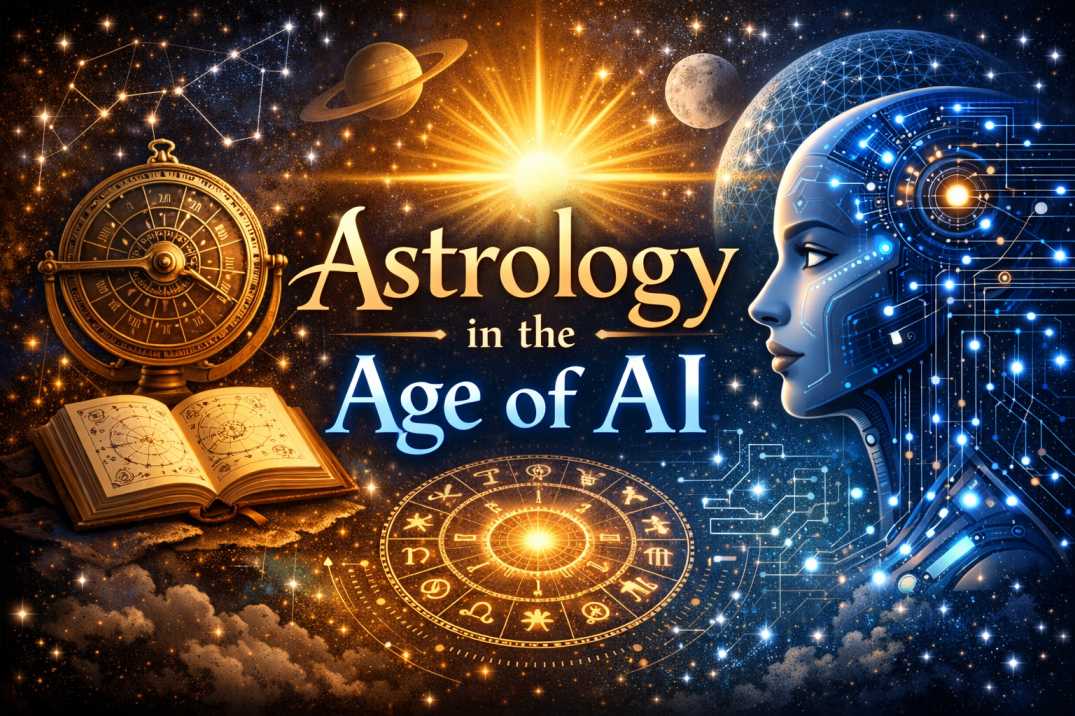
Astrology in the Age of AI represents a significant shift in how ancient celestial knowledge is studied, interpreted, and applied in daily life. Traditionally rooted in Vedic astrology (Jyotish Shastra), astrology has always relied on mathematical precision, planetary cycles, and human interpretation. Artificial Intelligence (AI), with its ability to process vast data sets and recognize complex patterns, now adds a new analytical layer to this timeless science.
For an Indian audience, this evolution is especially relevant. From daily horoscopes read every morning to muhurta calculations done at precise moments in IST (Indian Standard Time), astrology continues to guide personal, professional, and spiritual decisions. AI does not replace astrology’s spiritual foundation; instead, it enhances accuracy, accessibility, and consistency while respecting traditional frameworks.
Astrology and AI: A Conceptual Alignment
Why Astrology and AI Naturally Connect
Astrology is structured, data-driven, and rule-based qualities that align closely with AI systems. Planetary positions, dashas, transits, and yogas are calculated using fixed astronomical rules, making them suitable for algorithmic processing.
AI contributes by:
- Processing millions of birth charts in seconds
- Identifying statistical trends across zodiac signs and houses
- Reducing manual calculation errors
- Offering time-specific predictions based on IST
This synergy helps astrologers focus more on interpretation and counselling rather than calculations alone.
Planetary Influences Through AI Analytics
How AI Interprets Grahas and Rashis
In Vedic astrology, planets (grahas) influence different areas of life depending on their placement in zodiac signs (rashis) and houses (bhavas). AI tools analyze these placements collectively, offering deeper comparative insights.
For example:
- Saturn (Shani) patterns linked with career delays are studied across thousands of charts
- Jupiter (Guru) transits are correlated with education and financial growth trends
- Rahu–Ketu cycles are mapped to psychological and karmic themes
These insights remain grounded in classical texts like Brihat Parashara Hora Shastra, but AI improves contextual relevance.
“ग्रहाणां चरितं ज्ञात्वा फलं वदति यो बुधः”
(The wise predict outcomes by understanding planetary behavior.)
Yogas, Dashas, and Predictive Accuracy
AI in Dasha and Transit Analysis
Dashas (planetary periods) determine timing in astrology. AI systems calculate:
- Mahadasha–Antardasha sequences
- Exact transit impacts in IST
- Overlapping yogas affecting results
This precision helps avoid generic predictions. For instance, two individuals under the same Saturn Mahadasha may experience different outcomes based on house strength and aspects, something AI highlights efficiently.
Practical Applications in Daily Life
Real-Life Relevance for Modern Indians
Astrology in the Age of AI is not limited to predictions. It supports practical decision-making in areas such as:
- Career planning and role transitions
- Marriage compatibility (Kundli matching)
- Financial risk assessment
- Health and lifestyle balance
Mobile-friendly astrology apps powered by AI now deliver personalized insights at specific IST-based times, such as daily planetary hours (Hora) or Rahu Kalam.
Remedies in a Tech-Enabled Framework
Simple, Logic-Based Astrological Remedies
AI does not change remedies; it refines their recommendation based on planetary strength and frequency of occurrence.
Common, culturally aligned remedies include:
- Chanting Gayatri Mantra at sunrise (around 5:30–6:30 AM IST)
- Donating food or black sesame on Saturdays for Saturn balance
- Wearing gemstones only after verified chart analysis
These remedies follow the principle of resonance, strengthening weak planetary energies rather than superstition.
Ethical Boundaries and Human Judgment
Why AI Cannot Replace the Astrologer
While AI excels at calculation and pattern recognition, astrology remains interpretative. Emotional intelligence, cultural sensitivity, and ethical responsibility cannot be automated.
E-E-A-T principles apply strongly here:
- Experience: Human astrologers understand lived realities
- Expertise: Classical training ensures textual accuracy
- Authoritativeness: Lineage and study build credibility
- Trustworthiness: Ethical guidance prevents fear-based predictions
AI serves best as a supportive tool, not a decision-maker.
Conclusion
Astrology in the Age of AI marks a thoughtful integration of tradition and technology. Rather than diminishing Vedic wisdom, AI strengthens astrology’s analytical clarity, accessibility, and relevance for modern life. By handling complex calculations and data patterns, AI allows astrologers to focus on meaningful guidance, ethical counsel, and practical remedies.
For individuals, this evolution offers clearer insights, time-accurate predictions in IST, and personalized support without abandoning cultural roots. The future of astrology lies not in choosing between human intuition and technology, but in balancing both with awareness and responsibility.
FAQs: Astrology in the Age of AI
1. What is Astrology in the Age of AI?
It is the use of artificial intelligence to enhance astrological calculations and analysis.
AI processes large datasets of planetary positions and charts to improve accuracy and consistency. It supports astrologers by reducing manual effort while maintaining traditional principles.
Tips: Use AI-based tools for calculations, but rely on human interpretation for guidance.
2. Can AI predict the future more accurately than astrologers?
No, AI improves calculation accuracy but does not replace interpretative wisdom.
Astrology involves symbolism, context, and free will, which require human judgment. AI identifies patterns; astrologers assign meaning.
Summary: Combine AI precision with expert consultation.
3. Is AI-based astrology aligned with Vedic principles?
Yes, when it follows classical texts and calculation methods.
Most reputable platforms base algorithms on siddhantic calculations and traditional rules.
Tip: Verify that tools use Lahiri Ayanamsa and IST-based timing.
4. Are remedies suggested by AI reliable?
They are reliable when based on validated planetary strength.
AI suggests remedies by analyzing recurring planetary imbalances, but discretion is essential.
Remedies: Mantras, charity, and disciplined routines remain effective.
5. Will AI make astrology too mechanical?
Only if human insight is excluded.
Astrology thrives on empathy and ethical guidance, which technology cannot replicate.
Advice: Treat AI as a support system, not a final authority.