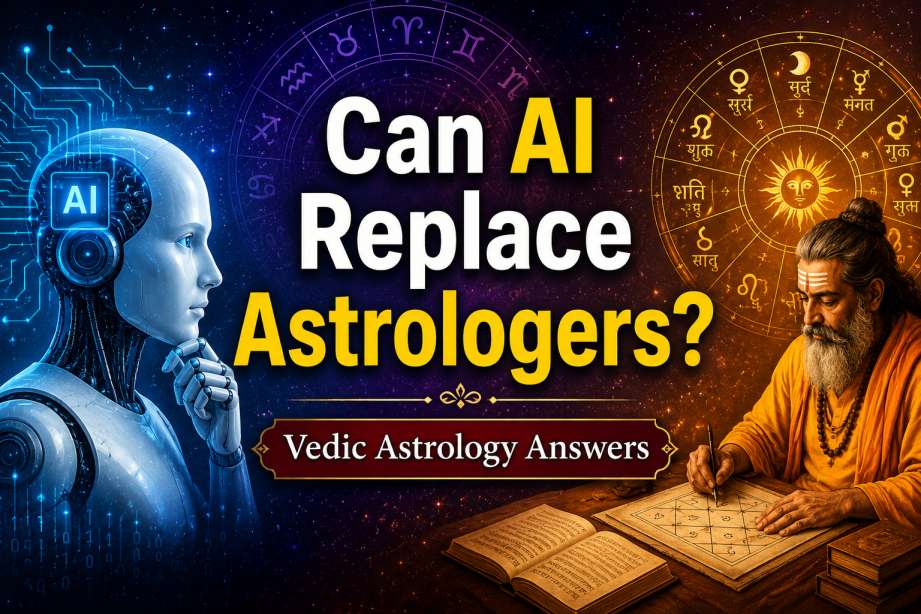
Artificial Intelligence (AI) is rapidly changing how people access information, including astrology. Today, many apps and websites can generate horoscopes, match kundlis, and predict planetary influences within seconds. This has created an important question in modern spiritual discussions: can AI truly replace human astrologers?
In the context of Vedic astrology, this topic is highly relevant because astrology is not only mathematical but also intuitive and spiritual. While AI can process large amounts of astrological data quickly, traditional Jyotish Shastra considers human wisdom, karmic understanding, and spiritual sensitivity equally important.
For millions of Indians who rely on astrology for marriage, career, health, and life decisions, understanding the difference between AI astrology and traditional astrologers is becoming increasingly necessary.
Understanding AI in Astrology
AI astrology works through algorithms, machine learning, and data analysis. These systems study planetary positions, birth charts, and astrological combinations to generate predictions.
Popular AI astrology tools can:
- Generate daily horoscopes
- Analyze birth charts instantly
- Match kundlis for marriage
- Suggest gemstones and remedies
- Provide dasha and transit analysis
From a technical point of view, AI performs calculations faster than humans. In Vedic astrology, calculations related to Nakshatras, Dashas, planetary degrees, and divisional charts require precision, and AI handles this efficiently.
However, Vedic astrology is more than calculation alone.
Why Vedic Astrology Depends on Human Wisdom
Ancient Jyotish texts describe astrology as a divine science connected to karma and consciousness.
A well-known Sanskrit verse says:
“यथा शिखा मयूराणां नागानां मणयो यथा।
तद्वद् वेदाङ्गशास्त्राणां ज्योतिषं मूर्धनि स्थितम्॥”
Meaning: Just as a peacock’s crest and a serpent’s jewel are important, Jyotish holds a supreme place among the Vedangas.
Traditional astrologers often combine:
- Planetary analysis
- Intuition and observation
- Spiritual understanding
- Emotional counseling
- Practical life experience
An experienced astrologer may notice emotional patterns, family karma, or psychological struggles that software may not fully understand.
For example, two people may have similar planetary combinations, but their karmic experiences, upbringing, and emotional maturity can lead to very different outcomes.
This human interpretation remains one of the biggest differences between AI and astrologers.
Planetary Combinations Related to Technology and AI
In Vedic astrology, technology and artificial intelligence are commonly associated with certain planets and houses.
Mercury (Budh)
Mercury governs:
- Intelligence
- Communication
- Logic
- Data processing
- Analytical thinking
Strong Mercury placements often indicate interest in computers, coding, and AI systems.
Rahu
Rahu represents:
- Modern technology
- Virtual reality
- Innovation
- Artificial intelligence
- Digital platforms
Rahu’s influence is strongly connected with futuristic inventions and unconventional sciences.
Saturn
Saturn relates to:
- Automation
- Repetitive systems
- Structured processes
- Machine-based work
When Saturn combines with Mercury or Rahu, it may create strong technological abilities.
Important Houses
Certain houses are linked to technology and astrology:
- 3rd House – Communication and digital media
- 5th House – Intelligence and predictive ability
- 8th House – Occult sciences and hidden knowledge
- 9th House – Spiritual wisdom and higher learning
- 10th House – Career and professional expertise
Astrologers believe AI tools may become more powerful during strong Rahu-Mercury planetary periods globally.
What AI Can Do Better Than Human Astrologers
AI certainly offers several advantages in modern astrology.
Faster Calculations
AI can generate detailed kundli reports within seconds, reducing manual errors.
Accessibility
People in remote areas can access astrology anytime through mobile apps.
Pattern Recognition
AI systems can analyze thousands of charts and identify statistical trends quickly.
Cost-Effective Guidance
Basic horoscope analysis through AI tools is often affordable or free.
These benefits explain why AI astrology is becoming increasingly popular among younger generations.
What AI Still Cannot Fully Replace
Despite its efficiency, AI still faces important limitations in Vedic astrology.
Spiritual Intuition
Traditional astrology involves intuition developed through years of spiritual practice and observation.
Emotional Understanding
Human astrologers can understand fear, grief, confusion, and emotional suffering more deeply.
Ethical Guidance
A wise astrologer knows when to speak carefully and when not to create unnecessary fear.
Karma and Free Will
Vedic astrology does not promote fixed destiny alone. Human guidance helps individuals understand karma while encouraging positive action.
AI may provide predictions, but interpreting karma compassionately requires human sensitivity.
Can AI and Astrologers Work Together?
The future of astrology may not involve competition between AI and astrologers. Instead, both may work together.
AI can assist astrologers by:
- Automating calculations
- Generating charts quickly
- Tracking planetary transits
- Managing historical data
Meanwhile, human astrologers can focus on:
- Spiritual counseling
- Personalized interpretation
- Emotional support
- Ethical guidance
This balanced approach may become the future of modern Vedic astrology in India.
Practical Remedies for Better Astrological Guidance
Whether using AI or consulting astrologers, clarity and spiritual balance remain important.
Simple Remedies
- Chant “Om Budhaya Namah” on Wednesdays for mental clarity.
- Meditate daily for at least 10 minutes.
- Avoid fear-based astrology content online.
- Verify predictions from trusted sources only.
- Maintain a balanced approach toward remedies and gemstones.
Spiritual Discipline
According to Jyotish traditions:
- Good karma improves planetary results.
- Charity and honesty strengthen positive energies.
- Self-awareness is more important than blind prediction.
Conclusion
AI is transforming astrology by making predictions faster, more accessible, and data-driven. In areas like chart calculation and pattern analysis, AI performs extremely well. However, Vedic astrology is not purely mechanical. It combines mathematics, intuition, spiritual wisdom, and human understanding.
For this reason, AI may assist astrologers, but completely replacing experienced Vedic astrologers remains unlikely. Human insight, compassion, and karmic interpretation still play a major role in Jyotish practice.
As technology evolves, the wisest approach may be to use AI as a helpful tool while preserving the spiritual depth and ethical responsibility of traditional astrology.
FAQs
1. Can AI accurately predict astrology?
Yes, AI can accurately calculate planetary positions and generate horoscope-based predictions.
AI uses astronomical data and algorithms to analyze kundlis quickly. It is especially effective for mathematical calculations and transit tracking.
However, prediction accuracy also depends on interpretation, timing, and human understanding of karma and life situations.
Tips
- Use AI for basic chart analysis.
- Consult experienced astrologers for major life decisions.
- Avoid depending entirely on automated predictions.
2. Why do people still consult human astrologers?
People often seek emotional clarity, spiritual guidance, and personalized interpretation.
Human astrologers can understand emotional struggles and provide practical advice with empathy. Vedic astrology traditionally values intuition and life experience alongside calculations.
AI cannot fully replicate emotional intelligence or spiritual counseling.
Remedies
- Choose astrologers with ethical practices.
- Focus on guidance rather than fear.
- Maintain practical thinking along with faith.
3. Which planets are connected to AI and technology?
Mercury, Rahu, and Saturn are strongly associated with AI and modern technology in Vedic astrology.
Mercury governs intelligence and analytical thinking. Rahu represents futuristic inventions and digital systems, while Saturn relates to automation and structured processes.
Strong combinations of these planets may indicate careers in AI, coding, or data science.
Helpful Practices
- Strengthen Mercury through learning and communication.
- Practice meditation to balance Rahu’s restless energy.
- Maintain discipline during Saturn periods.
4. Can AI generate accurate kundli matching?
AI can calculate guna matching and planetary compatibility with high precision.
Modern software accurately checks Manglik Dosha, Ashtakoota matching, and planetary positions. However, deeper marital compatibility also requires emotional and family understanding.
Experienced astrologers often analyze factors beyond automated scoring.
Suggestions
- Do not depend only on guna points.
- Consider emotional compatibility as well.
- Consult trusted experts before marriage decisions.
5. Is Vedic astrology scientific or spiritual?
Vedic astrology is traditionally viewed as both mathematical and spiritual.
The calculation side involves astronomy, planetary motion, and timing systems. The interpretive side includes karma, consciousness, and spiritual philosophy.
This combination makes Jyotish unique compared to purely predictive systems.
Key Insight
- Astrology should guide, not control life.
- Good actions improve outcomes.
- Spiritual growth remains more important than fear-based predictions.