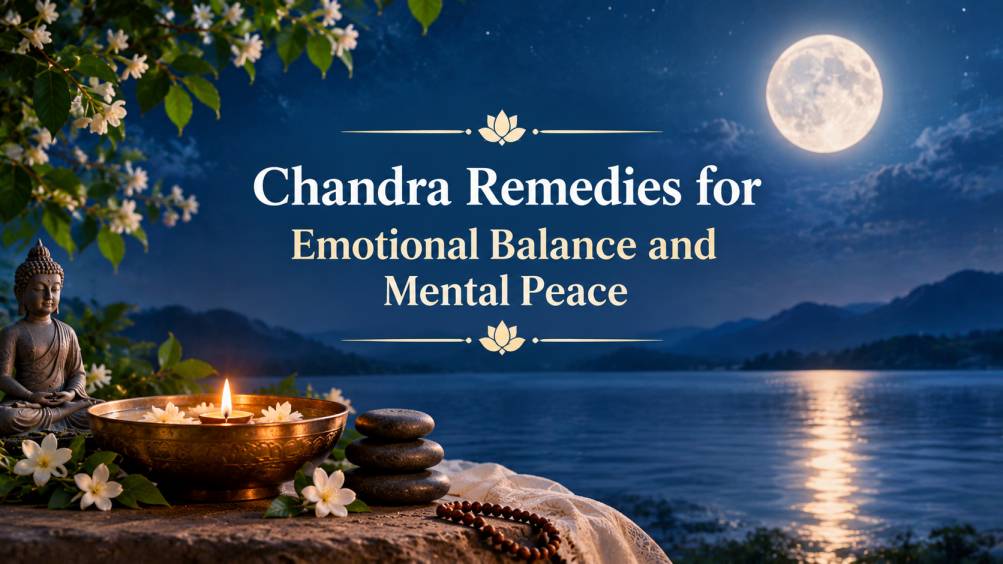
In Vedic astrology, Chandra (the Moon) represents the mind, emotions, feelings, mental stability and inner peace. It is considered one of the most important planets in a birth chart because its placement is traditionally associated with how a person processes emotions, responds to situations and maintains relationships.
A strong and well-placed Moon is associated with emotional maturity, sensitivity and mental calmness, while an afflicted or weak Moon is traditionally linked with mood fluctuations, overthinking and emotional insecurity. Chandra remedies are spiritual and astrological practices intended to strengthen the positive qualities of the Moon. These include mantra chanting, meditation, charity, worship and lifestyle changes. Understanding these remedies can help individuals develop a more balanced and mindful approach to everyday life.
Importance of Chandra in Vedic Astrology
In Vedic astrology, the Moon is the ruler of Cancer (Karka Rashi) and is associated with motherhood, nourishment, comfort, intuition and the subconscious mind.
The Moon also represents the following aspects of life:
- Mental peace: Emotional stability and the ability to handle stressful situations.
- Relationships: Attachment, care, affection and family connections.
- Motherly influences: Relationship with the mother and maternal figures.
- Intuition: Sensitivity, imagination and instinctive understanding.
- Public image: Popularity, public interaction and social adaptability.
The Moon completes its zodiac cycle approximately every 27.3 days, passing through all 12 zodiac signs. Its changing phases are also significant in traditional astrology.
Signs of a Weak or Afflicted Moon in Kundli
An astrologically weak Moon does not automatically indicate emotional problems. Its influence must be assessed alongside other planetary placements, aspects, conjunctions and house positions.
However, traditional Jyotish identifies certain combinations that may require attention.
1. Moon in the Sixth, Eighth or Twelfth House
These houses are associated with challenges, transformation, isolation, expenses and subconscious patterns. Depending on the complete horoscope, Moon placement here may indicate a need to develop emotional resilience.
2. Moon Conjunct Rahu or Ketu
The Moon-Rahu combination is traditionally associated with Grahan Yoga. Some astrologers interpret it as a symbol of confusion, unusual emotional responses or excessive mental activity.
Moon-Ketu conjunction may be associated with detachment, introspection and difficulty expressing emotions.
3. Moon Conjunct Saturn
When Saturn influences the Moon, traditional astrology associates the combination with seriousness, responsibility and emotional restraint. In certain charts, it may indicate a tendency towards pessimistic thinking.
4. Debilitated Moon in Scorpio
The Moon is traditionally considered debilitated in Scorpio. Astrologers associate this placement with emotional intensity and sensitivity. However, Neecha Bhanga Yoga and other planetary influences can modify its results.
9 Effective Chandra Remedies for Emotional Balance
The following remedies are commonly recommended in Vedic astrology to strengthen the positive qualities associated with Chandra.
1. Chant the Chandra Beej Mantra
Mantra chanting is a traditional remedy associated with planetary worship.
The Chandra Beej Mantra is:
ॐ श्रां श्रीं श्रौं सः चन्द्राय नमः।
Chanting this mantra 108 times is a commonly followed practice. Monday is traditionally considered suitable for Moon-related worship.
It can also serve as a daily mindfulness practice by creating a dedicated period for prayer and concentration.
2. Worship Lord Shiva on Mondays
Lord Shiva is closely associated with the Moon, which is depicted on his head as Chandra Shekhar.
Devotees traditionally visit Shiva temples on Mondays and offer water, milk and white flowers to the Shiva Lingam, following local temple customs.
Suggested practice:
- Chant Om Namah Shivaya.
- Offer prayers to Lord Shiva.
- Spend a few minutes in meditation.
- Practise gratitude towards family members.
3. Donate White-Coloured Items
White is traditionally associated with the Moon in Vedic astrology.
Donating white-coloured items on Mondays is considered a Chandra remedy.
Common donation items include:
- Rice
- Milk
- White clothes
- Sugar
- White sweets
Donate according to your financial capacity and avoid unnecessary expenditure.
4. Wear a Pearl Gemstone (Moti)
Pearl is traditionally associated with the Moon and is recommended by some astrologers for individuals whose birth charts support its use.
However, gemstone selection should not be based only on the Moon sign or a general horoscope prediction. An astrologer should examine the ascendant, Moon’s functional role, planetary relationships and Mahadasha before recommending Moti.
Pearls are not scientifically proven treatments for emotional or mental health conditions.
5. Practise Meditation and Deep Breathing
Meditation is a practical way to develop emotional awareness and mental calmness.
Since Chandra symbolises the mind in Vedic astrology, mindfulness practices are often recommended as complementary remedies.
Try the following:
- Practise meditation for 10–15 minutes daily.
- Follow slow, comfortable breathing.
- Maintain a consistent sleep schedule.
- Reduce unnecessary screen exposure before bedtime.
6. Respect Your Mother and Maternal Figures
The Moon represents motherhood and nurturing relationships in traditional astrology.
Showing care and respect towards your mother, grandmother or other maternal figures is considered a meaningful Chandra remedy.
Offering emotional support, spending quality time and expressing gratitude can also improve family relationships.
7. Observe Monday Vrat
Some devotees observe Somvar Vrat to worship Lord Shiva and seek blessings for peace and well-being.
A fast may involve eating fruits, milk or simple vegetarian food, depending on family traditions.
Fasting is optional. People with medical conditions, dietary restrictions or specific nutritional needs should avoid fasting without appropriate professional guidance.
8. Spend Time in Natural Surroundings
The Moon is associated with water, nature and emotional sensitivity.
Spending time near gardens, lakes or other peaceful natural surroundings can encourage relaxation.
A short evening walk, gardening or listening to calming music may help reduce everyday stress.
9. Read or Listen to Spiritual Texts
Reading the Bhagavad Gita or listening to devotional prayers can provide opportunities for reflection.
The teachings of the Bhagavad Gita emphasise self-awareness, balance and maintaining equanimity in changing circumstances.
These ideas can complement traditional Chandra remedies.
Chandra Remedies According to Moon Sign
The Moon’s zodiac placement can provide additional context for choosing traditional spiritual practices.
| Moon Sign | Suggested practice |
| Aries | Meditation and patience-building activities |
| Taurus | Charity and gratitude practices |
| Gemini | Mantra chanting and mindful communication |
| Cancer | Shiva worship and family time |
| Leo | Humility and charitable activities |
| Virgo | Meditation and organised routines |
| Libra | Relationship harmony and charity |
| Scorpio | Emotional reflection and spiritual practices |
| Sagittarius | Reading spiritual texts |
| Capricorn | Relaxation and family bonding |
| Aquarius | Community service and meditation |
| Pisces | Prayer, compassion and mindfulness |
These are general suggestions. Individual remedies should be selected after analysing the complete birth chart.
Which Houses Influence Mental Peace in Kundli?
Apart from the Moon’s placement, astrologers examine several houses when analysing emotional well-being.
- Fourth House: Represents emotional comfort, home, mother and inner happiness.
- Fifth House: Associated with intelligence, creativity and emotional expression.
- Eighth House: Represents transformation, uncertainty and deeper psychological patterns.
- Twelfth House: Associated with sleep, solitude, spirituality and expenses.
The Moon’s relationship with these houses, along with Saturn, Rahu, Jupiter and Mercury, can provide a broader understanding of emotional tendencies.
Conclusion
Chandra remedies in Vedic astrology focus on developing emotional balance, inner peace and a more positive relationship with oneself and others. Practices such as Monday worship, Chandra mantra chanting, charity, meditation and maintaining healthy family relationships are traditionally recommended to strengthen the positive qualities of the Moon.
However, the effectiveness of an astrological remedy should not be treated as scientifically established or guaranteed. A complete Kundli analysis is important before choosing specific remedies or gemstones.
Along with spiritual practices, maintaining healthy sleep habits, managing stress and seeking professional support when needed can contribute to emotional well-being. The real purpose of Chandra remedies should be to encourage mindfulness, compassion and balance in everyday life.
Frequently Asked Questions (FAQs)
1. What are the best Chandra remedies for mental peace?
Chanting the Chandra Beej Mantra, worshipping Lord Shiva on Mondays and practising meditation are popular traditional Chandra remedies.
In Vedic astrology, these practices are associated with strengthening the positive qualities of the Moon, such as emotional awareness, calmness and sensitivity.
Suggested remedies:
- Chant Om Shraam Shreem Shraum Sah Chandraya Namah.
- Observe Monday worship.
- Practise daily meditation.
- Maintain a regular sleep routine.
2. How can I identify a weak Moon in my Kundli?
A weak or afflicted Moon is identified by examining its sign, house placement, planetary conjunctions, aspects and overall horoscope strength.
A debilitated Moon in Scorpio, conjunction with Rahu or Saturn, or certain challenging house placements may require further astrological analysis. However, these combinations do not independently determine a person’s emotional condition.
Tip: Consult an experienced Vedic astrologer for a complete birth chart analysis rather than relying only on your Moon sign.
3. Which day is best for Chandra remedies?
Monday is traditionally considered the most suitable day for Chandra-related remedies because it is associated with Lord Shiva and the Moon.
Devotees often perform Shiva Puja, chant Chandra mantras and donate white-coloured items on this day.
Recommended practices:
- Chant the Chandra Beej Mantra.
- Offer prayers to Lord Shiva.
- Donate rice or milk.
- Practise meditation.
4. Does wearing Moti (Pearl) improve mental peace?
According to traditional Vedic astrology, Moti is associated with the Moon and is sometimes recommended to strengthen its favourable influence.
However, pearl should not be worn automatically by everyone. Its suitability depends on the ascendant, planetary lordship, Moon placement and other horoscope factors.
Tip: Get your Kundli analysed before investing in a gemstone.
5. Which mantra is powerful for strengthening Chandra?
The Chandra Beej Mantra is traditionally recommended for Moon-related worship.
The mantra is:
ॐ श्रां श्रीं श्रौं सः चन्द्राय नमः।
Devotees commonly chant it 108 times, especially on Mondays. Regular chanting can also provide a structured opportunity for prayer and mindfulness.
Tip: Chant in a quiet place with concentration and consistency.
6. What happens when Moon and Rahu are together in Kundli?
The Moon-Rahu conjunction is traditionally associated with Grahan Yoga in Vedic astrology.
Depending on the complete birth chart, astrologers may interpret this combination as indicating unusual thought patterns, heightened sensitivity or difficulty maintaining emotional clarity. Its results can vary considerably with sign, house, aspects and planetary strength.
Traditional remedies:
- Worship Lord Shiva.
- Chant Chandra mantras.
- Practise meditation.
- Maintain a disciplined daily routine.
7. Can Chandra remedies help with overthinking and anxiety?
Chandra remedies may provide spiritual comfort and encourage mindfulness, but they are not scientifically established treatments for anxiety or other mental health conditions.
Meditation, regular sleep, physical activity and healthy communication can support emotional well-being. If anxiety or persistent distress affects daily life, professional mental health support is important.