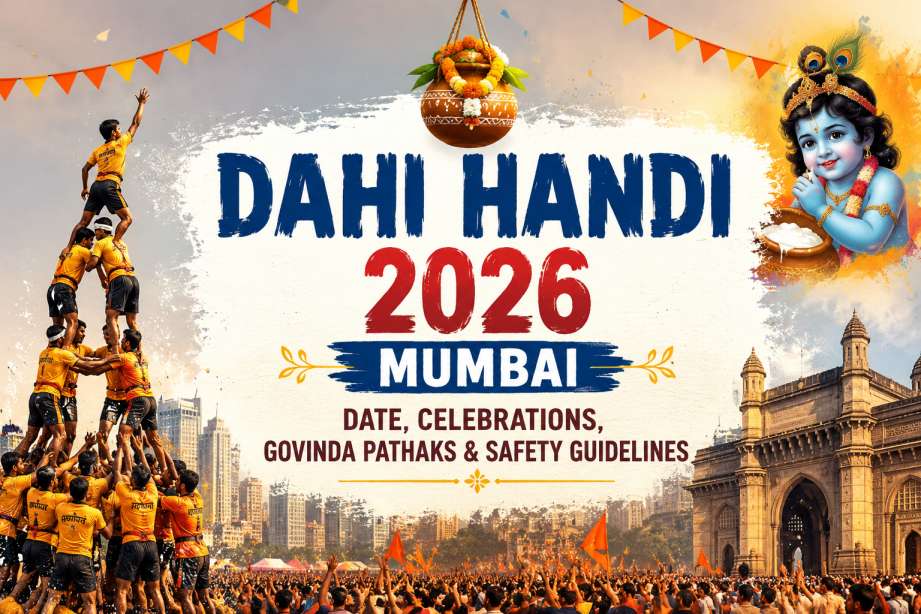
Dahi Handi is one of Mumbai’s most energetic celebrations associated with Lord Krishna and Janmashtami. In Maharashtra, the festival is also known as Gopalakala and traditionally commemorates Krishna’s childhood Makhan Chor Leela, when he and his friends are believed to have formed human pyramids to reach pots of curd and butter.
In 2026, Krishna Janmashtami falls on Friday, September 4, while Dahi Handi in Mumbai is observed on Saturday, September 5. Drik Panchang lists Mumbai’s Nishita Puja Muhurat as approximately 12:14 AM to 1:01 AM IST on September 5.
For Mumbai residents, however, Dahi Handi is much more than a religious ritual. It combines devotion, teamwork, physical coordination, music, community participation and friendly competition.
Why Dahi Handi Is Important in Mumbai
Mumbai has transformed Dahi Handi into a major public celebration. Govinda Pathaks, also called Govinda mandals, train together to create human pyramids and compete to break the suspended handi.
The Maharashtra Tourism Department describes the festival as a celebration of teamwork, perseverance, devotion and communal harmony. Traditional celebrations include dhol beats, decorations, Krishna chants and the familiar call of “Govinda Ala Re!”
What Happens During Dahi Handi?
A typical celebration involves:
- A decorated earthen handi suspended above the ground.
- Govinda Pathaks forming multiple human-pyramid levels.
- The top participant attempting to break the handi.
- Spectators cheering and chanting Krishna’s name.
- Music, dhol and community celebrations.
- Prizes or cash awards for successful teams.
The competitive character of Mumbai’s Dahi Handi has grown considerably over the years, making preparation, coordination and safety increasingly important.
Dahi Handi 2026 and Its Astrological Connection
From a Vedic astrology perspective, Dahi Handi carries symbolic connections with Mars, Jupiter, Moon and the 3rd, 5th and 11th houses.
Mars: Strength and Courage
Mars represents physical energy, courage, competition, stamina and determination. These qualities are clearly visible when Govindas train for pyramid formations.
However, Mars also teaches restraint. Strength without discipline can create unnecessary risk. Therefore, the traditional message of the festival can be interpreted as courage combined with control.
Jupiter: Devotion and Dharma
Jupiter represents wisdom, faith, teachers and dharma. Since Dahi Handi is connected with Lord Krishna’s childhood Leela, Jupiter’s symbolism reflects the spiritual and cultural dimension of the celebration.
Moon: Community and Emotion
The Moon is associated with emotions, public connection and collective consciousness. Large gatherings, devotional singing and shared celebrations naturally reflect these themes.
Relevant Houses
Astrologically, the:
- 3rd house relates to courage, effort and coordination.
- 5th house represents devotion, creativity and children.
- 11th house signifies groups, networks, gains and collective achievements.
This makes Dahi Handi a useful cultural example of how individual effort can contribute to a larger group achievement.
Govinda Pathaks: Training and Teamwork
The success of a Govinda Pathak does not depend only on physical strength. It requires trust, timing, communication and repeated practice.
Different participants have different responsibilities. Those at the bottom provide stability, while middle layers maintain balance and the climber at the top completes the final task.
Interestingly, Mumbai continues to see inclusive forms of participation. A visually impaired Govinda Pathak has been training for 2026 using audio cues and structured safety practices, showing how teamwork can extend beyond conventional participation.
What Makes a Strong Govinda Team?
A responsible team should focus on:
- Regular supervised practice.
- Adequate hydration and rest.
- Proper physical conditioning.
- Clear communication between participants.
- Safety equipment.
- Medical preparedness.
- Following current administrative and legal requirements.
Dahi Handi 2026 Safety Guidelines
Safety should remain more important than competition or prize money. Human pyramids involve genuine risks from falls, slippery surfaces and crowd pressure.
Previous Bombay High Court directions have emphasized measures such as helmets, safety belts, cushioning and advance information to authorities. The court directions have also addressed participant age and pyramid height; because regulations can change, organizers should follow the latest applicable government, police and court instructions rather than relying on old festival rules.
Essential Safety Measures
Organizers and Govinda Pathaks should consider:
- Use appropriate helmets, chest protection and safety equipment.
- Keep adequate cushioning and protective nets around the performance area.
- Arrange a first-aid facility and ambulance.
- Keep spectators behind appropriate barricades.
- Avoid slippery substances and hazardous chemicals.
- Ensure participants are properly registered and insured where required.
- Obtain necessary permissions from police, municipal and other authorities.
- Avoid participation by anyone who is medically unfit, intoxicated or excessively fatigued.
- Keep emergency exits and access routes clear.
- Check weather and ground conditions before the event.
Earlier official safety guidelines cited in court proceedings have also included medical assistance, participant insurance, crowd management and appropriate permissions.
For 2026, Maharashtra has also announced insurance coverage for 1.6 lakh Govindas, subject to the applicable registration, eligibility and participation conditions.
Practical Spiritual Remedies for Krishna Devotees
Dahi Handi does not require elaborate remedies. Simple devotional practices can make the festival more meaningful.
Easy Krishna Remedies
- Chant “Om Namo Bhagavate Vasudevaya” 108 times.
- Offer tulsi leaves to Lord Krishna, where appropriate.
- Read or listen to a few verses from the Bhagavad Gita.
- Donate food or curd-based offerings to people in need.
- Practice patience and cooperation with family members.
- Avoid unnecessary arguments during the festive period.
The deeper lesson is simple: individual strength becomes meaningful when it supports collective effort.
Conclusion
Dahi Handi 2026 in Mumbai will be celebrated on Saturday, September 5, following Krishna Janmashtami on September 4. The festival brings together Krishna devotion, Maharashtra’s cultural identity, Govinda Pathaks, music and competitive spirit.
Astrologically, its symbolism connects courage and physical effort with Mars, devotion and wisdom with Jupiter, and community participation with the Moon and social houses. But the most important practical message remains safety.
Whether you participate in a Govinda Pathak or simply watch the celebrations, enjoy the festival responsibly. Let devotion, teamwork and discipline remain at the heart of “Govinda Ala Re!”
FAQs
1. When is Dahi Handi 2026 in Mumbai?
Dahi Handi 2026 in Mumbai will be celebrated on Saturday, September 5, 2026.
It follows Krishna Janmashtami, which falls on Friday, September 4. Dahi Handi traditionally takes place the following day in Maharashtra.
Related tips:
- Check your local mandal schedule.
- Follow traffic and crowd-control instructions.
- Keep children away from active pyramid areas.
2. When is Janmashtami 2026 in Mumbai?
Krishna Janmashtami will be observed in Mumbai on Friday, September 4, 2026.
The Mumbai Nishita Puja period is approximately 12:14 AM to 1:01 AM IST on September 5, according to the cited Panchang calculation.
Related practice:
- Observe Krishna worship according to your family tradition.
- Chant Krishna mantras.
- Offer tulsi where customary.
3. What is a Govinda Pathak?
A Govinda Pathak is a team of participants who form human pyramids to break the Dahi Handi.
In Maharashtra, Govindas train collectively for balance, coordination and strength. Modern participation increasingly emphasizes organized practice and safety measures.
For participants:
- Train under supervision.
- Stay hydrated.
- Use appropriate protective equipment.
- Do not participate when injured or unwell.
4. Is Dahi Handi safe for children?
Children should not be allowed to participate in human-pyramid performances unless specifically permitted under the latest applicable laws and official rules.
The Bombay High Court has historically issued directions concerning the participation of children and safety standards for Dahi Handi, making it important for organizers to verify the current rules rather than relying on outdated information.
Safety priority:
- Verify age eligibility.
- Maintain proper supervision.
- Never compromise safety for additional pyramid levels.
5. What safety equipment is recommended for Dahi Handi?
Helmets, protective equipment, cushioning, safety nets, medical assistance and proper crowd management are among the important safety measures associated with Dahi Handi events.
Organizers should also obtain the required permissions and keep emergency medical arrangements ready.
Essential checklist:
- Helmet and protective gear
- Cushioning/mats
- Safety net
- First-aid kit
- Ambulance or emergency medical access
- Barricades and crowd control
6. What is the spiritual significance of Dahi Handi?
Dahi Handi symbolically celebrates Lord Krishna’s childhood butter-stealing Leela and represents teamwork, devotion, perseverance and collective effort.
Its cultural message is particularly relevant today: difficult goals become achievable when people coordinate their individual abilities toward a shared purpose.
Simple spiritual practice:
- Chant Krishna’s name.
- Read the Bhagavad Gita.
- Offer food to others.
- Practice cooperation and humility.