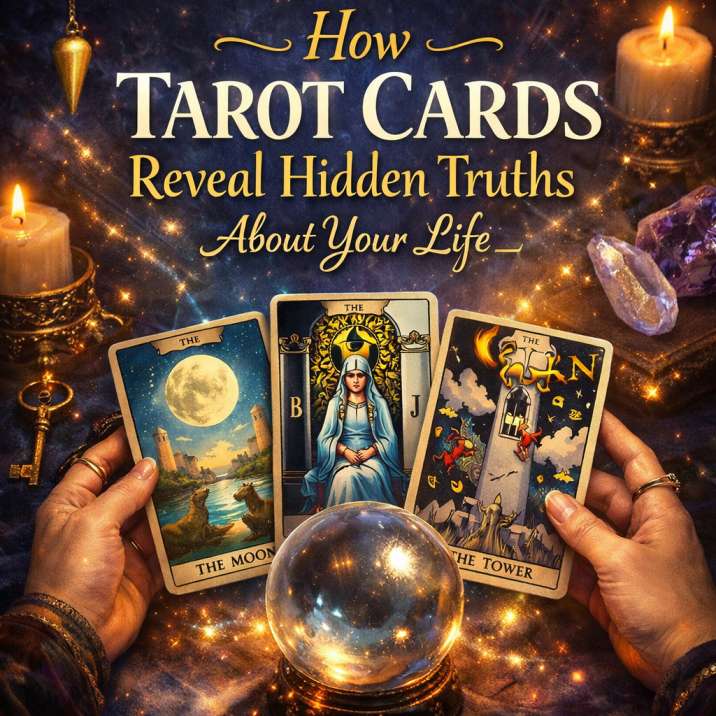
Tarot reading is often misunderstood as mere fortune-telling, but in reality, it is a structured symbolic system that helps uncover hidden patterns in life. Rooted in archetypes, intuition, and psychological insight, tarot works as a mirror to the subconscious. For an Indian audience familiar with astrology, karma, and planetary influences, tarot becomes a complementary tool rather than a contradiction to Vedic wisdom.
Just as a birth chart reveals tendencies based on planetary placements, tarot cards highlight current energies, choices, and unseen influences shaping your life right now. Whether a reading is done early morning around 6:00 AM IST or during calm evening hours near 8:00 PM IST, timing matters because the reader’s mental clarity and the seeker’s intent play a vital role. Tarot does not predict fate rigidly; instead, it reveals truths that help you make conscious decisions.
Understanding Tarot Beyond Prediction
Tarot as a Symbolic Language
Tarot works through symbols that speak directly to the human psyche. Each card carries layered meanings that adapt based on context.
- Major Arcana (22 cards): Life lessons, karmic themes, soul growth
- Minor Arcana (56 cards): Daily situations, emotions, actions, and challenges
- Court Cards: Personality traits, people, or behavioral patterns
These symbols bypass logical resistance and bring subconscious truths to the surface.
Connection Between Tarot and Astrology
Tarot and astrology are deeply interconnected:
- The Sun card relates to Surya (Sun) and confidence
- The Moon card reflects Chandra (Moon) and emotional depth
- The Wheel of Fortune aligns with Jupiter (Guru) and destiny
- Justice resonates with Saturn (Shani) and karma
This overlap allows tarot readings to feel culturally aligned for those familiar with planetary logic.
How Tarot Reveals Hidden Truths
1. Revealing Emotional Blind Spots
Tarot highlights emotions you may be avoiding or suppressing. For example, repeated appearance of Cups cards often indicates emotional overwhelm or unresolved feelings.
Practical insight:
If emotional cards dominate a reading, pause major decisions for at least 48 hours (IST) and observe your emotional triggers.
2. Identifying Karmic Patterns
Cards like Judgement, Death, or The Devil often indicate karmic loops rather than negative outcomes. They point to habits, relationships, or fears repeating across time.
“कर्मण्येवाधिकारस्ते मा फलेषु कदाचन”
— Bhagavad Gita 2.47
This shloka aligns with tarot’s core message: focus on conscious action, not fear of outcomes.
3. Clarifying Career and Money Confusion
Pentacles cards reflect material stability, work ethics, and long-term planning. Tarot does not tell you “when” money will come but shows how your mindset affects financial flow.
Indicators include:
- Upright Pentacles → steady progress
- Reversed Pentacles → misaligned priorities
4. Understanding Relationship Dynamics
Tarot reveals power balance, emotional availability, and communication gaps in relationships. Cards like The Lovers or Two of Cups show alignment, while Five of Swords points to ego conflicts.
Real-life relevance:
Instead of asking “Will this relationship work?”, tarot answers “What energy am I bringing into it?”
Practical Remedies Suggested Through Tarot
Tarot readings often naturally lead to remedies aligned with Indian spiritual practices:
- For emotional imbalance:
- Moon-related remedies on Mondays
- Journaling after 9:00 PM IST when mental noise settles
- For career confusion:
- Lighting a ghee lamp on Thursdays
- Grounding practices if Earth cards dominate
- For karmic blocks:
- Charity or seva on Saturdays
- Mindful silence for 15 minutes daily
These remedies are not superstition but psychological anchors that reinforce clarity and discipline.
Why Tarot Feels Accurate in Real Life
Tarot feels revealing because it works on three levels:
- Psychological: Brings unconscious thoughts into awareness
- Energetic: Reflects current mental and emotional frequency
- Spiritual: Aligns choices with inner truth and dharma
When read responsibly, tarot empowers rather than creates dependency.
Conclusion
Tarot cards reveal hidden truths not by predicting a fixed future, but by illuminating the present moment with honesty and clarity. For an Indian audience grounded in karma and astrology, tarot becomes a practical reflection tool that complements planetary wisdom. It encourages self-awareness, responsibility, and conscious choice-making.
When used thoughtfully, ideally during calm hours in IST and with a clear intention, tarot helps you understand why certain patterns repeat and what inner shifts are needed. Instead of asking tarot for answers, use it to ask better questions. Reflection, not fear, is where true guidance begins.
FAQs
1. Can tarot cards really reveal hidden truths?
Yes, tarot reveals hidden truths by reflecting subconscious thoughts and current emotional energies rather than predicting fate.
Tarot works like a psychological and symbolic mirror, helping you see what you may be ignoring or avoiding.
Tip: Approach tarot with an open but grounded mindset for clearer insights.
2. Is tarot against Vedic astrology?
No, tarot complements Vedic astrology by focusing on present energies instead of birth-based destiny.
Astrology shows why tendencies exist, while tarot shows how they are playing out now.
Tip: Use tarot during planetary transits for better timing clarity.
3. How often should one take a tarot reading?
Once every few weeks is sufficient unless there is a major life transition.
Frequent readings can create confusion instead of clarity.
Remedy: Reflect on one reading for at least 7–14 days before the next.
4. Can tarot help with relationship decisions?
Yes, tarot helps you understand emotional dynamics, communication gaps, and personal responsibility.
It does not force outcomes but highlights conscious choices.
Tip: Ask open-ended questions instead of yes/no questions.
5. What is the best time for tarot reading in India?
Early morning (5:30–7:00 AM IST) or evening (7:00–9:00 PM IST) is considered ideal.
These times support mental calm and intuitive clarity.
Tip: Avoid readings when emotionally agitated or exhausted.