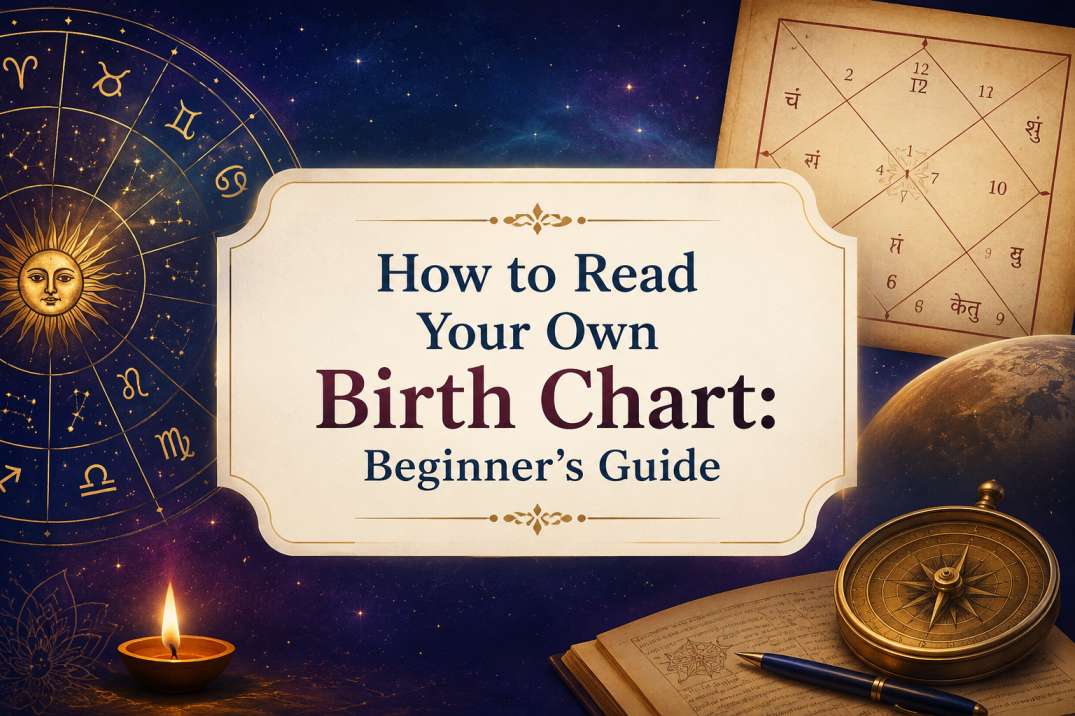
A birth chart, also known as a Kundli or Janma Kundli, is one of the most important tools in Vedic astrology. It is a map of the sky at the exact moment of your birth and reflects the positions of planets, zodiac signs, and houses. Astrologers study this chart to understand personality traits, career potential, relationships, finances, health, and spiritual growth.
Learning how to read your own birth chart does not require years of experience. By understanding a few basic principles, beginners can start interpreting the major themes of their horoscope. While professional guidance is valuable for detailed predictions, knowing the fundamentals helps you make informed decisions and better understand yourself. This guide explains the essentials in a simple and practical manner for anyone interested in Vedic astrology.
Understanding the Basics of a Birth Chart
Before interpreting any horoscope, it is important to know the four main building blocks.
1. The Ascendant (Lagna)
The Ascendant, or Lagna, is the zodiac sign rising on the eastern horizon at your birth. It changes approximately every two hours, making the exact birth time very important.
The Lagna represents:
- Physical appearance
- Personality
- Life path
- Overall strength of the horoscope
In Vedic astrology, many predictions begin by studying the Lagna and its ruling planet.
2. The Twelve Zodiac Signs
Each zodiac sign has unique qualities that influence how planetary energy is expressed.
- Aries – Leadership and initiative
- Taurus – Stability and comfort
- Gemini – Communication and learning
- Cancer – Emotions and family
- Leo – Confidence and creativity
- Virgo – Analysis and service
- Libra – Balance and partnerships
- Scorpio – Transformation and determination
- Sagittarius – Wisdom and exploration
- Capricorn – Discipline and ambition
- Aquarius – Innovation and humanitarian thinking
- Pisces – Compassion and spirituality
A planet behaves differently depending on the zodiac sign it occupies.
The Twelve Houses Explained
The horoscope is divided into twelve houses, each governing a different area of life.
Key House Meanings
- Self and personality
- Wealth and speech
- Courage and communication
- Home and mother
- Education and children
- Health and competition
- Marriage and partnerships
- Transformation and longevity
- Luck, dharma and higher learning
- Career and profession
- Income and achievements
- Expenses, foreign travel and spirituality
Rather than focusing only on planets, observe which house they occupy, as this often determines where their influence becomes most visible.
Understanding the Nine Planets
In Vedic astrology, the Navagrahas represent different life energies.
Sun (Surya)
Represents authority, confidence, leadership and father.
Moon (Chandra)
Represents emotions, mind, habits and mental peace.
Mars (Mangal)
Symbolizes courage, energy, competition and determination.
Mercury (Budh)
Rules communication, intelligence, education and business.
Jupiter (Guru)
Represents wisdom, prosperity, ethics and spiritual knowledge.
Venus (Shukra)
Influences love, luxury, creativity and relationships.
Saturn (Shani)
Teaches discipline, patience, responsibility and long-term success.
Rahu
Represents ambition, innovation, foreign connections and material desires.
Ketu
Represents spirituality, detachment, intuition and liberation.
A planet’s strength depends on its sign, house placement, aspects, conjunctions, and overall chart context.
How to Read Your Birth Chart Step by Step
Beginners can follow a simple sequence.
Step 1: Identify Your Ascendant
Your Lagna forms the foundation of the horoscope.
Step 2: Check Planetary Placements
Observe:
- Which sign each planet occupies
- Which house each planet occupies
- Whether multiple planets are together
Step 3: Study the House Lords
Every house has a ruling planet. Understanding where that ruler sits reveals important life themes.
Step 4: Observe Strong and Weak Planets
Generally, planets placed in their own sign, exaltation sign, or friendly signs perform better.
Weak planets may indicate areas needing greater effort and awareness.
Step 5: Look for Major Yogas
Certain combinations, known as Yogas, enhance specific life areas.
Examples include:
- Gaja Kesari Yoga
- Budha Aditya Yoga
- Raj Yoga
- Dhana Yoga
These yogas should always be interpreted alongside the complete horoscope rather than in isolation.
Practical Tips for Beginners
Avoid trying to predict everything at once.
Instead:
- Study one planet at a time.
- Understand one house every week.
- Compare interpretations with real-life experiences.
- Keep a journal of important life events.
- Learn gradually instead of memorizing combinations.
With practice, patterns become easier to recognize.
Simple Traditional Remedies
Vedic astrology emphasizes improving self-awareness rather than fearing planetary influences.
Some commonly followed traditional practices include:
- Offer water to the rising Sun regularly with sincerity.
- Maintain honesty and discipline to strengthen Saturn’s lessons.
- Practice meditation to improve Moon-related emotional balance.
- Respect teachers and elders to cultivate Jupiter’s positive qualities.
- Chant mantras with understanding rather than mechanically.
A well-known verse praising the Sun is:
आदित्याय नमः।
Simple devotional practices are traditionally believed to promote gratitude, focus, and inner discipline. These should complement practical action rather than replace it.
Common Mistakes Beginners Make
Many new learners become confused because they:
- Focus only on zodiac signs.
- Ignore the importance of houses.
- Judge a planet as “good” or “bad” without context.
- Expect instant predictions.
- Depend only on online software interpretations.
A birth chart should always be interpreted as a complete system where planets, houses, signs, aspects, yogas, and planetary periods work together.
Conclusion
Learning how to read your own birth chart is an enriching journey that combines observation, tradition, and self-reflection. By understanding the Ascendant, planets, zodiac signs, and houses, beginners can gradually recognize important life themes without becoming overwhelmed by technical details. Vedic astrology is most useful when it encourages awareness, responsibility, and thoughtful decision-making rather than certainty about future events.
As your knowledge grows, compare astrological principles with your real-life experiences. Over time, this balanced approach will help you appreciate the depth of your horoscope while recognizing that personal effort, values, and choices remain central to shaping your life.
FAQs
1. Can I read my own birth chart without an astrologer?
Yes, you can learn the basics and understand major life themes on your own.
Start by studying the Ascendant, planetary placements, and the twelve houses before moving to advanced topics like yogas and dashas. Professional astrologers can provide deeper analysis, but self-study is an excellent foundation.
Tips:
- Learn one concept at a time.
- Use accurate birth details.
- Keep notes on your observations.
2. Why is the exact birth time important?
Even a small difference in birth time can change the Ascendant and house placements.
Since the Lagna changes roughly every two hours, incorrect birth timing may alter important chart interpretations, especially regarding career, marriage, and life direction.
Tips:
- Verify your birth time from official records whenever possible.
- Consider birth time rectification if the recorded time is uncertain.
3. Which planet should beginners study first?
The Ascendant lord, Sun, and Moon are the best starting points.
These three provide valuable insights into personality, vitality, emotions, and overall life direction before exploring more complex planetary combinations.
Focus on:
- Ascendant and its ruler
- Sun’s house and sign
- Moon’s house and sign
4. Are online birth charts accurate?
Yes, if your birth date, time, and place are entered correctly.
Most reliable software accurately calculates planetary positions. However, interpretation requires knowledge, context, and experience rather than relying solely on automated descriptions.
Remember:
- Use trusted astrology software.
- Cross-check interpretations with traditional principles.
- Avoid making conclusions based on one factor alone.
5. How long does it take to learn birth chart reading?
Most beginners can understand the fundamentals within a few months of consistent study.
Mastery takes longer because Vedic astrology combines planets, signs, houses, yogas, aspects, divisional charts, and planetary periods into a comprehensive interpretive system.
For steady progress:
- Read a little every day.
- Practice with real birth charts.
- Study classical principles alongside modern explanations.
- Stay patient and focus on gradual learning.