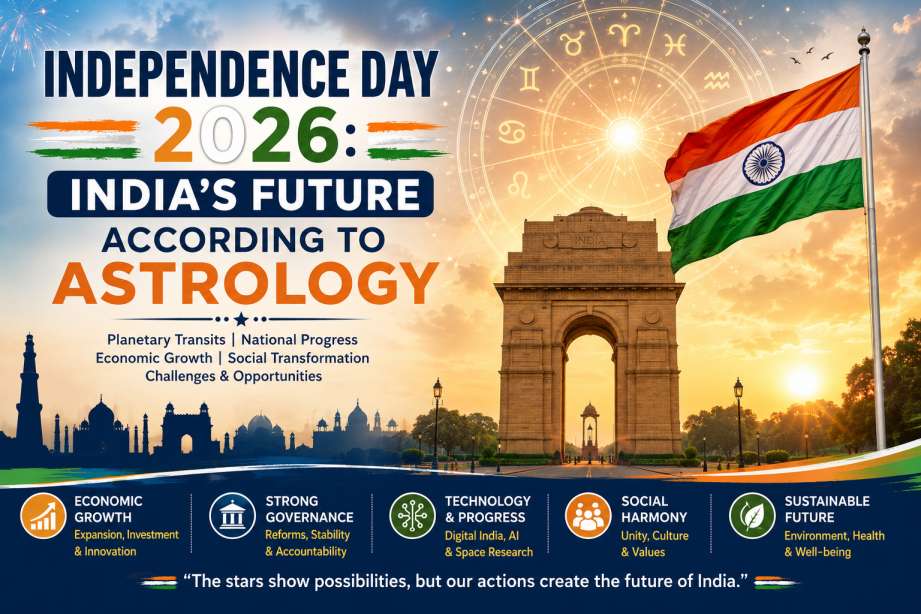
India’s Independence Day on 15 August 2026 marks 79 years since independence and offers an interesting occasion to examine the country’s future through the traditional lens of Vedic astrology. In mundane astrology, nations can be studied through an event chart just as individuals are studied through a birth kundli.
For India, astrologers commonly examine the chart cast for 15 August 1947 at 00:00 IST in New Delhi, the moment associated with independence. Different astrological traditions use different national charts, so interpretations should be viewed as symbolic rather than absolute predictions.
The larger question for Independence Day 2026 is therefore not simply whether India will have a “good” or “bad” year. Instead, astrology can be used to explore themes around economic development, governance, technology, public sentiment, international relations and social transformation.
India’s Independence Chart and Its Astrological Significance
The 1947 Independence chart is widely used in national astrology. One commonly referenced version places the Ascendant around Gemini, with the Sun in Leo and Moon in Cancer; other Vedic calculations may produce different ascendants because even small changes in the assumed time and calculation system can alter house positions.
This is important because a national horoscope is not an objectively established scientific forecasting system. It is a traditional interpretive framework.
From a Jyotish perspective, however, several themes stand out:
- Sun: Leadership, authority, national identity and government.
- Moon: Public sentiment, agriculture, people and collective emotions.
- Mercury: Communication, commerce, education and technology.
- Jupiter: Knowledge, expansion, institutions and economic optimism.
- Saturn: Governance, infrastructure, labour, responsibility and long-term reforms.
- Rahu-Ketu: Disruption, technological change, unconventional developments and ideological shifts.
These planetary significations provide a useful framework for interpreting broader national themes.
Major Planetary Influences on India in 2026
Jupiter: Growth Through Knowledge and Institutions
One of the most significant developments of 2026 is Jupiter’s transit through Cancer. In sidereal Vedic astrology, Jupiter entered Cancer on 2 June 2026, where it is traditionally considered exalted. It remains there until late October 2026.
For India, this can symbolically emphasize:
- Education and skill development
- Family and social welfare
- Agriculture and food-related sectors
- Financial confidence
- Institutional expansion
- Cultural and spiritual interests
Jupiter’s symbolism favours growth, but growth still requires sound policy and execution. Therefore, the period can be interpreted as supportive for knowledge-driven development rather than effortless prosperity.
Saturn: Discipline, Reform and Long-Term Building
Saturn remains in Pisces throughout most of 2026 and turns retrograde in late July.
In mundane astrology, Saturn represents institutions, workers, infrastructure, regulations and accountability. Its influence suggests that India’s progress may increasingly depend on implementation, administrative discipline and sustainable planning.
The message is straightforward: ambitious national goals require patient execution.
Areas such as infrastructure, public administration, employment systems, urban planning and institutional reforms may therefore remain important themes.
Rahu-Ketu: Technology and Changing Public Narratives
For most of 2026, Rahu-Ketu remain on the Aquarius-Leo axis in commonly used Vedic transit calculations.
Aquarius is associated symbolically with networks, technology, mass participation and large systems, while Leo relates to leadership, authority and national identity.
This combination may be interpreted as a period in which India experiences rapid developments in:
- Artificial intelligence and digital technology
- Social-media communication
- Digital governance
- Space and scientific innovation
- Changing political narratives
- Youth participation
At the same time, Rahu symbolism reminds us to distinguish innovation from misinformation. Responsible digital literacy may become increasingly important.
India’s Economy and Career Landscape
Astrologically, 2026 appears more suitable for structured expansion than speculative excess.
Jupiter can support confidence and investment in knowledge-based sectors, while Saturn demands fiscal discipline and long-term planning.
The broader outlook can favour:
- Technology and AI
- Education and research
- Infrastructure
- Digital services
- Manufacturing
- Agriculture-linked innovation
- Financial and professional services
However, astrology should not be treated as a substitute for economic data. Actual GDP growth, inflation, employment, trade and investment will depend on measurable economic conditions and policy decisions.
Leadership and Governance
The Sun remains an important symbol in any national horoscope because it represents authority and leadership.
The interaction of Jupiter’s expansive symbolism with Saturn’s restrictive and disciplined nature suggests a potential theme of balancing ambition with accountability.
For governance, this may translate into greater emphasis on:
- Institutional stability
- Policy implementation
- Administrative efficiency
- Public accountability
- Long-term national planning
Rather than expecting dramatic overnight changes, the astrological symbolism points toward gradual institutional development.
Social and Cultural Trends
Jupiter in Cancer can also bring attention toward heritage, family values, cultural identity and emotional connection with the nation.
Independence Day 2026 may therefore encourage renewed interest in India’s history, traditions and collective identity.
However, the Rahu influence suggests that cultural conversations can become highly amplified through digital platforms. A balanced approach—respecting tradition while encouraging rational discussion—can be especially valuable.
Practical Astrological Remedies for Collective Well-Being
National astrology is not a substitute for civic action, but traditional spiritual practices can be used as symbolic expressions of gratitude and responsibility.
On Independence Day, people may consider:
- Offering Arghya to the Sun at sunrise.
- Chanting “Om Suryaya Namah” 11 times.
- Donating food, books or educational supplies.
- Supporting local cleanliness and environmental initiatives.
- Helping students or underprivileged communities.
- Spending a few minutes in gratitude for India’s freedom and constitutional values.
The most meaningful “remedy” for a nation is ultimately responsible citizenship.
What Could India’s Future Look Like?
From the astrological perspective, 2026 can be viewed as a year of growth accompanied by responsibility.
Jupiter offers the symbolism of expansion, learning and confidence, while Saturn emphasizes discipline, patience and institutional maturity. Rahu-Ketu add an element of technological disruption and changing collective narratives.
The combination suggests that India’s future strength may depend increasingly on its ability to combine:
- Innovation with ethics
- Economic growth with inclusion
- Technology with accountability
- Tradition with modernisation
- National ambition with institutional discipline
Astrology cannot guarantee specific political, economic or geopolitical events. It is better understood here as a cultural and symbolic framework for reflection.
Conclusion
Independence Day 2026 can be seen astrologically as a moment to reflect on India’s continuing transformation. The country’s Independence chart, when interpreted alongside major 2026 planetary transits, highlights themes of growth, institutional responsibility, technology, education and collective identity.
Jupiter’s strong position in Cancer provides an optimistic symbolic backdrop for knowledge, welfare and national development, while Saturn reminds India that sustainable progress requires patience and disciplined implementation. Rahu-Ketu further underline the importance of technology, information and changing social narratives.
The most constructive takeaway is not to predict a fixed destiny but to recognise opportunities and challenges. India’s future will ultimately be shaped by its people, institutions, policies and collective choices.
Astrology may suggest themes, but responsible action creates outcomes.
FAQs
1. What does astrology say about India’s future in 2026?
Astrologically, 2026 highlights growth, institutional responsibility, technology and social transformation for India.
Jupiter’s transit through Cancer is traditionally associated with expansion, knowledge and welfare, while Saturn in Pisces represents discipline and long-term restructuring.
Related practices:
- Offer Arghya to the Sun.
- Support education and community welfare.
- Practise responsible digital communication.
2. Which planetary transit is most important for India in 2026?
Jupiter’s transit through Cancer is one of the major astrological influences of 2026, particularly because Jupiter is traditionally considered exalted in Cancer.
This symbolism can be associated with education, social welfare, financial confidence, cultural values and institutional development.
Key takeaway: Growth is most constructive when combined with planning and accountability.
3. Will India’s economy grow according to astrology?
Astrology can symbolically indicate an environment supportive of growth, but it cannot reliably determine actual economic performance.
Jupiter may represent expansion and opportunity, while Saturn highlights fiscal discipline and sustainable development. Real economic outcomes depend on policy, global conditions, investment, productivity and other measurable factors.
Practical approach: Use economic data alongside any astrological interpretation.
4. What does Saturn indicate for India in 2026?
Saturn symbolically emphasizes discipline, infrastructure, institutions, labour and long-term reforms.
Because Saturn remains in Pisces during 2026 and turns retrograde in July, traditional astrologers may interpret the period as one requiring review, patience and careful implementation.
Useful lesson: Sustainable progress usually comes through consistent execution rather than quick results.
5. How can Indians observe Independence Day astrologically?
Independence Day can be observed through simple spiritual and civic practices rather than superstition.
Offering water to the rising Sun, chanting “Om Suryaya Namah”, donating educational materials and contributing to community welfare can provide meaningful ways to connect traditional symbolism with modern citizenship.
Simple Independence Day remedies:
- Perform Surya Arghya at sunrise.
- Practise gratitude.
- Help someone in need.
- Support education.
- Avoid spreading misinformation.
6. Is India’s Independence chart scientifically proven?
No; a national horoscope belongs to the traditional practice of astrology and should not be presented as a scientifically validated forecasting method.
The commonly used chart is based on India’s independence at midnight on 15 August 1947 in New Delhi, but astrologers use different calculation approaches and reference charts.