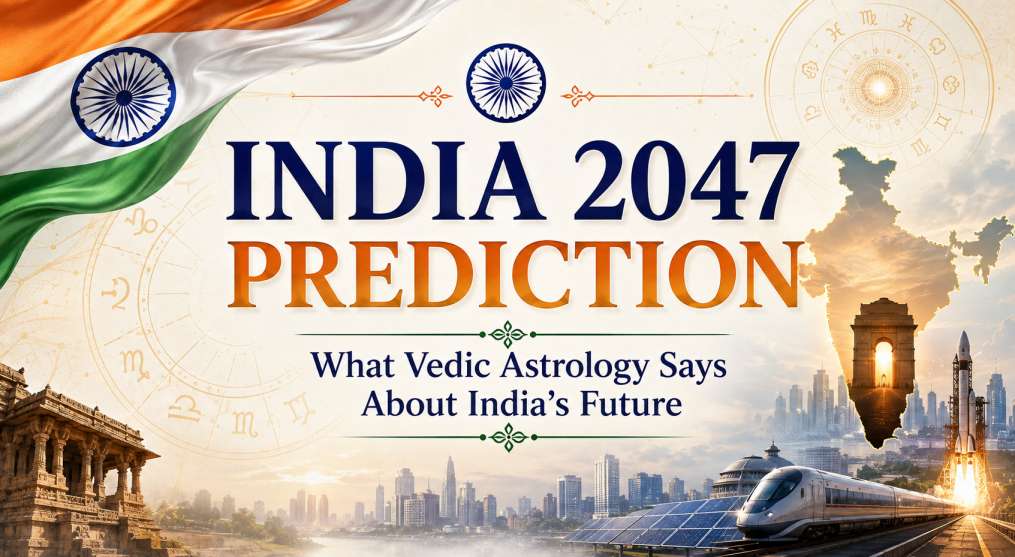
India 2047 marks a historic milestone: 100 years since Independence. As India moves toward its centenary, questions about economic development, technology, global influence, social stability and cultural identity naturally become more important. Vedic astrology offers a symbolic framework through Mundane Astrology (Mundane Jyotish) to study the broader cycles affecting nations.
For this analysis, astrologers may refer to India’s Independence chart of 15 August 1947, along with major planetary transits and long-term cycles. The chart is not a scientific forecasting model, and astrology cannot guarantee specific political, economic or geopolitical outcomes. Instead, it can be used as a traditional interpretive system for understanding themes such as national leadership, institutions, public sentiment, prosperity, international relations and periods of transformation.
India’s journey toward 2047 can therefore be viewed as a combination of astrological symbolism, historical patterns and practical national priorities.
India’s Independence Chart and the 2047 Question
Why the 1947 Chart Matters
In Mundane Jyotish, a nation’s birth or independence chart can be treated symbolically as the foundation chart of its modern political identity. India’s Independence chart is therefore frequently used by astrologers to examine national developments.
Important areas include:
- 1st house: National identity, general condition and public image
- 2nd house: National wealth, treasury and resources
- 4th house: Land, agriculture, infrastructure and domestic stability
- 6th house: Employment, health systems and internal challenges
- 7th house: Foreign relations and international partnerships
- 10th house: Government, leadership and national authority
- 11th house: Gains, economic networks and collective achievements
For an India 2047 prediction, these houses are studied alongside planetary periods and major transits rather than interpreted independently.
Planetary Influences on India’s Future
Jupiter: Expansion and Knowledge
Jupiter traditionally represents wisdom, education, law, prosperity, teachers and institutional growth. Strong Jupiter periods can symbolically support India’s expansion in education, research, finance, diplomacy and knowledge-based industries.
By 2047, India’s ability to convert its young population into a highly skilled workforce could become especially important. From an astrological perspective, Jupiter-related themes favour investment in knowledge, ethical leadership and long-term institutions.
Saturn: Infrastructure, Discipline and Responsibility
Saturn represents labour, masses, infrastructure, systems, discipline and long-term responsibility. Its influence is rarely associated with instant results; instead, it points toward gradual development through structure and persistence.
For India’s 2047 journey, Saturn symbolism can be connected with:
- Infrastructure development
- Manufacturing and employment
- Urban planning
- Institutional reforms
- Social responsibility
- Long-term environmental management
The broader message is that sustainable progress requires strong systems rather than short-term achievements.
Rahu and Ketu: Technology and Transformation
Rahu is traditionally associated with unconventional ideas, foreign influences, technology, ambition and rapid change, while Ketu represents detachment, research, spirituality and disruption.
Their symbolism is particularly relevant to a future shaped by artificial intelligence, automation, space technology, digital finance, cybersecurity and changing global alliances.
However, Rahu can also symbolically represent misinformation, excessive materialism and unrealistic expectations. Therefore, technological progress must be accompanied by ethics, regulation and digital literacy.
India 2047 Prediction: Major Areas to Watch
Economy and Employment
India’s future prosperity will depend not only on GDP growth but also on employment quality, productivity, entrepreneurship and equitable access to opportunity.
Astrologically, Jupiter and Saturn themes together suggest a useful principle: expansion must be supported by strong institutions.
Technology and Innovation
India’s growing technology ecosystem may become one of the defining features of the country’s centenary period. Rahu-type symbolism supports experimentation and technological disruption, while Mercury represents communication, commerce, data and analytical intelligence.
The practical priority should be responsible innovation rather than technology for its own sake.
Global Position
The 7th and 10th houses are particularly relevant when astrologers examine foreign relations, diplomacy and national authority.
India’s international role by 2047 may increasingly depend on its ability to balance strategic autonomy with international partnerships. Astrologically, this can be viewed through the interaction of expansion-oriented Jupiter themes and Saturn’s emphasis on responsibility.
Society and Cultural Identity
The 4th house represents homeland, domestic happiness, land and collective foundations. India’s future development will therefore also depend on maintaining social cohesion while adapting to urbanisation, demographic changes and technological transformation.
Traditional astrology can offer reflection here, but real-world outcomes will ultimately depend on education, governance, economic policy and civic participation.
What Could Be India’s Biggest Challenge?
Astrological symbolism suggests that rapid growth can create its own pressures.
Potential areas requiring attention include:
- Economic inequality
- Employment and skill development
- Environmental sustainability
- Urban infrastructure
- Social polarisation
- Cybersecurity and misinformation
- Water and resource management
- Balancing tradition with technological change
These are not predetermined events. They are practical areas where preparation can make a meaningful difference.
Vedic Astrology Remedies for National Prosperity
Astrological remedies should be understood as spiritual and cultural practices, not substitutes for public policy or evidence-based solutions.
Individuals who wish to contribute positively to India’s future can adopt simple practices:
- Chant “Om Brihaspataye Namah” on Thursdays as a Jupiter-oriented spiritual practice.
- Respect teachers, knowledge and education.
- Support education or skill development initiatives.
- Practise disciplined financial planning, reflecting Saturn’s principle of responsibility.
- Avoid spreading unverified information online.
- Plant and protect trees as a practical expression of respect for nature.
- Donate food or educational materials to people who need them.
- Observe national occasions with reflection on civic responsibility.
The most meaningful “remedy” for a nation’s future is ultimately responsible action by its citizens and institutions.
Conclusion
The India 2047 prediction through Vedic astrology should be understood as a symbolic interpretation rather than a fixed prophecy. India’s Independence chart, planetary cycles and Mundane Jyotish principles can provide themes around growth, institutional responsibility, technological transformation, diplomacy and social change.
Jupiter points toward knowledge and expansion, Saturn toward discipline and durable systems, while Rahu-Ketu symbolism highlights technological disruption and transformation. Yet astrology alone cannot determine India’s destiny.
The real India 2047 story will be shaped by education, innovation, governance, infrastructure, environmental responsibility and the choices made by millions of citizens. Astrology can encourage reflection—but preparation and action remain the strongest tools for building the future.
FAQs
1. Can Vedic astrology predict India’s future in 2047?
Vedic astrology can offer symbolic interpretations of India’s future but cannot guarantee specific events or outcomes.
Astrologers may study India’s Independence chart, planetary periods and major transits to identify broader themes involving governance, economy, foreign relations and social change. These interpretations should be treated as traditional astrological analysis rather than scientific forecasts.
Key takeaway:
- Astrology suggests themes, not certainty.
- Real-world decisions remain decisive.
- Historical and economic evidence should complement astrological interpretation.
2. Which chart is used for India 2047 predictions?
Many astrologers use India’s Independence chart dated 15 August 1947 as a reference point for national astrology.
Different astrologers may use different birth times or chart conventions, which can produce variations in interpretation. Therefore, there is no single universally accepted astrological chart that can provide an unquestionable India 2047 forecast.
For responsible analysis:
- State the chart and birth time being used.
- Consider planetary periods and transits.
- Compare astrological themes with historical developments.
3. Which planets are important for India’s future?
Jupiter, Saturn, Rahu, Ketu and Mercury can be particularly meaningful when discussing themes such as growth, institutions, technology and communication.
Jupiter represents expansion and knowledge, Saturn represents systems and responsibility, while Rahu and Ketu are associated symbolically with disruption, unconventional developments and transformation. Mercury can relate to commerce, communication and information.
Practical interpretation:
- Jupiter → education and expansion
- Saturn → infrastructure and institutions
- Mercury → technology and commerce
- Rahu → innovation and disruption
- Ketu → research and transformation
4. What does Saturn indicate for India by 2047?
Saturn symbolically highlights the importance of discipline, infrastructure, employment, institutions and sustainable long-term development.
Saturn is traditionally associated with slow but durable results. For India’s centenary vision, this symbolism supports patience, administrative efficiency, infrastructure investment and responsible use of resources.
Saturn-oriented principles include:
- Consistency over shortcuts
- Strong institutions
- Respect for workers
- Long-term planning
- Responsible resource management
5. Does Rahu indicate India’s technological growth?
Rahu can symbolically represent technology, unconventional innovation, foreign connections and rapid transformation, making it relevant to discussions about India’s digital future.
However, Rahu is also traditionally associated with confusion and illusion. Therefore, rapid technological expansion should be accompanied by cybersecurity, ethical AI practices, digital literacy and reliable information systems.
Useful approach:
- Encourage innovation.
- Verify information before sharing it.
- Develop responsible AI systems.
- Strengthen cybersecurity awareness.
6. What can individuals do for India’s prosperity according to astrology?
The most constructive approach is to combine spiritual practices with responsible citizenship and practical contribution.
Traditional remedies may include mantra chanting, charity, respect for teachers and service to society. These practices can be meaningful when they encourage discipline, compassion and ethical conduct rather than fear.
Simple practices:
- Support education.
- Help people in need.
- Protect nature.
- Follow financial discipline.
- Avoid misinformation.
- Participate responsibly in civic life.
7. Will India become a global power by 2047 according to astrology?
Astrology may indicate themes of growth and increasing influence, but becoming a global power depends on economic, technological, diplomatic and social factors.
A national horoscope cannot independently establish a geopolitical outcome. India’s future influence will depend on productivity, human capital, innovation, institutions, international relationships and its ability to manage internal challenges.
The broader lesson: India’s 2047 potential is best understood as an opportunity that requires sustained effort rather than a predetermined astrological promise.