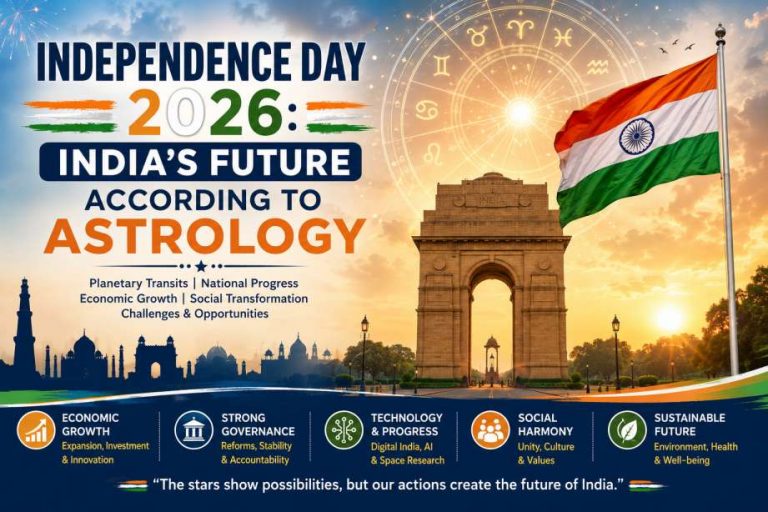
India Independence Day 2026 marks 79 years of independence and offers an interesting opportunity to examine the nation through the lens of Vedic astrology. In mundane astrology, a country can be studied through a national horoscope based on a significant founding event. For modern India, astrologers commonly use 15 August 1947, 00:00 IST, New Delhi, the moment associated with independence. This chart is generally interpreted with Taurus (Vrishabha) Lagna and Cancer (Karka) Moon, although different traditions may use slightly different birth times or chart frameworks.
Astrology cannot scientifically guarantee political, economic, or social outcomes. However, within the traditional Jyotish framework, planetary cycles are used symbolically to examine themes such as governance, economic development, public sentiment, diplomacy, infrastructure, and national stability. For 2026, the emphasis is on balancing growth with discipline and long-term planning.
India’s Independence Chart: Key Astrological Foundation
Taurus Lagna and National Stability
The commonly used Vedic Independence chart gives India Taurus Lagna, a fixed earth sign ruled by Venus. Taurus is traditionally associated with stability, resources, agriculture, material development, values, and gradual growth.
This symbolism is particularly relevant when examining India’s long-term economic and infrastructural journey. A Taurus national chart suggests that sustainable progress may be more important than short-lived expansion.
The chart is also traditionally associated with Rahu in the ascendant, which can indicate periods of rapid transformation, unconventional development, technological change, and shifts in national identity.
Cancer Moon and Public Sentiment
The Moon is associated with the public, collective emotions, domestic matters, and popular sentiment. India’s commonly referenced Independence chart places the Moon in Cancer, a sign traditionally ruled by the Moon itself.
For 2026, this symbolism highlights the importance of:
- Public confidence and social cohesion
- Food, agriculture, water, and housing
- Emotional responses to political developments
- Family and community values
- Domestic economic conditions
This suggests that national leadership may need to pay particular attention to public perception alongside economic indicators.
India Independence Day 2026: Major Astrological Themes
Economic Growth and Infrastructure
The Taurus influence supports a practical approach toward wealth creation, infrastructure, manufacturing, agriculture, and financial stability.
For 2026, the broader astrological interpretation favours long-term investment over impulsive expansion. Infrastructure, digital systems, transportation, energy, manufacturing, and technology can remain important areas of national development.
The strongest results are likely to come when innovation is combined with financial discipline.
Technology and Innovation
Rahu’s traditional association with unconventional technology, foreign connections, mass communication, and sudden developments makes technological transformation an important theme.
India’s progress in artificial intelligence, digital infrastructure, space technology, telecommunications, cybersecurity, and emerging industries can therefore be viewed as particularly significant from an astrological perspective.
However, Rahu also symbolises confusion and excess. The practical lesson is to balance technological ambition with regulation, transparency, and responsible implementation.
Foreign Relations and Global Position
National astrology also considers houses connected with diplomacy, alliances, foreign countries, trade, and international competition.
India’s 2026 outlook can be interpreted as one where global partnerships and strategic autonomy need to coexist. Trade relationships, technology partnerships, defence cooperation, and India’s role in international institutions may remain important.
Astrologically, the lesson is not simply expansion but careful negotiation—building relationships without compromising long-term national interests.
Social Stability and Governance
India’s Cancer Moon symbolism makes public sentiment an important factor in national astrology. Political decisions that directly affect households, employment, agriculture, education, and living costs may have a stronger emotional impact on society.
In 2026, constructive governance can benefit from:
- Clear communication with citizens
- Greater attention to rural and urban needs
- Balanced economic policies
- Stronger institutional transparency
- Investment in education and skill development
Astrology should not be used to declare that a particular political party or leader will definitely succeed. National outcomes depend on institutions, public policy, economic conditions, international events, and decisions made by people.
Practical Vedic Remedies for National Well-Being
Traditional Jyotish recommends remedies as spiritual or cultural practices rather than guaranteed mechanisms for changing events.
For citizens wishing to observe Independence Day 2026 with a positive spiritual intention, simple practices include:
- Offer water to the Surya at sunrise on 15 August.
- Recite “Om Suryaya Namah” with a calm and respectful mindset.
- Donate food, books, or educational materials to those in need.
- Plant or care for a tree as a symbolic act of service to the nation.
- Visit a temple or place of worship according to personal tradition.
- Spend a few moments praying for peace, prosperity, and social harmony.
The most meaningful remedy is constructive action: responsible citizenship, helping others, respecting the environment, and contributing positively to society.
What Could India’s Future Look Like?
From a traditional astrological perspective, 2026 can be viewed as a period of consolidation combined with transformation. India’s growth story may increasingly depend on how effectively it manages technology, infrastructure, human resources, environmental pressures, and international relationships.
The Taurus foundation favours stability and tangible development, while Rahu adds an element of disruption and experimentation. The combination suggests that India may continue moving toward a more technology-driven and globally influential economy, provided growth remains inclusive and institutions remain resilient.
These are symbolic astrological interpretations rather than fixed predictions.
Conclusion
India Independence Day 2026 provides a meaningful occasion to reflect on the country’s journey through the traditional framework of Vedic astrology. The commonly used Independence chart, based on 15 August 1947 at 00:00 IST in New Delhi, highlights Taurus Lagna, a Cancer Moon, and strong themes of stability, public sentiment, transformation, and national development.
Astrologically, India’s future appears most constructive when stability and innovation work together. Economic development, technological progress, responsible governance, social harmony, and international cooperation can become important pillars of the coming years.
Ultimately, astrology offers a framework for reflection—not certainty. The nation’s future will be shaped not only by planetary symbolism but also by the choices, institutions, and collective efforts of its people.
FAQs
1. What is India’s Independence Day birth chart?
India’s commonly used Independence chart is calculated for 15 August 1947 at 00:00 IST in New Delhi.
This chart represents the emergence of modern India as an independent political entity. Astro-Databank records the same date, midnight time, Delhi location, and IST timezone for the Independence chart.
Related insight:
- Commonly interpreted with Taurus Lagna
- Cancer Moon is an important feature
- The chart is used in mundane or national astrology
2. What does Taurus Lagna mean for India?
Taurus Lagna traditionally represents stability, material resources, economic development, and gradual long-term growth.
Because Taurus is a fixed earth sign, astrologers often associate this national chart with India’s emphasis on infrastructure, agriculture, finance, resources, and sustainable development.
Traditional focus: Stability, wealth creation, land, resources, institutions, and long-term planning.
3. What does Rahu in India’s ascendant indicate?
Rahu in the ascendant is traditionally interpreted as a symbol of transformation, unconventional development, technology, and changing national identity.
It can correspond symbolically with rapid technological advancement and greater international visibility. At the same time, Rahu is traditionally associated with confusion and excess, making transparency and responsible innovation important.
Practical lesson: Embrace innovation while maintaining regulation, accountability, and institutional stability.
4. What does the Cancer Moon signify for India?
The Cancer Moon is traditionally associated with public emotions, domestic concerns, cultural identity, food, family, and collective sentiment.
Because the Moon represents the public in mundane astrology, this placement can make public confidence and social welfare important themes when interpreting India’s national horoscope.
Important areas: Agriculture, food security, housing, family welfare, social harmony, and public opinion.
5. Can Vedic astrology accurately predict India’s future?
Vedic astrology can offer a traditional interpretive framework, but it cannot guarantee specific political, economic, or social events.
National predictions depend on the chart selected, birth time, ayanamsa, planetary periods, transits, and the astrologer’s methodology. Real-world events are also shaped by human decisions, institutions, economics, technology, and international circumstances.
Best approach: Treat astrological predictions as reflective guidance rather than certain forecasts.
6. What can people do on Independence Day 2026 according to Vedic astrology?
Surya worship, charity, prayer, environmental service, and constructive civic action are suitable traditional practices.
Offering water to the Sun at sunrise and reciting “Om Suryaya Namah” can be observed as a simple spiritual practice. Charity and service can add a practical dimension to the celebration.
Simple remedies:
- Offer water to Surya at sunrise.
- Recite “Om Suryaya Namah.”
- Donate food or educational materials.
- Plant or protect a tree.
- Pray for national peace and prosperity.