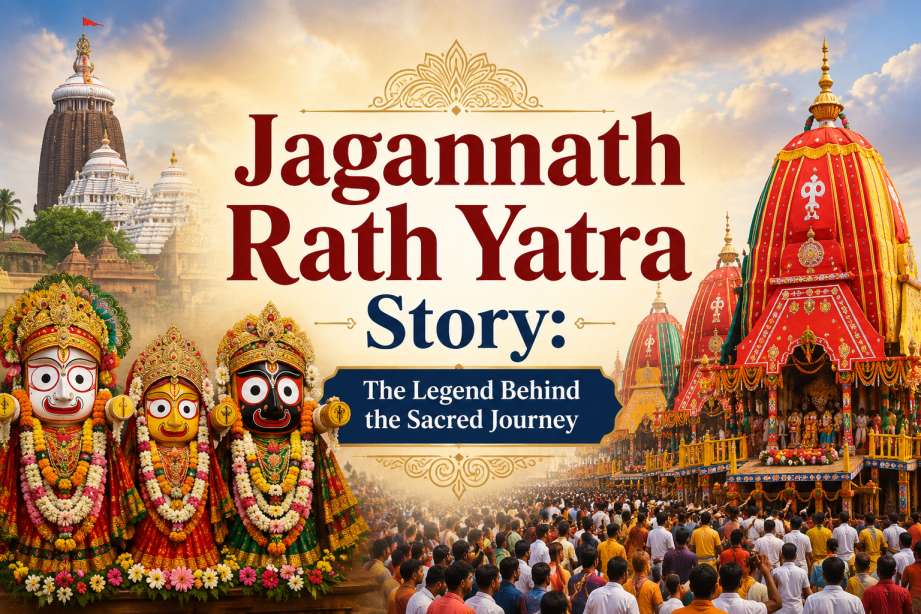
The Jagannath Rath Yatra is one of India’s most revered Hindu festivals, celebrated annually with immense devotion in Puri, Odisha. The festival marks the ceremonial journey of Lord Jagannath, along with his siblings Lord Balabhadra and Devi Subhadra, from the Jagannath Temple to the Gundicha Temple in beautifully decorated wooden chariots.
Beyond its grand processions, the Jagannath Rath Yatra story carries profound spiritual symbolism rooted in Hindu scriptures and regional traditions. In Vedic philosophy, the chariot represents the human body, while the Lord symbolizes the Supreme Consciousness guiding every soul toward liberation. Astrologically, the festival is believed to be a favorable period for seeking divine blessings, reducing karmic burdens, and strengthening spiritual growth. Since the festival date varies each year according to the Hindu lunar calendar, all observances are followed in IST (Indian Standard Time).
The Jagannath Rath Yatra Story
The Legend of Lord Jagannath’s Journey
The most widely accepted legend states that Lord Jagannath, considered a form of Lord Krishna, travels annually with his elder brother Balabhadra and sister Subhadra to visit the Gundicha Temple, believed to be the home of their maternal aunt.
According to tradition:
- Lord Jagannath expresses the desire to meet all devotees, regardless of caste, community, or social status.
- Since many people could not enter the temple in ancient times, the Lord himself comes out to bless everyone equally.
- The divine siblings travel on magnificent wooden chariots through the streets of Puri.
- After staying at Gundicha Temple for several days, they return to the Jagannath Temple during the Bahuda Yatra.
This journey symbolizes divine compassion, accessibility, and the universal nature of devotion.
The Krishna Connection
Many Vaishnava traditions associate Rath Yatra with the emotional episode from Lord Krishna’s life.
According to devotional literature:
- After leaving Vrindavan for Mathura, Krishna remained separated from Radha and the Gopis.
- The annual chariot journey is viewed as Krishna’s symbolic return to his beloved devotees.
- It represents reunion, unconditional love, and spiritual longing.
This interpretation is especially popular in Gaudiya Vaishnavism and emphasizes devotion (Bhakti) as the highest spiritual path.
Why Are the Deities Made of Wood?
Unlike most temple idols carved from stone or metal, Lord Jagannath’s idols are made of sacred neem wood.
This unique tradition reflects:
- The temporary nature of the physical body.
- The eternal existence of the soul.
- Continuous renewal through the sacred ritual known as Nabakalebara, performed in specific years when the idols are ceremonially replaced.
The philosophy closely aligns with the teachings of the Bhagavad Gita, where Lord Krishna explains:
वासांसि जीर्णानि यथा विहाय
नवानि गृह्णाति नरोऽपराणि।
Meaning: Just as a person changes old garments for new ones, the soul leaves an old body and accepts another.
This verse beautifully reflects the deeper symbolism behind Lord Jagannath’s wooden form.
Spiritual Symbolism of Rath Yatra
The festival carries multiple layers of spiritual meaning.
The Chariot Represents the Human Body
In many Upanishadic interpretations:
- The body is compared to a chariot.
- The mind acts as the reins.
- The senses are the horses.
- The soul is the passenger.
- God is the ultimate guide.
This symbolism encourages individuals to maintain control over desires while moving toward spiritual wisdom.
Equality Before the Divine
One of Rath Yatra’s greatest messages is inclusiveness.
Everyone can:
- Pull the chariot ropes.
- Offer prayers.
- Seek blessings.
- Participate without distinction.
This reflects the universal teaching that divine grace is available to all sincere devotees.
Astrological Significance of Jagannath Rath Yatra
Although Rath Yatra is primarily a religious festival, Vedic astrology associates it with favorable spiritual energies.
Planetary Associations
Sun (Surya)
Represents:
- Divine authority
- Dharma
- Leadership
- Spiritual confidence
Offering prayers during Rath Yatra is traditionally believed to strengthen one’s sense of purpose.
Moon (Chandra)
Associated with:
- Emotional peace
- Devotion
- Inner stability
Devotional activities during the festival may help cultivate emotional balance.
Jupiter (Guru)
Jupiter governs:
- Wisdom
- Faith
- Higher learning
- Spiritual guidance
Many astrologers consider this period auspicious for beginning spiritual practices or scriptural study.
Zodiac Signs That May Benefit Spiritually
While the blessings of Lord Jagannath are believed to be universal, these signs may particularly focus on spiritual reflection:
- Aries – Develop patience and discipline.
- Cancer – Strengthen emotional resilience.
- Leo – Balance leadership with humility.
- Sagittarius – Deepen philosophical understanding.
- Pisces – Enhance meditation and devotion.
These insights are general Vedic astrological interpretations rather than guaranteed predictions.
Simple Remedies During Rath Yatra
The festival encourages acts of devotion rather than elaborate rituals.
Easy spiritual practices include:
- Chant “Om Namo Bhagavate Vasudevaya” 108 times.
- Read portions of the Bhagavad Gita.
- Offer seasonal fruits and flowers.
- Donate food to those in need.
- Practice gratitude and forgiveness.
- Participate in devotional singing (bhajans).
- Light a ghee lamp in the evening.
These practices emphasize inner transformation over ritual complexity.
Lessons We Can Learn Today
The Jagannath Rath Yatra remains highly relevant in modern life.
Its timeless lessons include:
- Humility over pride.
- Service before selfishness.
- Unity beyond social differences.
- Faith during uncertainty.
- Movement toward continuous self-improvement.
Just as the divine chariot moves forward every year, individuals are encouraged to keep progressing spiritually despite life’s obstacles.
Conclusion
The Jagannath Rath Yatra story is much more than a historical legend. It beautifully combines devotion, philosophy, symbolism, and timeless values that continue to inspire millions across India and beyond. Lord Jagannath’s annual journey reminds devotees that the Divine reaches out to everyone with compassion and acceptance.
From an astrological perspective, the festival offers an opportunity to strengthen faith, perform charitable acts, and cultivate inner peace. Rather than focusing on miraculous outcomes, the true essence of Rath Yatra lies in personal transformation, humility, and sincere devotion. Reflect on the deeper message of the sacred journey and allow it to inspire positive changes in your own spiritual path.
FAQs
1. What is the story behind Jagannath Rath Yatra?
The Jagannath Rath Yatra commemorates Lord Jagannath’s annual journey to the Gundicha Temple with Lord Balabhadra and Devi Subhadra.
According to traditional beliefs, this sacred journey symbolizes the Lord visiting devotees outside the temple, making divine blessings accessible to everyone regardless of social background. It also reflects themes of compassion, equality, and devotion.
Related tips:
- Read the Bhagavad Gita during the festival.
- Offer prayers with sincerity.
- Participate in charitable activities.
2. Why is Rath Yatra considered spiritually important?
Rath Yatra symbolizes the soul’s journey toward spiritual awakening and divine grace.
The moving chariot represents life’s continuous progress, while Lord Jagannath’s presence signifies divine guidance throughout one’s spiritual path. The festival encourages humility, devotion, and self-reflection.
Helpful practices:
- Chant Vishnu mantras.
- Spend time in meditation.
- Perform acts of kindness.
3. What is the astrological significance of Jagannath Rath Yatra?
The festival is traditionally regarded as an auspicious period for spiritual growth and positive karmic actions.
Many Vedic astrologers associate the observance with strengthening qualities linked to the Sun, Moon, and Jupiter, such as wisdom, emotional balance, and righteous conduct. These associations are interpretative rather than predictive.
Suggested remedies:
- Donate food or clothing.
- Light a ghee lamp.
- Recite “Om Namo Bhagavate Vasudevaya.”
4. Why are Lord Jagannath’s idols made of wood?
The wooden idols symbolize the impermanence of the physical body and the eternity of the soul.
This tradition aligns with Vedic teachings on rebirth and renewal. During the sacred Nabakalebara ceremony, held in specific years, the deities are ceremonially renewed, reflecting the cycle of life while preserving the eternal divine essence.
Key takeaways:
- Reflect on spiritual growth over material attachment.
- Study verses from the Bhagavad Gita.
- Practice detachment with compassion.
5. Can anyone participate in Jagannath Rath Yatra?
Yes, the festival is traditionally open to all devotees, emphasizing inclusiveness and equality.
One of the defining features of Rath Yatra is that the deities come out of the temple to bless everyone. Pulling the chariot ropes, offering prayers, and participating in devotional singing are considered meaningful acts of devotion for people from all walks of life.
Ways to participate:
- Join local Rath Yatra celebrations.
- Offer prayers with a pure heart.
- Engage in community service or food donation.