Introduction
Kundli matching for marriage, also known as Guna Milan or Ashtakoota Milan, is a traditional Vedic astrology method used to assess compatibility between two people before marriage. It compares important birth-chart factors, particularly the Moon signs and Nakshatras of the prospective bride and groom.
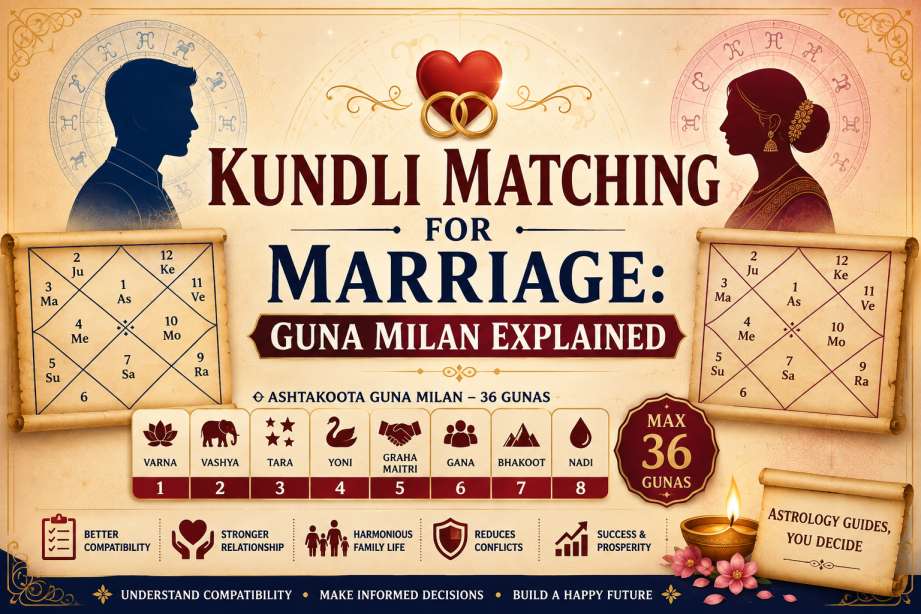
The most commonly used system assigns a maximum of 36 Gunas across eight compatibility factors, known as Ashtakoota. These include emotional compatibility, temperament, mutual understanding, health-related traditional indicators and family-related considerations.
However, Guna Milan should not be treated as a simple pass-or-fail test. A meaningful marriage analysis also considers the 7th house, 7th lord, Venus, Jupiter, Navamsa chart, planetary aspects, Dashas and Manglik considerations. The goal is to understand the overall relationship potential rather than rely on one score.
What Is Guna Milan in Kundli Matching?
Guna Milan is a traditional compatibility assessment based primarily on the Janma Nakshatra and Moon sign of two individuals.
The Ashtakoota system contains eight Kootas with a combined maximum of 36 points:
| Koota | Maximum Points | Traditional Focus |
| Varna | 1 | Values and spiritual compatibility |
| Vashya | 2 | Mutual influence and attraction |
| Tara | 3 | Birth-star compatibility |
| Yoni | 4 | Intimacy and instinctive compatibility |
| Graha Maitri | 5 | Mental and intellectual friendship |
| Gana | 6 | Temperament and nature |
| Bhakoot | 7 | Emotional and family compatibility |
| Nadi | 8 | Traditional health and progeny considerations |
| Total | 36 |
This framework is rooted in classical Jyotisha traditions, while exact calculation practices can vary among astrologers and regional traditions.
How the 36 Guna Score Is Interpreted
A commonly used traditional guideline is:
- 18 or more: Generally considered acceptable for further evaluation.
- 18–24: Moderate compatibility.
- 25–32: Generally favourable compatibility.
- 33–36: High Guna compatibility.
These ranges are guidelines, not guarantees.
A couple scoring 30 Gunas may still experience difficulties if important marriage-related factors in both charts are challenging. Similarly, a score below 18 should not automatically be considered a reason to reject a relationship without examining the complete charts.
Why the Score Alone Is Not Enough
Marriage is influenced by personality, communication, financial expectations, family environment, emotional maturity and shared values. Astrology can provide a traditional framework for examining some of these themes, but it cannot replace informed personal decisions.
The Eight Kootas Explained
1. Varna Koota
Varna carries 1 point and is traditionally associated with values, outlook and spiritual compatibility.
It has relatively low weight in the overall score, so it should not be given disproportionate importance.
2. Vashya Koota
Vashya carries 2 points and relates traditionally to mutual attraction, influence and interpersonal dynamics.
It can provide an indication of how naturally two individuals may respond to one another.
3. Tara Koota
Tara contributes 3 points and is calculated using the Nakshatras.
Traditionally, it is associated with wellbeing, fortune and supportive life circumstances within the relationship.
4. Yoni Koota
Yoni carries 4 points and is traditionally connected with instinctive compatibility, attraction and intimate nature.
It is one of the factors considered when assessing personal chemistry.
5. Graha Maitri
Graha Maitri contributes 5 points and focuses on the friendship between the planetary lords of the couple’s Moon signs.
It is commonly associated with mental compatibility, communication and mutual understanding.
6. Gana Koota
Gana carries 6 points and classifies Nakshatras into three broad categories: Deva, Manushya and Rakshasa.
These categories are traditionally interpreted in relation to temperament and behavioural tendencies. The terms should not be understood as moral labels; they describe different symbolic personality patterns.
7. Bhakoot Koota
Bhakoot contributes 7 points and examines the relationship between the Moon signs.
Certain Moon-sign combinations are traditionally associated with Bhakoot Dosha, which some astrologers consider relevant to emotional harmony, family life and financial stability.
However, cancellation or mitigation factors should also be examined rather than judging the combination in isolation.
8. Nadi Koota
Nadi carries the highest weight of 8 points.
The traditional system divides Nakshatras into Adi, Madhya and Antya Nadi. When both individuals have the same Nadi, it may result in what is commonly called Nadi Dosha.
Nadi considerations have traditionally been associated with health and progeny-related compatibility. However, Nadi Dosha should not be interpreted as a medical diagnosis or as a certainty regarding fertility or children.
Experienced astrologers generally examine cancellation factors and the broader birth charts before drawing conclusions.
Why Manglik Dosha Should Be Checked Separately
Manglik Dosha, also called Mangal Dosha, is not one of the eight Ashtakoota factors.
It is assessed through the placement of Mars in particular houses of the horoscope. Different traditions use somewhat different rules for calculating and interpreting it.
A proper marriage analysis should therefore consider:
- Mars placement in both charts
- Ascendant and Moon-based considerations
- Strength and dignity of Mars
- Beneficial planetary aspects
- Cancellation or mitigation factors
- The overall 7th-house condition
Simply declaring someone “Manglik” based on one placement can create unnecessary fear.
Other Factors in Complete Kundli Matching
Guna Milan is only one layer of compatibility analysis. A detailed Vedic assessment may also examine:
7th House and 7th Lord
The 7th house represents marriage, spouse and long-term partnerships. Its lord, occupants and planetary aspects can provide important information about relationship dynamics.
Venus and Jupiter
Venus is an important significator for relationships, attraction and marital happiness, while Jupiter has an important traditional role in marriage analysis, particularly in the horoscope of a woman under classical interpretive frameworks.
Modern practitioners often consider both planets in both charts while avoiding overly rigid gender-based assumptions.
Navamsa Chart
The Navamsa (D9) is one of the most important divisional charts used in Vedic astrology for examining marriage and the strength of planets.
It can provide additional context that a basic Guna score cannot show.
Dashas and Transits
The timing of marriage and significant relationship developments can be studied through Mahadasha, Antardasha and planetary transits.
This helps distinguish compatibility from timing. Two people may have good compatibility but experience marriage-related developments during different periods.
What to Do If Guna Milan Shows Dosha
A lower Guna score or a traditional Dosha does not automatically mean that marriage will fail.
Depending on the specific chart, traditional astrologers may consider:
- Cancellation of Nadi or Bhakoot Dosha
- Strength of the 7th house and 7th lord
- Beneficial Jupiter or Venus influences
- Supportive Navamsa placements
- Relevant Dasha periods
- Overall planetary compatibility
Simple Traditional Remedies
Remedies should be understood as devotional and cultural practices, not guaranteed solutions.
Depending on individual beliefs, couples may consider:
- Worship of Lord Shiva and Goddess Parvati
- Regular prayer and meditation together
- Charity and service
- Respectful communication with families
- Recitation of traditional marriage-related mantras
- Seeking personalised guidance before performing elaborate rituals
A commonly recited devotional mantra is:
“ॐ नमः शिवाय” — Om Namah Shivaya
The emphasis should remain on sincere practice, mutual respect and constructive action rather than fear of Doshas.
Conclusion
Kundli matching for marriage can provide a structured traditional approach to understanding compatibility. The 36-point Guna Milan system examines eight areas, with Nadi, Bhakoot, Gana and Graha Maitri receiving relatively greater weight than some other Kootas.
Yet no single score can describe an entire marriage. A responsible analysis should also consider the 7th house, 7th lord, Venus, Jupiter, Navamsa, Mars, Dashas and relevant planetary influences.
Most importantly, astrology should complement—not replace—honest conversations about values, finances, family expectations, career goals, emotional compatibility and future plans. Use Kundli matching as a tool for reflection and understanding, rather than as a source of fear or certainty.
FAQs
1. How many Gunas should match for marriage?
Traditionally, a score of 18 or more out of 36 is often considered a basic acceptable threshold for further evaluation.
However, the total score is only one part of marriage compatibility. A high score does not guarantee a successful marriage, while a lower score does not automatically indicate failure.
The individual Kootas, Doshas, planetary strengths and complete birth charts should be examined together.
Key tip: Never judge marriage compatibility from the Guna score alone.
2. What is Nadi Dosha in Kundli matching?
Nadi Dosha is traditionally considered when both partners belong to the same Nadi category in the Ashtakoota system.
Nadi has the highest weight in Guna Milan, carrying 8 out of 36 points. Traditional astrology associates it with health and progeny-related compatibility, but it should not be treated as a medical or fertility diagnosis.
Various traditional cancellation and exception rules may apply.
What to check:
- Nadi classification
- Nakshatra details
- Cancellation conditions
- Complete horoscope
- Relevant planetary strengths
3. Is 36 Guna matching necessary for a successful marriage?
No, matching all 36 Gunas is not necessary for a successful marriage.
The 36-point system represents a maximum compatibility score, not a requirement. Even within traditional astrology, the overall horoscope is more important than achieving a perfect score.
Communication, trust, shared values and emotional maturity also play major roles in real-life relationships.
Practical advice: Treat Guna Milan as one input in a broader compatibility assessment.
4. Is Manglik Dosha included in Guna Milan?
No, Manglik Dosha is assessed separately from the eight Ashtakoota Gunas.
Guna Milan primarily compares Moon signs and Nakshatras, whereas Manglik analysis focuses on Mars and its placement according to the relevant astrological tradition.
Different schools may use different rules, so a complete chart assessment is preferable to a simplified Manglik label.
Before concluding, check:
- Mars placement
- Ascendant
- Moon
- Relevant cancellation factors
- Both partners’ charts
5. Can Kundli matching predict divorce?
Kundli matching cannot guarantee whether a marriage will succeed or end in divorce.
Traditional astrologers may examine relationship-related houses, planetary influences, Dashas and transits for periods of stress or change. These should be understood as interpretive possibilities rather than certain outcomes.
Real-life relationship quality depends on many factors that no birth-chart score can completely measure.
Best approach: Combine astrological reflection with communication, counselling when needed and practical relationship planning.
6. What if Kundli matching shows fewer than 18 Gunas?
A score below 18 suggests that further analysis is traditionally recommended rather than automatically rejecting the match.
The reason for the lower score matters. A reduced score may result from one or more specific Kootas, while other parts of the charts may provide supportive factors.
An astrologer may examine the 7th house, Navamsa, planetary relationships, Dosha cancellation and Dashas before reaching a conclusion.
Remember: A low score is a reason to investigate more carefully, not a reason to panic.