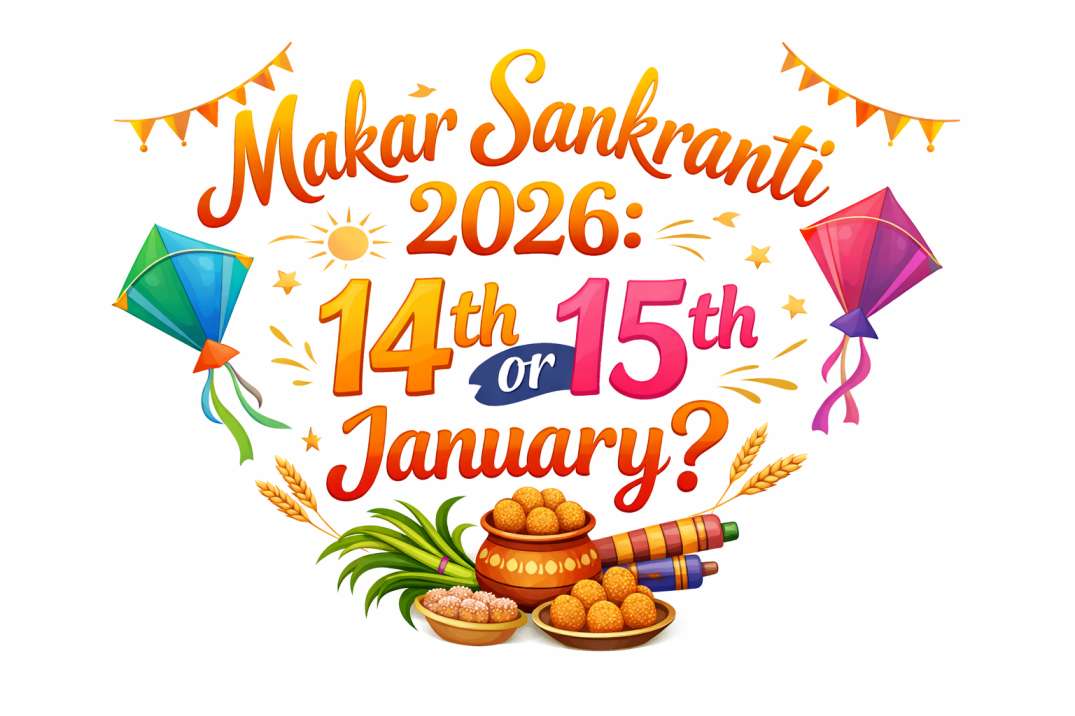
Every year, as January approaches, a familiar question arises in many Indian households: Is Makar Sankranti on 14th or 15th January? In 2026, this confusion appears again, driven by planetary calculations rather than calendar habits. Makar Sankranti is one of the few Hindu festivals based on solar movement, not the Moon, which makes its date astronomically precise but socially confusing.
In Vedic astrology, Makar Sankranti marks the moment when the Sun enters Capricorn (Makara Rashi), beginning the auspicious Uttarayana period. This transition is associated with spiritual progress, seasonal change, and agricultural renewal. Understanding the correct date is important not only for rituals and charity but also for aligning personal practices with cosmic timing.
This article explains the exact Makar Sankranti 2026 date using astrology, traditional logic, and practical relevance without superstition or exaggeration.
What Is Makar Sankranti in Vedic Astrology?
Solar Transition, Not a Lunar Festival
Unlike most Hindu festivals, Makar Sankranti is based on Surya Gochar (Sun’s transit).
- The festival occurs when the Sun moves from Sagittarius (Dhanu) to Capricorn (Makara)
- This marks the start of Uttarayana, the Sun’s northward journey
- It is astrologically associated with discipline, responsibility, and gradual growth
A classical reference often cited is:
उत्तरायणं पुण्यकालः
Uttarayana is considered an auspicious period
This explains why charity, bathing rituals, and spiritual practices are emphasized on Sankranti.
Makar Sankranti 2026: The Exact Date and Time (IST)
When Does the Sun Enter Makara Rashi in 2026?
In 2026, the Sun enters Capricorn (Makara Rashi) on:
- 14 January 2026 at approximately 09:20 PM IST
So, Is Sankranti on 14th or 15th January?
According to traditional Panchang rules:
- If Sankranti occurs after sunset, the festival is observed the next day
- Since the Sun’s transit happens at night on 14 January, Makar Sankranti will be celebrated on 15 January 2026
Final Answer (Astrologically Correct)
- Sankranti Moment (Punya Kaal begins): 14 January 2026, ~09:20 PM IST
- Makar Sankranti Festival Date: 15 January 2026 (Thursday)
Why Many People Still Say “14th January”?
Cultural Habit vs Astronomical Reality
For decades, Makar Sankranti often fell on 14 January, creating a cultural habit. However, due to:
- The precession of Earth’s axis
- Slow astronomical shifts (ayanamsha corrections)
…the Sankranti moment has gradually moved later in the day.
This is why:
- Some years → 14 January
- Some years → 15 January
Astrology relies on actual solar position, not fixed calendar dates.
Astrological Significance of Makar Sankranti 2026
Planetary Energy at the Time of Transit
In 2026, the Sun’s entry into Capricorn emphasizes:
- Karma, discipline, and structured effort
- Gradual rewards rather than instant results
- Focus on career, duty, and long-term planning
Capricorn is ruled by Saturn (Shani), so this Sankranti subtly blends:
- Solar authority with Saturnine patience
- Action guided by responsibility
This makes the period favorable for:
- Setting realistic goals
- Long-term investments
- Spiritual discipline rather than emotional rituals
Rituals and Practical Remedies for Makar Sankranti 2026
Simple, Astrology-Aligned Practices
You don’t need elaborate rituals. Traditional remedies focus on balance and intention.
Recommended Practices (15 January 2026, IST):
- Take a morning bath, preferably before sunrise
- Offer water to the Sun (Surya Arghya)
- Donate items linked to Saturn and Sun:
- Sesame seeds (til)
- Jaggery (gud)
- Black blanket or clothes
- Eat simple, sattvic food
Why Til and Gud?
- Til (sesame) → Saturn balance
- Gud (jaggery) → Solar warmth
Together, they symbolise harmony between effort and reward.
Relevance in Daily Life and Modern Context
Makar Sankranti is not just symbolic-it reflects seasonal and psychological shifts:
- Days begin to lengthen
- Energy slowly increases after winter
- Farmers prepare for new agricultural cycles
- Individuals naturally feel motivated to plan ahead
Astrologically, it’s a reminder that growth after stagnation is gradual, not instant.
Conclusion
The confusion around Makar Sankranti 2026 arises from the difference between habit and astrology. When we rely on precise solar movement, the answer becomes clear: Makar Sankranti will be observed on 15 January 2026, because the Sun enters Makara Rashi late on the night of 14 January (IST).
Understanding this logic helps us respect tradition without blind belief. Makar Sankranti reminds us to align with time, nature, and disciplined effort, values that remain relevant in both spiritual and practical life. Observing it with awareness matters more than the date alone.
FAQs on Makar Sankranti 2026
1. Is Makar Sankranti 2026 on 14th or 15th January?
Answer: Makar Sankranti 2026 will be celebrated on 15 January.
The Sun enters Capricorn at night on 14 January (IST), so the festival is observed the next day as per Panchang rules. This method ensures rituals align with the actual solar transition.
Tip: Always follow the Sankranti timing, not just the calendar date.
2. Why does the date of Makar Sankranti change?
Answer: The date changes due to Earth’s astronomical movement and ayanamsha correction.
Although it stays in January, the exact day shifts between 14th and 15th as the Sun’s transit time changes yearly.
Reminder: Makar Sankranti is solar-based, unlike most lunar festivals.
3. What is the most auspicious time (Punya Kaal) in 2026?
Answer: The Punya Kaal begins from the moment of Sun’s transit and continues into 15 January morning.
Since the transit occurs at night, most rituals are done on 15 January during daylight hours.
Practice: Morning charity and Surya Arghya are ideal.
4. Is Makar Sankranti important in astrology?
Answer: Yes, it marks a major solar shift influencing collective and personal energy.
It signifies discipline, responsibility, and slow but stable progress, especially in career and life goals.
Astro Insight: Excellent time for long-term planning, not quick decisions.
5. What simple remedies can anyone do on Makar Sankranti?
Answer: Charity, gratitude, and solar prayers are the most effective remedies.
You can:
- Donate til, gud, or warm clothes
- Offer water to the Sun
- Avoid negativity and excess indulgence
Key Idea: Sankranti rewards intention more than ritual complexity.