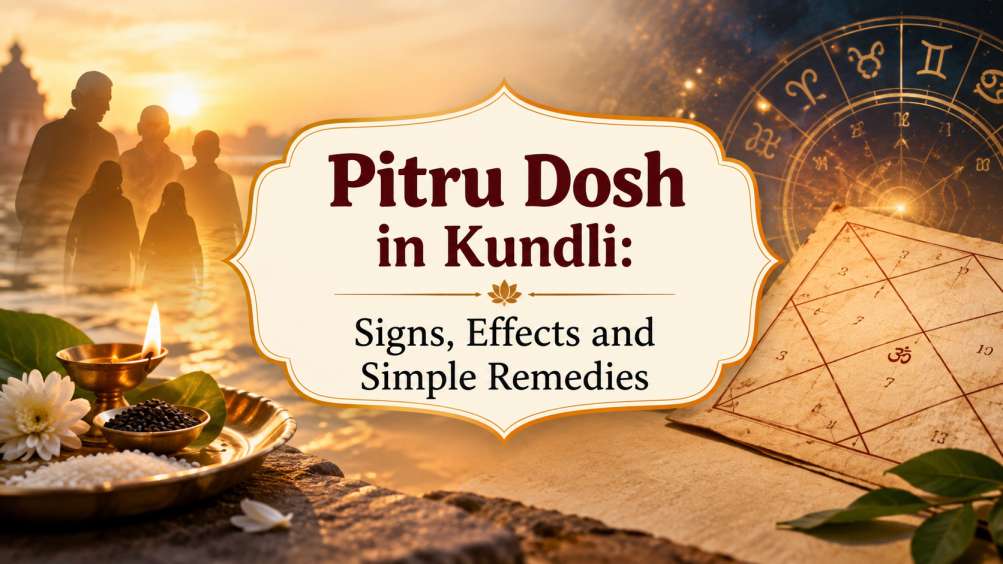
In Vedic astrology, Pitru Dosh in Kundli is traditionally associated with ancestral karma, unresolved family obligations, or certain planetary combinations believed to influence a person’s life. The term “Pitru” refers to ancestors, while “Dosh” generally indicates an astrological affliction or imbalance.
Pitru Dosh is often discussed when a horoscope shows challenges related to family harmony, marriage, childbirth, career stability, finances, or repeated obstacles. However, it is important not to assume that every difficulty is caused by Pitru Dosh. Different Jyotisha traditions use different combinations and interpretations, and a complete birth chart should always be examined before reaching a conclusion.
In practical terms, the concept can also encourage respect for one’s ancestors, family responsibilities, charitable activities, and remembrance rituals.
What Is Pitru Dosh in Kundli?
Pitru Dosh is not represented by one universally accepted planetary combination. In traditional Jyotisha practice, astrologers may examine the Sun, Rahu, Ketu, the 9th house, the 5th house, and their lords while assessing ancestral influences.
The Sun is particularly important because it represents father, lineage, authority and vitality. The 9th house is traditionally associated with father, ancestors, dharma and blessings from one’s lineage. The 5th house can also become relevant because it represents children, past-life merit and continuation of the family line.
Some astrologers consider combinations involving the Sun and Rahu or Ketu, especially when these planets influence relevant houses or their lords. However, the exact interpretation depends on the Lagna, planetary strength, aspects, conjunctions, Navamsa and Dasha periods.
Therefore, simply having Rahu or Ketu in a particular house does not automatically mean a person has severe Pitru Dosh.
Common Signs of Pitru Dosh
Astrologers traditionally associate certain recurring patterns with possible ancestral affliction. These should be treated as indicators for further horoscope analysis rather than proof.
1. Repeated Family Conflicts
Persistent disagreements among family members, particularly around property, responsibilities, or inherited matters, are sometimes considered relevant.
2. Delays in Marriage
Some traditions associate strong afflictions involving the 7th, 5th or 9th houses with relationship or marriage-related delays. However, Venus, Jupiter, the 7th house and the relevant Dashas must also be examined.
3. Concerns Related to Children
Difficulties concerning conception, pregnancy, or children’s wellbeing may sometimes be linked astrologically with ancestral karma. Such matters should never be attributed solely to astrology, and medical guidance remains essential.
4. Repeated Obstacles
A person may experience recurring setbacks despite sincere effort. In astrology, this may prompt an examination of the Sun, Rahu, Ketu, 9th house and relevant planetary periods.
5. Family Patterns
Repeated patterns across generations—such as disputes, financial instability or unresolved responsibilities—may be interpreted symbolically through the concept of ancestral karma.
Planetary Influences Associated With Pitru Dosh
Sun and Rahu
A conjunction or strong association between the Sun and Rahu is sometimes called Grahan Yoga and may be interpreted by some astrologers as an indicator of ancestral or paternal challenges when other chart factors support that interpretation.
Sun and Ketu
The Sun-Ketu connection can indicate detachment, unusual paternal experiences, or questions concerning lineage and identity. Its effects depend greatly on house placement, sign, strength and Dasha.
Ninth House
The 9th house is central when assessing father, ancestors, dharma and traditional blessings. Affliction to the 9th house, its lord, or the Sun may receive additional attention.
Fifth House
The 5th house represents children, creativity, past-life merit and lineage continuation. Afflictions here can become relevant when assessing ancestral themes, especially if supported by other combinations.
Effects of Pitru Dosh
Traditional astrological interpretations may associate Pitru Dosh with:
- Delays in important life decisions
- Family disagreements or misunderstandings
- Obstacles in marriage
- Concerns related to progeny
- Fluctuations in career or finances
- Repeated family responsibilities
- Emotional stress related to family matters
- Difficulty maintaining harmony between generations
These are not guaranteed outcomes. A strong horoscope can modify or reduce the influence of an affliction. Benefic aspects, planetary dignity, favourable Dashas and supportive divisional charts must be considered before making predictions.
Simple Remedies for Pitru Dosh
Remedies should ideally be performed with sincerity rather than fear.
1. Perform Pitru Tarpan
Offering water to ancestors during appropriate traditional observances is one of the commonly followed practices. Many families perform Pitru Tarpan during Pitru Paksha according to their regional traditions and Panchang.
2. Observe Shraddha Rituals
Shraddha is traditionally performed to honour departed ancestors. The appropriate date and procedure may vary according to family tradition, location and Panchang.
3. Offer Food and Charity
Feeding people in need, cows, birds, or other charitable acts in remembrance of ancestors is a simple way to express gratitude.
4. Worship the Sun
Since the Sun represents paternal lineage in Jyotisha, offering Arghya to the rising Sun is traditionally recommended by some astrologers.
A simple practice is to offer clean water while maintaining a respectful and grateful mindset.
5. Respect Parents and Elders
One of the most practical interpretations of ancestral harmony is maintaining respect and responsibility toward parents and elders.
6. Help the Needy
Charity, food donation and service can be incorporated into remembrance rituals. The focus should be on genuine service rather than expecting an instant astrological result.
Should You Fear Pitru Dosh?
No. Pitru Dosh should not be treated as a prediction of unavoidable misfortune.
Astrology involves interpreting combinations within the complete horoscope. A single conjunction or placement should not be isolated from the rest of the chart. In addition, many life difficulties have practical, social, financial, psychological or medical causes.
A balanced approach is therefore to combine traditional spiritual practices with sensible real-world action.
Conclusion
Pitru Dosh in Kundli is a traditional concept connected with ancestors, lineage and certain planetary afflictions in Vedic astrology. The Sun, Rahu, Ketu, 5th house and 9th house often receive attention during such an assessment, but there is no single combination that should automatically be labelled as Pitru Dosh.
Traditional remedies such as Pitru Tarpan, Shraddha, charity, Sun worship and respecting parents and elders can be followed as meaningful spiritual practices. Most importantly, these remedies should be performed without fear or superstition.
A complete Kundli analysis can help determine whether an alleged Pitru Dosh is actually significant, modified by benefic influences, or simply being misunderstood.
Reflection: Honouring one’s ancestors can be viewed not only as an astrological remedy but also as a way of preserving gratitude, family values and cultural traditions.
Disclaimer: Astrology is a traditional belief system and should not replace medical, legal, financial or professional advice.