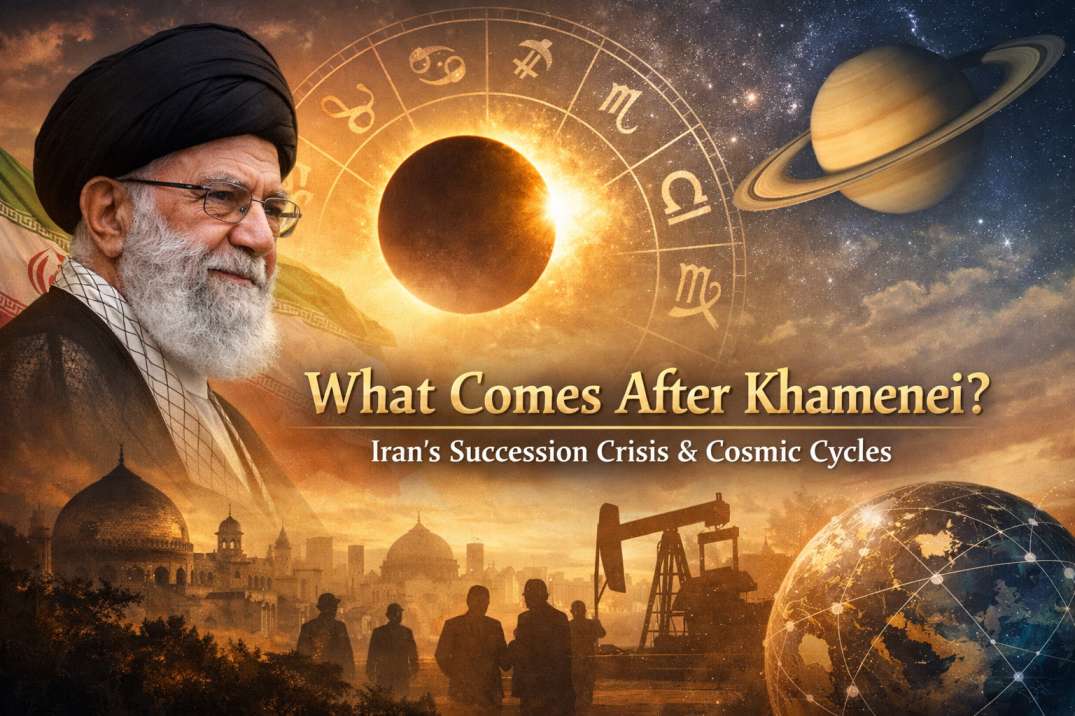
As the Supreme Leader of Iran ages, the question of “What comes after Khamenei?” is no longer political alone, it also invites symbolic and astrological interpretation. Ali Khamenei has dominated Iran’s ideological direction for decades, and any transition will reshape not only the nation but global geopolitics.
In Vedic astrology, leadership changes often coincide with major planetary cycles (dashas), eclipses, and slow-moving transits of Saturn, Jupiter, and Rahu-Ketu. Mundane astrology- the branch that studies nations, suggests that Iran is entering a karmic turning point. For Indian readers, understanding these cycles offers perspective on oil markets, regional stability, diplomacy, and even domestic economic ripple effects.
Astrological Background of Iran’s Leadership
The Legacy of Revolution
Modern Iran was shaped by the 1979 Islamic Revolution led by Ayatollah Ruhollah Khomeini, founder of the Islamic Republic of Iran. Astrologically, revolutions often align with Uranus-like disruptions (in Western astrology) or Rahu-dominated cycles in Vedic tradition.
Key themes in Iran’s national chart (commonly set for April 1, 1979):
- Strong Mars influence → militant defense posture
- Prominent Saturn → ideological rigidity, endurance
- Rahu effects → global controversy, sanctions, unpredictability
These signatures persist regardless of who leads.
Planetary Cycles Indicating Transition
Saturn: The Test of Power
Saturn (Shani) governs authority, karma, and institutional endurance. Its transits often coincide with leadership challenges or restructuring.
Current Saturn themes affecting Iran include:
- Institutional stress and public dissatisfaction
- Pressure from sanctions and economic realities
- Aging leadership structures
Traditional text Brihat Parashara Hora Shastra notes:
“शनि: कर्मफलदाता” — Saturn delivers the results of past actions.
For nations, this means long-term policies returning as consequences.
Rahu–Ketu Axis: Sudden Shifts
Rahu represents upheaval, foreign influence, and unconventional outcomes. When Rahu activates key national points:
- Unexpected successors may emerge
- Power struggles intensify
- External actors gain influence
This axis often produces leaders who break tradition rather than preserve it.
Jupiter: The Stabilizing Force
Jupiter (Guru) symbolizes wisdom, clergy, and moral authority; highly relevant in a theocratic system.
A strong Jupiter period could indicate:
- Consensus-based succession
- Religious legitimacy for the new leader
- Potential softening of foreign policy
For Indian observers, Jupiter’s influence often signals negotiation over confrontation.
Possible Succession Scenarios (Astrological View)
Mundane astrology does not predict specific individuals reliably, but it highlights patterns.
1. Conservative Continuity
If Saturn dominates:
- A senior cleric aligned with current ideology may take power
- Policies remain largely unchanged
- Stability with slow reform
2. Controlled Reform
If Jupiter strengthens:
- Moderate leadership emerges
- Gradual opening to diplomacy
- Economic adjustments
3. Power Struggle or Dual Authority
If Rahu is dominant:
- Internal factional conflict
- Military or council-based influence
- Period of uncertainty
Global Impact for India
Leadership changes in Iran matter to India in practical ways:
- Oil prices and energy security
- Chabahar Port cooperation
- Regional stability affecting trade routes
- Relations with Gulf nations
Astrologically, India-Iran ties often activate during Jupiter periods, symbolizing trade and cultural exchange.
Practical Remedies for Collective Stability
While citizens cannot influence another nation’s leadership, Vedic tradition suggests remedies to reduce collective anxiety and geopolitical tension.
Personal Remedies
- Chant “Om Sham Shanicharaya Namah” on Saturdays for stability
- Donate black sesame or mustard oil to the needy
- Practice grounding activities like yoga or pranayama
Collective Peace Practices
- Lighting a diya on Saturdays for global harmony
- Avoid spreading panic-driven news
- Support humanitarian causes
These actions align with the dharmic principle that inner stability contributes to outer peace.
Timing Windows to Watch (IST)
Astrologically sensitive periods often align with eclipses and major planetary shifts.
Key windows to monitor (approximate):
- Solar/Lunar eclipse seasons — heightened uncertainty
- Saturn sign changes — structural transitions
- Jupiter sign changes — policy shifts or diplomatic openings
Such events typically unfold gradually rather than overnight.
Conclusion
Iran’s succession question is not just about one leader, it reflects a larger karmic cycle for the nation. Whether continuity, reform, or turbulence emerges depends on the interplay of Saturn’s discipline, Jupiter’s wisdom, and Rahu’s unpredictability.
For Indian readers, the takeaway is pragmatic: global shifts affect energy prices, diplomacy, and economic stability at home. Astrology does not replace political analysis, but it offers a symbolic framework to understand timing and patterns.
Rather than fear uncertainty, this period can be viewed as a transition toward a new geopolitical balance, one shaped by both human decisions and cosmic rhythms.
FAQs Section
1. Can astrology really predict political succession?
Astrology can indicate periods of change but cannot reliably name specific leaders.
Mundane astrology studies cycles affecting nations—Saturn for institutions, Jupiter for legitimacy, and Rahu for upheaval. These cycles show when transitions are likely, not who will lead.
Tips:
- Focus on patterns, not personalities
- Combine astrology with real-world analysis
- Avoid sensational predictions
2. Why is Saturn so important in leadership transitions?
Saturn governs authority, structure, and karma, making it central to political change.
When Saturn activates national charts, aging systems face tests. Leaders may step down, institutions reform, or public pressure intensifies.
Remedies for Saturn balance:
- Charity on Saturdays
- Discipline in daily routine
- Service to the elderly or poor
3. What role does Rahu play in sudden political events?
Rahu triggers unpredictability, foreign involvement, and unconventional outcomes.
In politics, Rahu periods can produce surprise leaders, scandals, or abrupt policy shifts. It amplifies ambition but reduces stability.
Grounding practices:
- Meditation and breathwork
- Limiting misinformation consumption
- Maintaining emotional neutrality
4. Could a leadership change in Iran affect India directly?
Yes—mainly through energy markets, trade routes, and regional stability.
India imports oil and collaborates on infrastructure projects, so any instability or policy shift can influence prices and strategic planning.
Practical preparedness:
- Track fuel price trends
- Diversify investments
- Stay informed through credible sources
5. Is there a positive side to such global transitions?
Yes—periods of disruption often open pathways for reform and new alliances.
Astrologically, challenging cycles clear outdated structures, allowing renewal under future Jupiter periods of growth and cooperation.
Constructive approach:
- Focus on long-term outcomes
- Support peace-oriented initiatives
- Maintain personal resilience