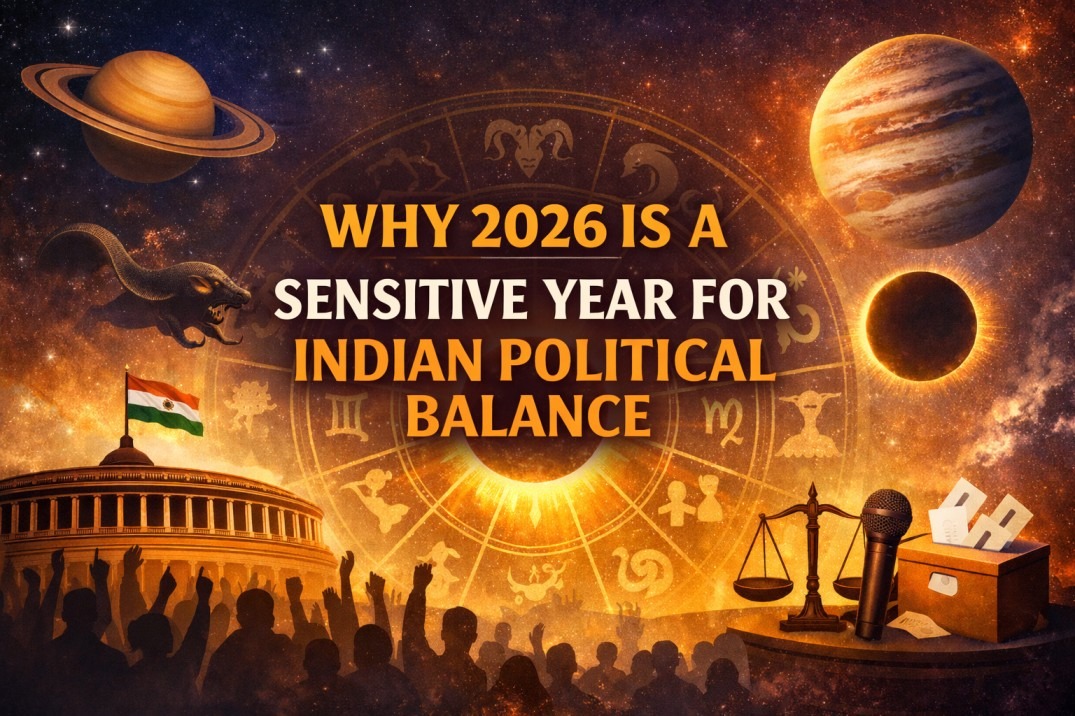
In Vedic astrology, years are not judged by headlines alone but by long-term planetary cycles that shape collective psychology, governance, and public mood. The year 2026 stands out as a sensitive phase for Indian political balance due to the simultaneous activation of slow-moving planets that influence authority, masses, and institutional stability.
Unlike sudden disruptive years, 2026 represents a pressure year where underlying tensions surface gradually. Decisions made during this period can have lasting consequences well beyond the year itself. For a country like India, where politics, economy, and public sentiment are deeply interconnected, such astrological signals deserve careful observation.
This article explores why 2026 requires caution, balance, and maturity in leadership, using traditional Vedic logic rather than speculation, and connects these insights with real-life governance and social harmony.
Astrological Context of 2026
Key Planetary Transits in 2026 (IST-Based Framework)
In Vedic astrology, Saturn (Shani), Rahu, Ketu, and Jupiter (Guru) play the most significant role in political and national charts. In 2026, their combined influence creates a climate of sensitivity rather than outright instability.
Key astrological themes of 2026 include:
- Saturn’s pressure on governance-related signs and houses
- Rahu–Ketu axis affecting public opinion and ideological divides
- Jupiter attempting to stabilize but facing resistance
- Eclipse periods amplifying emotional reactions among the masses
These energies unfold gradually across the year in IST timeframes, especially around eclipses and major retrograde phases.
Saturn’s Role: Pressure on Authority and Institutions
Saturn as the Planet of Governance
Saturn represents:
- Law, order, and administration
- Accountability and responsibility
- Long-term consequences of past actions
In 2026, Saturn’s placement indicates institutional stress-testing rather than collapse.
Possible Political Manifestations
- Increased scrutiny of leadership decisions
- Delays in policy implementation
- Public demand for accountability
- Resistance to rushed reforms
From a Vedic perspective, Saturn does not punish randomly. It exposes weaknesses so systems can be strengthened.
“शनैश्चरः कर्मफलदाता”
Saturn delivers results strictly based on past actions.
Rahu–Ketu Axis: Polarisation and Narrative Battles
Why Rahu–Ketu Matters for Political Balance
Rahu represents mass psychology, media narratives, and unconventional movements, while Ketu signifies detachment and ideological rigidity.
In 2026, this axis indicates:
- Strong opinion-based politics
- Emotional public discourse
- Rise of alternative narratives and counter-narratives
Real-Life Relevance
- Social media-driven political debates intensify
- Identity-based discussions gain prominence
- Difficulty in achieving consensus
This does not imply chaos, but it does suggest mental unrest and ideological friction, requiring wise communication strategies.
Jupiter’s Role: Attempted Stability Amid Sensitivity
Jupiter as the Balancing Force
Jupiter governs wisdom, ethics, and guidance. In 2026, Jupiter works to:
- Restore constitutional balance
- Encourage dialogue and reform
- Protect democratic values
However, Jupiter’s influence appears corrective rather than dominant, meaning its stabilising effect depends heavily on leadership maturity.
Practical implication:
Policies rooted in long-term welfare gain support, while short-term populism faces resistance.
Eclipse Cycles and Public Mood Shifts
Eclipses are known to amplify collective emotions. In 2026, eclipse periods in IST windows may coincide with:
- Sudden political statements
- Shifts in public sentiment
- Re-evaluation of leadership narratives
Astrologically, eclipses do not create events but magnify existing trends, making timing crucial for major announcements or reforms.
Practical Astrological Insights for Political Stability
For Leadership and Institutions
- Prioritise transparency over speed
- Avoid emotionally charged decisions during eclipse periods
- Strengthen institutional processes rather than personalities
For Citizens and Observers
- Verify information before reacting
- Focus on long-term national interest
- Avoid fear-based interpretations of political changes
Simple Traditional Remedies (Non-Superstitious)
In Vedic tradition, remedies focus on mental balance and ethical conduct, not magical outcomes.
- Observing discipline and patience on Saturdays
- Supporting lawful and ethical actions
- Reading or reflecting on Bhagavad Gita verses related to duty (karma yoga)
These practices symbolically align individuals with Saturn’s constructive energy.
Why 2026 Is “Sensitive,” Not “Dangerous”
A sensitive year is not a destructive year. Astrologically, 2026 is about course correction, where ignored issues demand attention.
Key themes include:
- Accountability over expansion
- Dialogue over dominance
- Reform over reaction
Handled wisely, this year can strengthen democratic foundations rather than weaken them.
Conclusion
From a Vedic astrology standpoint, 2026 is a sensitive year for Indian political balance because it activates planets that test governance, public trust, and institutional maturity. Saturn demands accountability, Rahu–Ketu intensifies ideological divides, and Jupiter attempts to guide through wisdom.
Rather than predicting instability, astrology highlights responsibility. Political balance in 2026 depends less on fate and more on conscious decision-making, ethical leadership, and informed citizenship. For India, this year offers an opportunity to recalibrate systems, strengthen democratic values, and move forward with greater awareness. Reflection, patience, and dialogue remain the most powerful remedies.
FAQs
1. Why is 2026 considered sensitive in Indian astrology?
Because multiple slow-moving planets simultaneously influence governance and public psychology.
In Vedic astrology, years become sensitive when Saturn, Rahu–Ketu, and Jupiter interact in ways that highlight unresolved issues. In 2026, these influences bring pressure without sudden collapse.
Helpful approach:
- Focus on patience
- Avoid extreme interpretations
- Encourage dialogue
2. Does astrology predict political instability in 2026?
No, astrology indicates stress-testing, not instability.
The planetary patterns suggest scrutiny, delays, and ideological debates rather than breakdown. Outcomes depend on human decisions.
Key takeaway:
- Accountability improves outcomes
- Rash decisions worsen pressure
3. What role does Saturn play in political balance?
Saturn enforces discipline, law, and long-term responsibility.
In 2026, Saturn highlights weaknesses in systems so they can be corrected.
Saturn-aligned actions:
- Ethical governance
- Rule-based administration
- Patience in reforms
4. How do Rahu and Ketu affect public opinion in 2026?
They intensify polarisation and narrative conflicts.
Rahu amplifies mass emotions, while Ketu causes ideological rigidity, making communication crucial.
Suggested remedies:
- Fact-based discussions
- Responsible media consumption
5. Can individuals do anything astrologically during 2026?
Yes, by focusing on discipline, awareness, and ethical conduct.
Astrology encourages internal alignment rather than fear-based rituals.
Simple practices:
- Mindful decision-making
- Respect for institutions
- Constructive civic participation