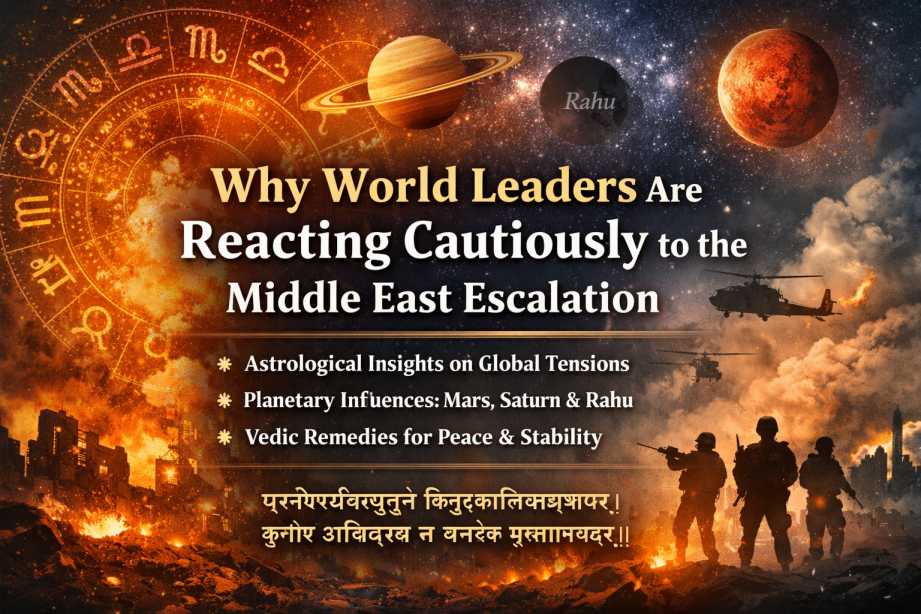
In recent weeks, tensions in the Middle East have intensified, yet many world leaders appear unusually cautious in their responses. Instead of immediate escalation, diplomatic statements, delayed decisions, and careful negotiations are dominating global politics.
From a Vedic astrology perspective, such collective caution is not unusual. Planetary transits often influence global moods, leadership decisions, and geopolitical strategies. When slow-moving planets interact with fiery or disruptive forces, leaders tend to pause, analyze risks, and avoid sudden actions.
Astrology has long been used to understand cycles of war, diplomacy, and global transformation. Ancient Indian texts such as Brihat Samhita by Varahamihira describe how planetary alignments can reflect shifts in kingdoms, conflicts, and alliances.
In this article, we explore the astrological reasons why world leaders may be reacting carefully to the Middle East escalation and what planetary energies suggest about the coming months.
Astrological Factors Behind the Global Caution
Mars Influence: The Planet of War
Mars represents aggression, military activity, and decisive action. When Mars is strongly placed or in conflict with other planets, tensions rise globally.
However, current planetary patterns suggest a controlled Mars influence rather than a fully explosive one.
Key astrological indicators include:
- Mars interacting with slow-moving planets
- Strategic rather than impulsive energy
- Increased military alertness without immediate large-scale war
In Vedic astrology, Mars is also called Mangal, associated with courage and warfare.
A classical verse reflects this symbolism:
“धरणीगर्भसम्भूतं विद्युत्कान्तिसमप्रभम्।
कुमारं शक्तिहस्तं तं मङ्गलं प्रणमाम्यहम्॥”
This mantra is traditionally recited to balance Mars energy and reduce conflict-driven impulses.
Saturn’s Role: The Planet of Delay and Responsibility
One of the biggest reasons for cautious global reactions may be the influence of Saturn.
Saturn represents:
- Delays
- Strategic thinking
- Responsibility
- Consequences of past actions
When Saturn strongly influences global planetary patterns, leaders often adopt a wait-and-watch strategy.
Instead of rushing into war, Saturn encourages:
- Long diplomatic discussions
- Sanctions rather than direct attacks
- Coalition building among nations
This aligns with what we are seeing today, many nations expressing concern while avoiding immediate escalation.
Rahu’s Influence: Unpredictable Global Events
Rahu in Vedic astrology represents sudden developments, illusions, and geopolitical surprises.
Its influence often brings:
- Cyber warfare
- Media narratives
- Information battles
- Unexpected alliances
Because Rahu can create uncertainty, world leaders may prefer caution rather than quick decisions.
Historically, Rahu periods have coincided with complex geopolitical situations where the truth is not always clear.
Global Astrology and Collective Karma
The Role of Collective Planetary Cycles
Vedic astrology believes nations also experience karmic cycles influenced by planetary movements.
Certain transits indicate:
- Periods of diplomacy
- Times of hidden negotiations
- Slow geopolitical shifts rather than sudden wars
During such phases, leaders often prioritize:
- Economic stability
- Strategic alliances
- Global reputation
Instead of dramatic military moves, countries may choose diplomatic caution.
Why Diplomacy Is Dominating Right Now
Several astrological combinations support diplomacy over conflict:
1. Saturn-Mars Interactions
This combination often forces leaders to think carefully before taking aggressive steps.
2. Strong Mercury Influence
Mercury governs communication, negotiations, and diplomacy.
When Mercury is active, global leaders rely more on dialogue than warfare.
3. Jupiter’s Moderating Effect
Jupiter represents wisdom and ethics. Its influence encourages leaders to consider long-term consequences.
In Vedic philosophy, Jupiter symbolizes guidance and moral responsibility, reminding rulers that decisions affect millions of lives.
Practical Vedic Remedies for Global Peace
While astrology cannot control geopolitics, spiritual practices are traditionally believed to harmonize planetary energies.
Individuals can contribute to collective peace through simple remedies.
1. Chant Peace Mantras
The famous Vedic peace mantra promotes harmony:
“ॐ द्यौः शान्तिरन्तरिक्षं शान्तिः
पृथ्वी शान्तिरापः शान्तिः…”
Chanting this mantra daily encourages mental calm and positive energy.
2. Strengthen Jupiter for Wisdom
Jupiter represents wisdom in leadership.
Simple remedies include:
- Donating yellow food items on Thursdays
- Respecting teachers and elders
- Reading spiritual texts
These practices are believed to promote wise decision-making energies globally.
3. Balance Mars Energy
Since Mars governs war-like energy, balancing it can reduce aggression.
Helpful practices:
- Offering red lentils (masoor dal) on Tuesdays
- Practicing yoga or physical discipline
- Avoiding unnecessary arguments
4. Support Saturn’s Lessons
Saturn teaches patience and responsibility.
Traditional remedies include:
- Helping the poor or elderly
- Lighting a sesame oil lamp on Saturdays
- Practicing humility and discipline
Conclusion
The cautious response of world leaders to the Middle East escalation may not simply be a political strategy, it could also reflect deeper global cycles.
Astrologically, the influence of Saturn, Rahu, Mars, and Jupiter suggests a phase of strategic patience rather than immediate confrontation. Leaders may prefer diplomacy, negotiations, and careful decision-making instead of rushing into conflict.
Vedic astrology reminds us that planetary cycles influence collective consciousness as well as individual lives. While geopolitical events unfold beyond our control, maintaining inner peace and spiritual balance can contribute positively to the world’s energy.
As the coming months unfold, observing planetary transits may provide further insights into whether diplomacy continues—or if global dynamics shift toward stronger action.
FAQs
1. Can astrology really explain global political decisions?
Yes, astrology studies planetary cycles that symbolically reflect human behavior and collective trends.
In Vedic astrology, the same planetary energies that affect individuals are believed to influence nations and leaders. Ancient texts like Brihat Samhita often discuss planetary signs connected with political events.
Astrology does not predict exact decisions but highlights patterns of caution, aggression, diplomacy, or transformation.
Tips for understanding global astrology:
- Observe slow-moving planets like Saturn and Jupiter
- Watch Mars transits for conflict-related trends
- Consider Rahu and Ketu for sudden events
2. Why is Mars associated with war in astrology?
Mars symbolizes energy, courage, and aggression.
In astrology, it governs soldiers, weapons, and decisive actions. When Mars forms challenging aspects with other planets, global tensions often rise.
However, Mars also represents discipline and protection, meaning its energy can support defense rather than conflict.
Ways to balance Mars energy:
- Chant Mars mantras on Tuesdays
- Engage in physical exercise
- Avoid impulsive decisions
3. What role does Saturn play in global conflicts?
Saturn encourages caution and responsibility.
When Saturn strongly influences planetary patterns, leaders tend to slow down decisions, analyze risks, and prioritize long-term consequences.
This is why diplomatic discussions often increase during strong Saturn phases.
Saturn-related remedies:
- Charity to the needy
- Practicing patience
- Lighting sesame oil lamps on Saturdays
4. Can planetary remedies influence world peace?
Remedies are believed to harmonize individual energies, which collectively impact society.
In Vedic philosophy, spiritual practices by individuals can contribute to collective harmony and positive vibrations.
While they cannot control political decisions, they encourage peace-focused thinking.
Simple practices:
- Chant peace mantras
- Practice meditation
- Support charitable causes
5. What planets influence diplomacy and negotiations?
Mercury and Jupiter are the main planets governing diplomacy.
Mercury supports communication, negotiations, and strategic dialogue. Jupiter promotes wisdom, ethics, and balanced decision-making.
When these planets are strong, leaders often prefer dialogue over conflict.
Strengthening diplomatic planetary energies:
- Respect teachers and advisors
- Study knowledge-based subjects
- Encourage dialogue rather than confrontation