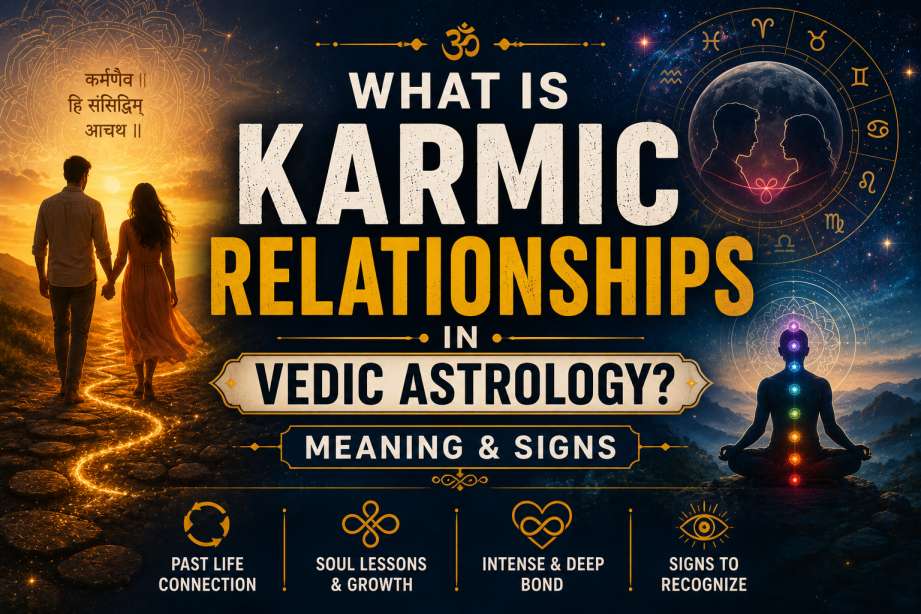
Relationships often feel deeper than simple attraction. Sometimes, two people meet and experience an instant connection, repeated misunderstandings, or life-changing emotional lessons. In Vedic astrology, such bonds are often described as karmic relationships, connections believed to arise from unfinished karmic patterns carried from previous births.
Karmic relationships are not necessarily positive or negative. Instead, they are considered opportunities for growth, healing, forgiveness, and self-awareness. By studying the birth chart (Kundli), astrologers analyze planetary positions, houses, and karmic indicators to understand why certain relationships feel destined. While astrology cannot prove past-life connections, it offers a symbolic framework that helps people understand recurring emotional patterns and relationship dynamics.
Understanding Karmic Relationships in Vedic Astrology
In Vedic astrology, karma refers to the actions and impressions that influence one’s present life. Relationships are believed to be one of the strongest mediums through which karma unfolds.
A karmic relationship may involve:
- Strong emotional attraction from the beginning
- Recurring life lessons
- Emotional highs and lows
- Difficult but meaningful experiences
- Spiritual transformation and personal growth
Rather than predicting a fixed destiny, Vedic astrology encourages understanding these experiences with awareness and responsibility.
Planetary Combinations Associated with Karmic Relationships
Rahu – The Planet of Unfinished Desires
Rahu often represents desires, obsessions, and lessons carried forward into this lifetime.
When Rahu strongly influences the:
- 7th House (Marriage)
- 5th House (Love)
- Venus
- Moon
the relationship may feel unusually intense or fated.
Such partnerships often teach lessons about attachment, expectations, and emotional maturity.
Ketu – The Planet of Past-Life Detachment
Ketu symbolizes spiritual experiences and karmic memories.
A strong Ketu influence may indicate:
- Familiarity from the first meeting
- Emotional distance despite love
- Spiritual learning
- The need to release old emotional baggage
Relationships involving Ketu often encourage inner growth rather than material satisfaction.
Saturn – Karma, Duty and Patience
Saturn is one of the strongest karmic planets in Vedic astrology.
Its influence may bring:
- Delayed relationships
- Long-term commitments
- Responsibility
- Tests of patience
- Emotional maturity
Although Saturn-related relationships may feel challenging initially, they often become stable when both partners learn discipline and mutual respect.
Venus and Moon
Venus represents love, while the Moon governs emotions.
When these planets interact with Rahu, Ketu, or Saturn, astrologers carefully study the emotional and karmic nature of relationships.
Houses That Reveal Karmic Relationship Patterns
5th House
The fifth house represents:
- Romance
- Emotional connection
- Past-life merit (Purva Punya)
- Attraction
Strong influences here may indicate meaningful romantic lessons.
7th House
The seventh house governs:
- Marriage
- Long-term partnerships
- Legal unions
- Relationship responsibilities
Afflictions or strong karmic planets here often indicate important life lessons through partnerships.
8th House
The eighth house is associated with:
- Transformation
- Hidden emotions
- Shared karma
- Deep psychological changes
Many astrologers examine this house while assessing emotionally transformative relationships.
12th House
The twelfth house relates to:
- Spiritual liberation
- Past-life impressions
- Emotional release
- Letting go
Strong planetary activity here may suggest relationships that encourage forgiveness and healing.
Zodiac Signs That May Experience Intense Karmic Lessons
Although every birth chart is unique, certain zodiac signs often experience deeper emotional growth through relationships.
- Scorpio: Transformation and emotional intensity.
- Pisces: Compassion, spirituality, and forgiveness.
- Cancer: Emotional bonding and family karma.
- Capricorn: Responsibility and long-term commitment.
These are general tendencies. A complete Kundli analysis is always more accurate than Sun sign predictions.
Common Signs of a Karmic Relationship
Some experiences frequently associated with karmic relationships include:
- Feeling like you’ve known the person for years.
- Strong emotional attraction from the beginning.
- Repeating similar conflicts.
- Learning important life lessons.
- Difficulty walking away despite challenges.
- Significant personal transformation after the relationship.
These signs are symbolic rather than definitive proof of a karmic connection.
Practical Remedies Suggested in Vedic Astrology
Vedic astrology emphasizes remedies as tools for self-improvement rather than magical solutions.
Some commonly recommended practices include:
Daily Self-Reflection
Observe recurring emotional patterns without blaming yourself or others.
Strengthen Positive Karma
Acts of kindness, charity, honesty, and compassion are considered powerful karmic remedies.
Meditation
Regular meditation helps reduce emotional reactions and improve clarity.
Chanting
Many practitioners recite:
“ॐ नमः शिवाय” (Om Namah Shivaya)
This mantra is traditionally associated with inner peace, emotional balance, and spiritual awareness.
Respect Family Relationships
Maintaining harmony with parents, elders, and mentors is often regarded as a way to cultivate positive karma.
Can Astrology Predict Every Relationship?
No. Vedic astrology provides symbolic guidance rather than certainty.
Free will, communication, mutual respect, emotional intelligence, and personal choices remain the biggest factors in building healthy relationships.
Astrology works best as a tool for self-awareness instead of fear or prediction.
Conclusion
Karmic relationships in Vedic astrology offer a thoughtful way to understand why certain connections feel unusually meaningful. Through the study of Rahu, Ketu, Saturn, Venus, the Moon, and important relationship houses, astrologers interpret emotional patterns that may encourage growth and spiritual maturity.
Rather than viewing difficult relationships as punishment, Vedic astrology encourages seeing them as opportunities to learn patience, compassion, forgiveness, and self-awareness. A balanced Kundli analysis combined with conscious choices can help individuals navigate relationships with greater wisdom and emotional stability.
If you’re curious about your own relationship patterns, consider consulting an experienced Vedic astrologer for a personalized Kundli analysis instead of relying solely on general zodiac predictions.
FAQs
1. What is a karmic relationship in Vedic astrology?
A karmic relationship is a bond believed to help individuals learn important life lessons through emotional experiences.
In Vedic astrology, such relationships are often linked to past karmic patterns symbolized through planetary placements. They may involve love, family, friendship, or marriage and often encourage personal growth.
Helpful Tips:
- Study the complete birth chart rather than only the zodiac sign.
- Focus on emotional maturity instead of destiny.
- Use astrology as guidance, not certainty.
2. Which planets indicate karmic relationships?
Rahu, Ketu, and Saturn are commonly associated with karmic relationships in Vedic astrology.
Astrologers also examine Venus, the Moon, and the 5th, 7th, 8th, and 12th houses for deeper relationship insights. Their combinations provide clues about lessons, responsibilities, and emotional evolution.
Suggested Remedies:
- Chant “Om Namah Shivaya.”
- Practice meditation regularly.
- Perform acts of kindness without expectations.
3. Are karmic relationships always painful?
No, karmic relationships are not always painful; many are deeply meaningful and transformative.
Some relationships bring support, healing, and spiritual progress, while others challenge individuals to overcome unhealthy emotional patterns. Their purpose is often growth rather than comfort.
Remember:
- Healthy communication remains essential.
- Personal choices influence outcomes.
- Emotional awareness reduces conflict.
4. Can a Kundli confirm a karmic relationship?
A Kundli may indicate karmic themes, but it cannot conclusively prove a past-life relationship.
Vedic astrologers analyze planetary combinations, dashas, and relationship houses to identify symbolic patterns. These insights should be interpreted alongside real-life experiences and practical judgment.
Best Practices:
- Get both partners’ charts analyzed.
- Consider planetary periods (Dashas).
- Avoid making major decisions based only on one astrological factor.
5. How can I reduce negative karmic effects in relationships?
Developing positive habits, self-awareness, and compassion is considered the most effective way to improve relationship karma.
Vedic traditions recommend ethical living, gratitude, prayer, meditation, and service as methods to strengthen positive karma while fostering healthier relationships.
Simple Remedies:
- Practice forgiveness where appropriate.
- Donate regularly according to your capacity.
- Maintain honesty and respect in relationships.
- Meditate consistently for emotional balance.
- Seek professional guidance when relationship challenges require practical support beyond astrology.