Guru Purnima is one of the most revered festivals in the Indian spiritual tradition. Celebrated on the full moon (Purnima) of the Ashadha month according to the Hindu lunar calendar, this day is dedicated to expressing gratitude towards teachers, mentors, spiritual guides, and gurus who illuminate the path of knowledge and wisdom.
In Vedic astrology, Guru Purnima carries deep significance because it symbolizes the blessings of Jupiter (Guru or Brihaspati), the planet associated with knowledge, ethics, spirituality, higher learning, and prosperity. The festival also commemorates Maharishi Ved Vyasa, the sage who compiled the Vedas and authored the Mahabharata, earning the title of the world’s greatest guru. Guru Purnima reminds us that true success comes not only through intelligence but also through guidance, discipline, and continuous learning.
Why Do We Celebrate Guru Purnima?
Guru Purnima is celebrated to honor the timeless relationship between a guru (teacher) and a disciple (student). In Indian philosophy, a guru removes the darkness of ignorance and helps individuals discover knowledge, values, and self-awareness.
The Sanskrit word “Guru” is traditionally interpreted as:
- Gu – Darkness
- Ru – One who removes it
This symbolic meaning emphasizes that a guru guides individuals toward clarity, wisdom, and spiritual growth.
The day is observed by:
- Offering respect to teachers and mentors
- Studying sacred texts
- Performing Guru Puja
- Meditating and chanting
- Practicing gratitude
- Beginning new learning journeys
Many educational institutions, spiritual organizations, yoga centers, and ashrams across India organize special ceremonies on Guru Purnima.
The Story of Maharishi Ved Vyasa
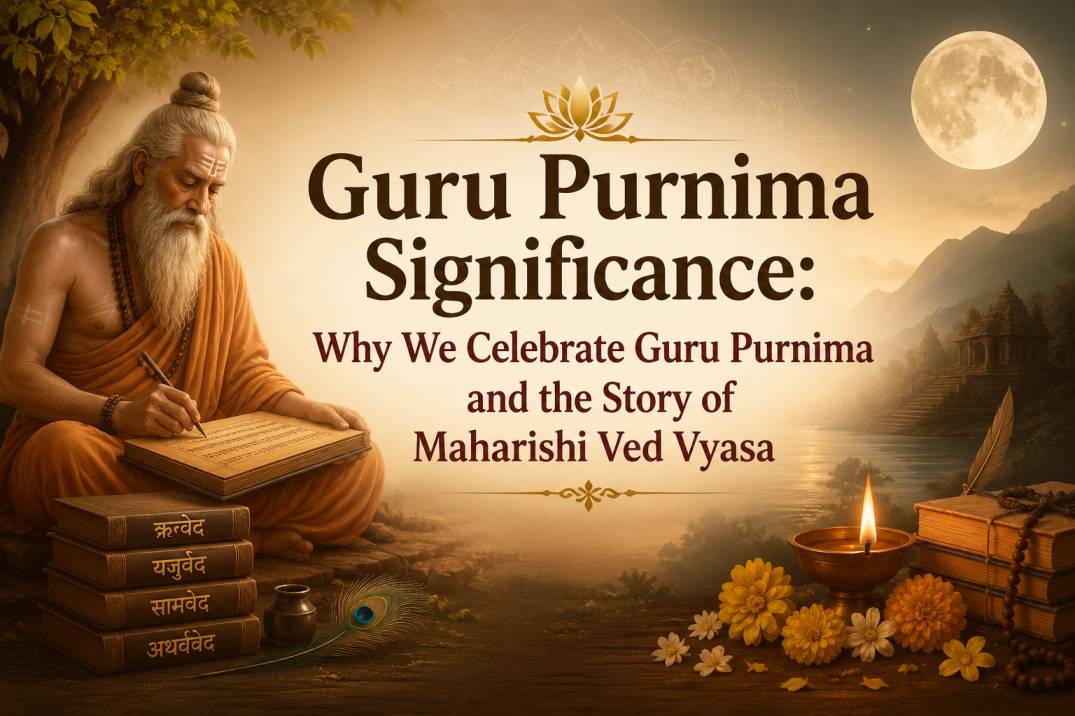
Guru Purnima is also known as Vyasa Purnima because it marks the birth anniversary of Maharishi Krishna Dvaipayana Ved Vyasa.
According to Hindu tradition, Maharishi Ved Vyasa made priceless contributions to Sanatan Dharma by:
- Dividing the Vedas into four parts for easier understanding
- Composing the Mahabharata
- Writing the Brahma Sutras
- Compiling the 18 Puranas
- Preserving ancient Vedic knowledge for future generations
Because of these extraordinary contributions, he is regarded as the Adi Guru (first teacher) of Vedic wisdom.
A famous Sanskrit verse often recited on Guru Purnima is:
गुरुर्ब्रह्मा गुरुर्विष्णुः गुरुर्देवो महेश्वरः।
गुरुः साक्षात् परं ब्रह्म तस्मै श्री गुरवे नमः॥
Meaning: The Guru represents Brahma, Vishnu, and Mahesh (Shiva); the Guru is the Supreme Reality itself. Salutations to that revered Guru.
This verse reflects the immense respect given to teachers in Indian culture.
Astrological Significance of Guru Purnima
In Vedic astrology, Guru Purnima is strongly connected with Jupiter (Brihaspati), the natural significator of:
- Wisdom
- Education
- Spirituality
- Dharma
- Fortune
- Children
- Higher knowledge
- Ethical living
When Jupiter is well-placed in a birth chart, it often supports learning, good judgment, optimism, and guidance from mentors. Guru Purnima is considered an auspicious occasion to seek blessings for strengthening these qualities.
The Importance of the Full Moon
Guru Purnima falls on the Ashadha Purnima, when the Moon is at its brightest phase.
In astrology:
- The Moon represents the mind and emotions.
- Jupiter represents wisdom and higher knowledge.
The symbolic combination of a bright Moon and Guru’s energy reminds individuals to balance emotions with wisdom and knowledge.
Houses Connected with Learning and Gurus
Certain houses in a horoscope are particularly linked with education and spiritual growth.
2nd House
Represents speech, early education, family values, and accumulated knowledge.
5th House
Associated with intelligence, higher learning, mantra siddhi, and wisdom.
9th House
Represents gurus, dharma, philosophy, higher education, and divine blessings.
A strong relationship between Jupiter and these houses is traditionally considered favorable for academic success and spiritual development.
Zodiac Signs That Benefit from Jupiter’s Energy
Although Guru Purnima is meaningful for everyone, Jupiter naturally supports qualities in all signs through learning and ethical conduct.
Traditionally, Jupiter rules:
It is also considered exalted in Cancer, symbolizing nourishment, compassion, and wisdom.
Rather than focusing on predictions for specific zodiac signs, Guru Purnima encourages every individual to cultivate humility, gratitude, and lifelong learning.
Practical Remedies on Guru Purnima
These simple practices align with traditional beliefs and can be followed with sincerity.
Offer Respect to Teachers
Express gratitude to parents, teachers, mentors, or spiritual guides.
Worship Lord Vishnu and Brihaspati
Offer yellow flowers, turmeric, sandalwood, or bananas during prayers.
Chant Jupiter Mantra
Recite:
ॐ बृं बृहस्पतये नमः।
Chanting this mantra with devotion is traditionally believed to strengthen positive Jupiter-related qualities.
Donate Yellow Items
You may donate:
- Turmeric
- Chana dal
- Yellow clothes
- Bananas
- Books for students
Charity performed with genuine intention reflects the spirit of Guru Purnima.
Read Sacred Literature
Reading the Bhagavad Gita, Mahabharata, or selected portions of the Puranas encourages reflection and learning.
Practice Gratitude
Spend a few minutes thanking those who have positively influenced your life. Gratitude is a timeless practice that supports emotional well-being.
Real-Life Relevance of Guru Purnima
The message of Guru Purnima extends beyond religious rituals.
In today’s world, a guru can be:
- A school teacher
- A parent
- A mentor
- A coach
- A spiritual guide
- A senior colleague
- Anyone who inspires positive growth
The festival reminds us that continuous learning and humility remain essential for personal and professional success.
Conclusion
Guru Purnima beautifully celebrates the eternal bond between knowledge and gratitude. By honoring Maharishi Ved Vyasa, remembering the role of our teachers, and reflecting on Jupiter’s symbolism in Vedic astrology, we reconnect with values that remain relevant across generations.
Whether you observe Guru Purnima through prayer, meditation, charity, or simply thanking a mentor, the essence of the festival lies in respecting wisdom and sharing knowledge with others. Let this auspicious occasion inspire you to remain a lifelong learner and guide others with kindness, integrity, and compassion.
FAQs
1. Why is Guru Purnima celebrated?
Guru Purnima is celebrated to honor teachers, spiritual guides, and Maharishi Ved Vyasa.
The festival recognizes the invaluable role of gurus in shaping knowledge, character, and wisdom. It also commemorates the contributions of Ved Vyasa, who preserved and organized much of India’s sacred literature.
Tips:
- Express gratitude to your teachers.
- Read a spiritual or educational text.
- Spend time reflecting on lessons learned in life.
2. Who was Maharishi Ved Vyasa?
Maharishi Ved Vyasa is regarded as the compiler of the Vedas and the author of the Mahabharata.
He is revered as one of the greatest sages in Hindu tradition for preserving Vedic knowledge and making it accessible to future generations. His literary and philosophical contributions continue to influence Indian culture.
Related Practices:
- Read passages from the Mahabharata.
- Learn about the Vedas and Puranas.
- Honor the tradition of knowledge-sharing.
3. What is the astrological importance of Guru Purnima?
Guru Purnima symbolizes the positive qualities associated with Jupiter, the planet of wisdom and higher learning.
In Vedic astrology, Jupiter represents education, ethics, spirituality, and guidance. The full moon on this day also symbolizes mental clarity and emotional balance.
Simple Remedies:
- Chant “Om Brim Brihaspataye Namah.”
- Wear clean yellow clothing during prayers.
- Donate educational materials to students.
4. Can anyone observe Guru Purnima?
Yes, Guru Purnima can be observed by anyone who wishes to express gratitude toward their teachers or mentors.
The festival is universal in its message of respecting knowledge and lifelong learning. It is observed across spiritual traditions and educational communities in India.
Ways to Observe:
- Thank a mentor personally.
- Practice meditation.
- Begin learning a new skill or scripture.
5. What should be done on Guru Purnima?
Simple acts of gratitude, prayer, charity, and study are considered meaningful ways to observe Guru Purnima.
There is no single mandatory ritual. Traditional observances focus on humility, devotion, and self-improvement rather than elaborate ceremonies.
Recommended Practices:
- Offer prayers to your guru or chosen deity.
- Donate books or food.
- Chant Jupiter mantras.
- Read spiritual literature.
- Practice gratitude and self-reflection.