Manglik Dosha, also known as Mangal Dosha or Kuja Dosha, is one of the most discussed concepts in Vedic astrology, especially during marriage matching. It is traditionally associated with the placement of Mars (Mangal) in certain houses of a person’s birth chart. Since Mars represents energy, courage, passion, assertiveness, and conflict, its placement is believed to influence how a person handles relationships, disagreements, and marital responsibilities.
However, Manglik Dosha should not be treated as an automatic indication of divorce, unhappy marriage, or relationship failure. A proper Kundli matching analysis considers Mars along with Venus, Jupiter, the Moon, the 7th house, its lord, Navamsa (D9) chart, planetary aspects, and the operating Mahadasha and Antardasha.
Understanding the complete horoscope is therefore more meaningful than judging marriage prospects from Manglik Dosha alone.
What Is Manglik Dosha in Vedic Astrology?
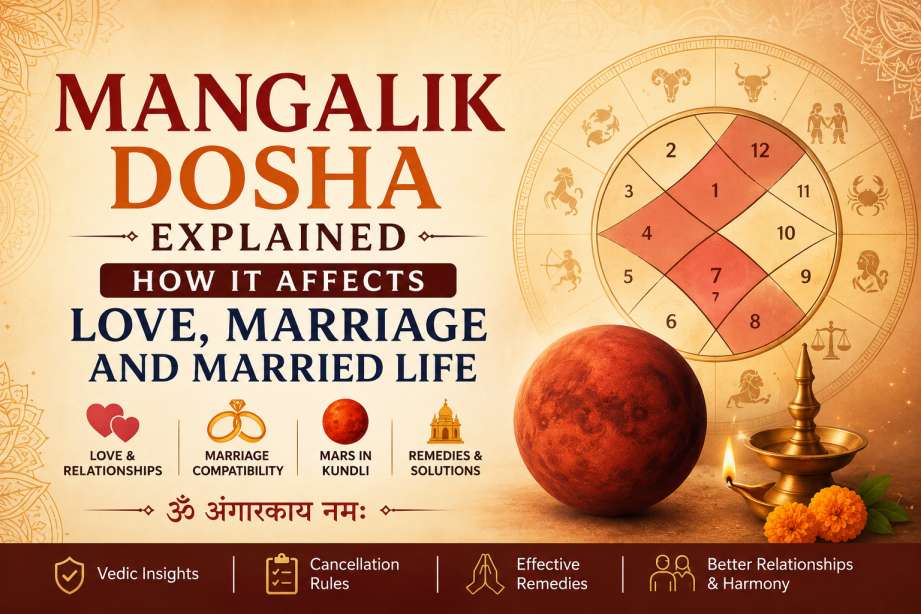
Manglik Dosha is traditionally considered when Mars occupies specific houses in the Lagna chart. Depending on the astrological tradition followed, the houses commonly examined are the 1st, 4th, 7th, 8th, and 12th houses from the Ascendant. Some traditions also examine Mars from the Moon and Venus.
These houses are significant because they relate to personality, domestic happiness, partnership, longevity-related matters, and emotional or physical intimacy.
Why Is Mars Important?
Mars is a fiery and action-oriented planet. It signifies:
- Courage and determination
- Physical energy and passion
- Assertiveness and independence
- Competition and aggression
- Ability to take initiative
- Conflict-handling style
When Mars strongly influences relationship-related houses, traditional astrology may interpret the placement as creating greater intensity or impatience in relationships. However, the actual result depends heavily on Mars’s zodiac sign, house placement, dignity, aspects, conjunctions, and overall chart strength.
How Manglik Dosha May Affect Love Relationships
Manglik Dosha is not necessarily a problem in every relationship. Its influence can sometimes appear as a strong personality, direct communication style, or a need for independence.
In relationships, a strongly placed or afflicted Mars may traditionally be associated with:
- Quick reactions during disagreements
- Strong expectations from a partner
- Emotional or physical intensity
- Difficulty compromising in certain situations
- Competitive behaviour between partners
At the same time, Mars can provide positive qualities. A well-supported Mars can contribute confidence, loyalty, courage, initiative, and the ability to protect and support a partner.
Therefore, calling every Manglik person aggressive or incompatible would be an oversimplification.
Manglik Dosha and Marriage Compatibility
Marriage compatibility should never be decided solely on whether one person is Manglik and the other is non-Manglik.
A detailed Vedic Kundli matching generally considers:
1. Seventh House
The 7th house represents marriage, spouse, partnership, and long-term relationships. Its lord, occupants, aspects, and overall strength are important.
2. Venus and Jupiter
Venus is especially important for relationships, affection, attraction, and marital harmony. Jupiter is traditionally associated with wisdom, guidance, family values, and marital support.
3. Moon
The Moon reflects emotional responses and mental compatibility. Two charts with strong emotional compatibility may handle Mars-related intensity more constructively.
4. Navamsa Chart
The Navamsa (D9) chart is an important divisional chart for assessing marriage and the deeper strength of planetary influences. It should be examined alongside the birth chart rather than independently.
5. Mahadasha and Antardasha
Planetary periods can activate relationship themes at different stages of life. A Manglik placement may not produce the same experience throughout a person’s lifetime.
Does Manglik Dosha Get Cancelled?
Traditional Jyotish includes several Mangal Dosha cancellation or reduction principles, often called Mangal Dosha Bhanga. These can vary according to the classical tradition and calculation method being followed.
Possible mitigating factors may include:
- Mars being strong and well placed
- Mars occupying its own sign or a favourable sign
- Beneficial aspects influencing Mars
- Similar Manglik influence in both charts
- Strong 7th house and 7th lord
- Supportive Venus and Jupiter
- Other planetary combinations reducing relationship stress
Because different schools of Vedic astrology use different cancellation rules, a qualified astrologer should examine the complete chart rather than applying a single rule mechanically.
Practical Remedies for Manglik Dosha
Traditional remedies are generally used as spiritual or supportive practices rather than guaranteed solutions.
Depending on the horoscope, commonly suggested practices include:
- Reciting “Om Angarakaya Namah” with discipline.
- Offering prayers to Lord Hanuman, particularly on Tuesdays.
- Reading or listening to the Hanuman Chalisa.
- Practising patience and conscious communication during conflicts.
- Performing charity or acts of service on Tuesdays.
- Following a suitable Mangal-related Puja only after personalised astrological guidance.
The most practical remedy is often behavioural: learning to manage anger, avoid impulsive decisions, communicate clearly, and respect a partner’s independence.
Manglik Dosha: Myth vs Reality
A common misconception is that a Manglik person cannot have a successful marriage. This is not a balanced interpretation.
Marriage outcomes are influenced by multiple factors, including personality, emotional maturity, communication, family environment, financial expectations, and mutual compatibility. Astrology can provide a traditional framework for examining tendencies, but it should not replace practical relationship judgement.
Similarly, Manglik and non-Manglik marriage is not automatically unsuccessful. The complete compatibility analysis is much more important than one planetary combination.
Conclusion
Manglik Dosha is an important concept in traditional Vedic astrology, but it should be understood in context. Mars can indicate intensity, courage, passion, and assertiveness, while its challenging expression may sometimes correspond with impatience or conflict.
A meaningful marriage assessment should examine the 7th house, 7th lord, Mars, Venus, Jupiter, Moon, Navamsa chart, planetary aspects, and Mahadasha-Antardasha periods. Cancellation and mitigation principles should also be considered before reaching a conclusion.
Instead of fearing the label “Manglik,” couples can use astrology as one perspective for understanding temperament and compatibility. Ultimately, mutual respect, communication, emotional maturity, and shared values remain essential foundations of a healthy married life.
FAQs
1. What is Manglik Dosha?
Manglik Dosha is a traditional Vedic astrology condition associated with Mars occupying certain houses of the birth chart.
It is commonly assessed from the Ascendant and, in some traditions, from the Moon and Venus. The interpretation depends on Mars’s sign, strength, aspects, conjunctions, and the rest of the horoscope.
Related tips:
- Check the complete Kundli.
- Examine Mars’s dignity and aspects.
- Do not judge compatibility from one placement.
2. Can a Manglik person marry a non-Manglik person?
Yes, a Manglik person can marry a non-Manglik person when the overall horoscope compatibility is supportive.
Traditional astrology includes several Mangal Dosha cancellation and mitigation principles. The strength of the 7th house, Venus, Jupiter, Moon, Navamsa, and other planetary combinations should be evaluated before making a conclusion.
Helpful approach: Consider complete Kundli matching rather than simply comparing Manglik labels.
3. Does Manglik Dosha cause divorce?
Manglik Dosha alone cannot be treated as a definite prediction of divorce.
Mars may indicate intensity or conflict tendencies, but relationship outcomes involve numerous astrological and real-life factors. The 7th house, its lord, Venus, Navamsa, planetary periods, and relationship dynamics are important.
Practical remedy: Focus on communication, emotional regulation, compromise, and mutual respect.
4. What are the common remedies for Manglik Dosha?
Traditional remedies include Hanuman worship, Mangal mantras, Tuesday observances, charity, and personalised Vedic rituals.
These practices are traditionally viewed as spiritual support rather than guaranteed methods of changing a marriage outcome. Remedies should ideally be selected according to the complete birth chart.
Common practices:
- Recite “Om Angarakaya Namah.”
- Pray to Lord Hanuman.
- Read Hanuman Chalisa.
- Practise disciplined anger management.
5. Is Manglik Dosha cancellation possible?
Yes, traditional Jyotish describes several conditions under which the effects of Mangal Dosha may be reduced or cancelled.
The applicable rules vary between astrological traditions. Mars’s sign and house, planetary aspects, the strength of the 7th house, and other supportive combinations should all be considered.
Remember: A cancellation rule should not be applied without checking the complete horoscope.
6. Is Manglik Dosha still important in modern marriage matching?
Manglik Dosha remains culturally significant in many Indian families, but it is best considered as one factor among several.
Modern relationships also depend on communication, emotional compatibility, financial expectations, career priorities, family boundaries, and personal values. Astrology can offer a traditional perspective, but practical compatibility deserves equal attention.
Best approach: Combine astrological assessment with honest conversations and informed relationship decisions.