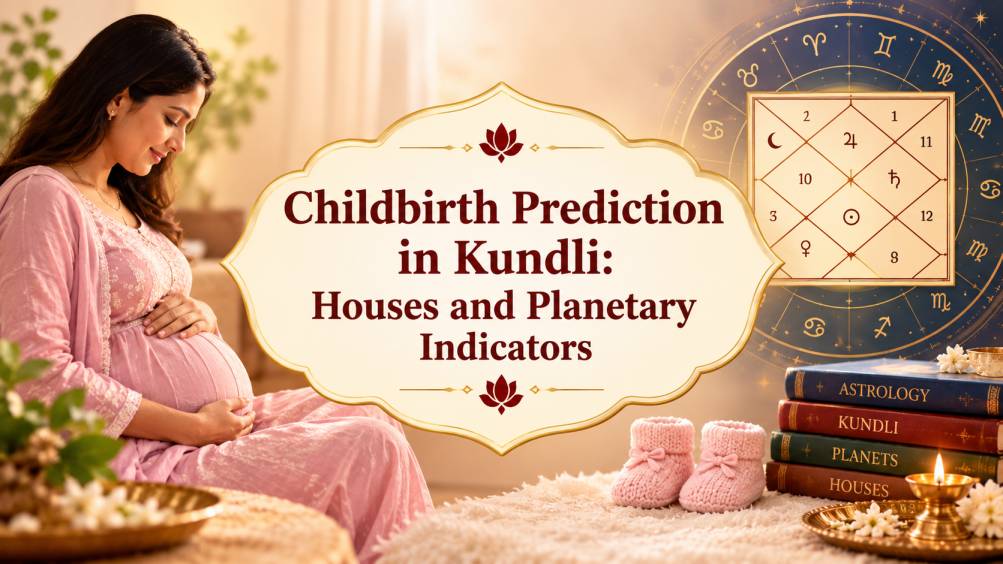
In Vedic astrology, childbirth prediction in Kundli traditionally involves examining the fifth house, Jupiter, the fifth house lord and specific divisional charts to understand themes related to children and parenthood. Known as Santana Yoga or progeny-related indications in traditional Jyotish, these factors are studied alongside the overall birth chart rather than in isolation.
For many Indian families, questions about childbirth, family planning and parenthood carry deep emotional and cultural significance. Astrology may offer a traditional framework for reflection, but it cannot scientifically establish whether a person will conceive, identify fertility problems or guarantee when a child will be born.
Understanding the astrological indicators can help readers learn how a traditional Kundli analysis is structured without creating unnecessary fear or unrealistic expectations. Medical guidance, personal circumstances and informed family decisions remain essential when planning for a child.
Which Houses Are Important for Childbirth Prediction in Kundli?
Vedic astrology considers several houses when examining childbirth and family-related themes. The interpretation depends on their lords, planetary placements, aspects and the overall horoscope.
1. Fifth House: The Primary House for Children
The fifth house, or Putra Bhava, is traditionally the principal house associated with children, progeny, creativity and the continuation of family life.
Astrologers examine:
- The zodiac sign occupying the fifth house.
- The placement and strength of the fifth house lord.
- Benefic and challenging planetary influences on the fifth house.
- Connections between the fifth house and other relevant houses.
A well-supported fifth house may traditionally be interpreted as favourable for progeny-related matters. However, no single placement can confirm childbirth or establish fertility.
2. Ninth House: Fortune and Family Blessings
The ninth house is associated with fortune, dharma, blessings and spiritual beliefs. Some traditional astrologers consider its relationship with the fifth house when studying progeny-related combinations.
A connection between the fifth and ninth house lords may be interpreted within the broader chart as a supportive indication. Its meaning still depends on planetary dignity, aspects and other chart factors.
3. Second House: Family Expansion
The second house represents family, accumulated resources, speech and family continuity. Its relationship with the fifth house may be examined when considering the growth of a household.
However, the second house does not independently predict childbirth. It is one component of a wider traditional interpretation.
4. Seventh and Eighth Houses: Partnership and Transformation
The seventh house represents marriage and partnerships, while the eighth house relates to shared resources, sudden changes and other complex themes.
Astrologers may examine these houses alongside the fifth house to understand the broader relationship context. Challenging placements should not automatically be interpreted as infertility, pregnancy loss or denial of children.
Planetary Indicators for Childbirth in Vedic Astrology
Jupiter: The Putra Karaka
Jupiter, known as Guru or Brihaspati, is traditionally regarded as the natural significator of children in Vedic astrology.
Astrologers assess Jupiter’s sign, house, dignity, aspects, conjunctions and relationship with the fifth house lord. A favourable Jupiter may be interpreted as supportive of progeny-related matters within the traditional system.
Nevertheless, Jupiter’s placement cannot medically determine fertility or guarantee conception.
Fifth House Lord
The fifth house lord is another central factor in childbirth prediction. Its placement and relationship with Jupiter and other relevant houses are traditionally considered.
For example, a connection between the fifth house lord and a benefic planet may be interpreted differently from one involving several challenging influences. Neither configuration should be treated as a definite prediction about a person’s ability to have children.
Venus and the Moon
Venus is traditionally associated with reproduction, relationships, pleasure and vitality, while the Moon represents emotions, nurturing and care.
Some astrologers include these planets in a broader progeny analysis. Their meanings depend on the complete horoscope, and they cannot replace medical assessments of reproductive health.
Role of the Saptamsha Chart (D7) in Childbirth Prediction
The Saptamsha, or D7 divisional chart, is traditionally used in Vedic astrology to explore themes related to children and progeny.
Astrologers may examine:
- The D7 Ascendant and its lord.
- The fifth house and its lord in the D7 chart.
- Jupiter’s placement and connections.
- Relationships between the D1 birth chart and D7 chart.
- Relevant Vimshottari Dasha and Antardasha periods.
The D7 chart is considered supplementary to the main birth chart, not a standalone method of prediction.
Birth time accuracy matters because the Ascendant and divisional chart placements can change with small differences in recorded birth time. If the birth time is uncertain, an interpretation may be less reliable even within the astrological framework.
Can Vimshottari Dasha Predict Childbirth Timing?
In traditional Jyotish, astrologers sometimes examine planetary periods when assessing the timing of family-related events.
Periods involving the fifth house lord, Jupiter or planets connected with the fifth house may be interpreted as potentially relevant. Some astrologers also consider transits of Jupiter and other planets.
However, these methods do not have established scientific validity for predicting conception or delivery dates. Pregnancy timing depends on biological, medical and personal factors, and delivery dates can vary.
Practical guidance: Use astrology, if meaningful to you, as a cultural or spiritual perspective rather than a basis for postponing fertility assessment or treatment.
Santana Yoga and Challenges in the Birth Chart
Santana Yoga is a broad term used for combinations traditionally associated with progeny. Different astrological schools interpret such combinations differently.
Astrologers may examine supportive relationships among the fifth house, its lord, Jupiter and the D7 chart. Challenging combinations may prompt a more detailed examination of the horoscope.
It is important to avoid conclusions such as permanent denial of children, guaranteed infertility or inevitable pregnancy complications based on a single planetary placement. These claims can cause considerable emotional distress and are not medically established.
Traditional Remedies for Santana-Related Concerns
Some Hindu traditions include devotional practices associated with family well-being and the wish for children. These may offer comfort to people who find spiritual practice meaningful, but they are not proven fertility treatments.
Common practices include:
- Prayer and devotion: Some families worship Lord Krishna, Lord Vishnu or Santana Gopala according to their traditions.
- Mantra recitation: Devotees may recite Santana Gopala prayers as part of personal worship.
- Charity and service: Offering food or essential supplies to people in need can be a meaningful expression of compassion.
- Emotional support: Maintain open communication with your partner and seek support during stressful periods.
- Medical consultation: Consult a qualified gynaecologist or fertility specialist when conception is delayed or when there are reproductive health concerns.
Gemstones, rituals or costly astrological remedies should never be presented as guaranteed ways to conceive. Spiritual practices can complement personal well-being but should not replace evidence-based healthcare.
Conclusion
Childbirth prediction in Kundli traditionally involves the fifth house, its lord, Jupiter, the ninth and second houses, and the Saptamsha (D7) chart. Astrologers may also consider Venus, the Moon, Santana Yoga and relevant planetary periods when interpreting progeny-related themes.
These indicators belong to a traditional belief system and cannot reliably determine fertility, guarantee childbirth or establish pregnancy timing. Every horoscope requires a broader interpretation, and even experienced astrologers may disagree about specific combinations.
For readers exploring this subject, the best approach is to combine cultural understanding with compassion, realistic expectations and informed decision-making. If you are planning a family, prioritise open communication and appropriate medical guidance while treating spiritual practices as a personal source of comfort. A thoughtful approach can respect tradition without allowing uncertain predictions to create fear or delay important care.
FAQs: Childbirth Prediction in Kundli
1. Which house is responsible for childbirth in Kundli?
The fifth house is traditionally considered the primary house for children and progeny in Vedic astrology.
Astrologers also examine the fifth house lord, Jupiter, relevant planetary aspects and the Saptamsha chart. The fifth house alone cannot establish whether someone will conceive.
Helpful points:
- Examine the entire birth chart rather than one placement.
- Avoid interpreting challenging combinations as definite medical outcomes.
2. Which planet is responsible for children in Vedic astrology?
Jupiter is traditionally regarded as the natural significator of children, also called Putra Karaka, in Vedic astrology.
Its position is assessed alongside the fifth house and its lord. Venus, the Moon and other planetary relationships may also be considered by some astrologers.
Helpful tip: Treat planetary interpretations as traditional symbolism rather than a medical assessment of reproductive health.
3. Can Kundli predict when I will have a child?
Some astrologers use Vimshottari Dasha, Antardasha and planetary transits to suggest potentially significant periods, but these methods cannot reliably establish when conception or childbirth will occur.
Pregnancy timing depends on reproductive health, age, individual circumstances and other biological factors.
- Seek medical guidance when needed.
- Do not postpone fertility evaluation because of an astrological prediction.
- Avoid treating estimated astrological periods as guaranteed dates.
4. What is the importance of the D7 chart in childbirth prediction?
The Saptamsha (D7) chart is a divisional chart traditionally used to study children and progeny-related themes in Vedic astrology.
Astrologers may analyse its Ascendant, fifth house, planetary placements and connections with the main birth chart. Its interpretation depends partly on the accuracy of the recorded birth time.
Helpful tip: If exploring D7 interpretations, ensure that the birth details are as accurate as possible and avoid relying on the divisional chart alone.
5. What is Santana Yoga in Vedic astrology?
Santana Yoga refers broadly to astrological combinations traditionally associated with progeny and children.
Different Jyotish traditions may define and interpret these combinations differently. No Santana Yoga can scientifically confirm conception, infertility or the birth of a child.
Helpful tip: Approach such interpretations without fear and seek qualified healthcare advice for reproductive concerns.
6. Does an afflicted fifth house mean a person cannot have children?
No, a challenging fifth-house placement does not establish that a person will be unable to have children.
Traditional astrologers interpret the fifth house alongside its lord, Jupiter, the D7 chart and other factors. Astrological interpretations are not medically validated fertility assessments.
- Do not assume infertility from a Kundli.
- Consult a qualified medical professional for fertility concerns.
- Avoid expensive remedies promoted with guarantees.
7. Which remedies are suggested for childbirth in Vedic astrology?
Some devotees follow Santana Gopala prayers, worship Lord Krishna or Lord Vishnu, and practise charity as spiritual expressions of hope for family well-being.
These practices may provide personal comfort but are not scientifically proven to improve fertility. They should complement, not replace, appropriate medical care.
Helpful tip: Choose affordable practices consistent with your beliefs and avoid anyone promising guaranteed pregnancy through rituals or gemstones.
8. Can Jupiter Mahadasha or the fifth lord’s Dasha indicate childbirth?
In traditional Jyotish, Jupiter Mahadasha or a planetary period connected with the fifth house may be interpreted as relevant to progeny-related events, depending on the entire horoscope.
However, planetary periods cannot reliably predict conception or delivery, and interpretations vary among astrologers.
Helpful tip: Use Dasha analysis as a cultural or spiritual perspective, while basing family-planning and healthcare decisions on medical advice and personal circumstances.