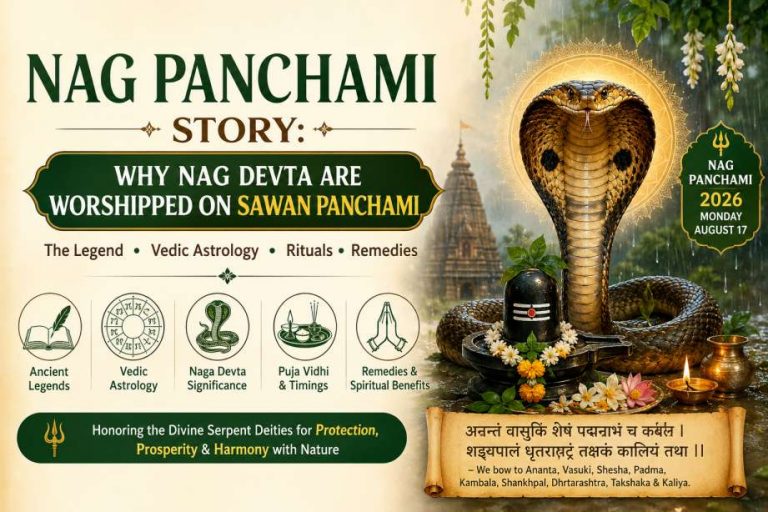
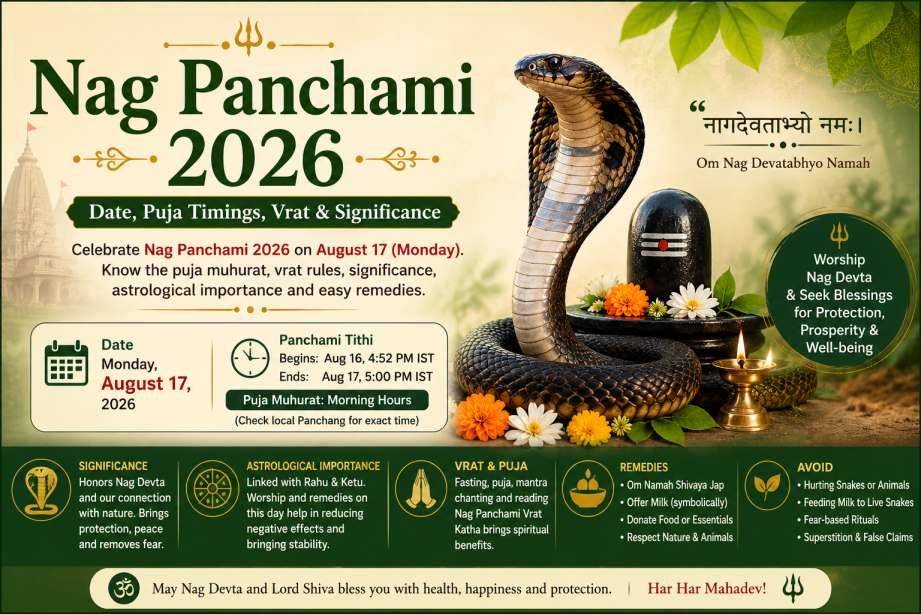
Nag Panchami 2026 will be observed on Monday, August 17, 2026, during Shukla Paksha Panchami of the Shravan month in the North Indian Purnimanta calendar. According to location-based Panchang calculations, the Panchami Tithi begins on August 16 at 4:52 PM IST and ends on August 17 at 5:00 PM IST.
Nag Panchami is traditionally dedicated to the worship of Nag Devta, representing the sacred relationship between human beings, nature and the serpent symbolism found throughout Hindu tradition. The festival is also associated with Lord Shiva, Kundalini symbolism and the balancing of certain planetary influences in Vedic astrology.
For devotees, the day can be used for prayer, fasting, charity, self-discipline and reflection rather than fear-based rituals or superstition.
Nag Panchami 2026 Date and Puja Timings
When is Nag Panchami in 2026?
- Date: Monday, August 17, 2026
- Tithi: Shukla Paksha Panchami
- Panchami Tithi Begins: August 16, 2026, 4:52 PM IST
- Panchami Tithi Ends: August 17, 2026, 5:00 PM IST
- Puja: Preferably during the morning Panchami period
The exact Nag Panchami Puja Muhurat varies by location because sunrise and local Panchang calculations differ. For example, Drik Panchang gives 5:22 AM–7:58 AM IST for Sheohar and 5:53 AM–8:30 AM IST for Gohana.
Therefore, devotees should check a location-specific Panchang before fixing the final puja time.
Why Is Nag Panchami Important?
Nag Panchami has religious, cultural and symbolic importance.
In Hindu traditions, serpents are connected with several deities and cosmic symbols. Shesha or Ananta, for example, is associated with Lord Vishnu, while Lord Shiva is traditionally depicted with a serpent around his neck.
The serpent can also represent transformation, hidden energy, protection and the cycle of renewal.
Nag Panchami is therefore not simply about worshipping snakes. At a deeper level, it encourages respect for nature and recognition of forces that humans cannot always control.
Nag Panchami and Vedic Astrology
From an astrological perspective, Nag Panchami is particularly interesting because serpent symbolism is closely connected with the lunar nodes Rahu and Ketu.
Rahu and Ketu are shadow planets in Vedic astrology. They do not have physical bodies like the visible planets, but their position in a birth chart is traditionally interpreted as influencing desires, attachments, uncertainty, karmic patterns and spiritual development.
Rahu-Ketu and Sarpa Symbolism
The association between serpents and Rahu-Ketu has contributed to the popularity of Nag Panchami remedies among people concerned about Kaal Sarp Dosha or challenging nodal placements.
However, it is important not to assume that every difficulty in life is caused by Kaal Sarp Dosha. A complete Kundli analysis should consider the Lagna, planetary strength, house ownership, aspects, yogas and Mahadasha-Antardasha before drawing conclusions.
Nag Panchami can instead be approached as an opportunity for disciplined spiritual practice.
Which Houses Can Be Considered?
In Vedic astrology, the following houses may become relevant when studying Rahu, Ketu and serpent symbolism:
- 2nd House: Family, speech and accumulated wealth
- 4th House: Emotional security, home and inner peace
- 5th House: Children, intelligence and past-life tendencies
- 8th House: Transformation, hidden matters and sudden changes
- 12th House: Spirituality, isolation and expenditure
The actual results depend entirely on the individual horoscope.
Nag Panchami Vrat and Puja Vidhi
People observe the Nag Panchami vrat according to their family and regional traditions. Some keep a complete fast, while others follow a simpler sattvic diet.
Simple Puja Method
- Take a bath and wear clean clothes.
- Clean the puja area and place an image or symbolic representation of Nag Devta.
- Offer flowers, turmeric, sandalwood and other traditional offerings.
- Light a diya and incense.
- Offer prayers to Nag Devta and Lord Shiva.
- Chant “Om Namah Shivaya” or a traditional Nag Devta prayer.
- Read or listen to the Nag Panchami Vrat Katha.
- Offer food or charity according to your family tradition.
A simple prayer can be:
“नागदेवताभ्यो नमः।”
The purpose is devotion and gratitude rather than fear.
Practical Remedies for Nag Panchami 2026
Traditional remedies can be kept simple and ethical.
- Chant Om Namah Shivaya 108 times.
- Offer prayers to Lord Shiva.
- Donate food, grains or essential items to someone in need.
- Practice silence or meditation for some time.
- Avoid anger, arguments and unnecessary conflict.
- Respect nature and avoid disturbing snakes or other wildlife.
- If concerned about Rahu-Ketu, get the complete Kundli assessed rather than relying on a single dosha.
Important: Milk should not be poured directly into snake burrows or offered to live snakes. Snakes generally do not naturally consume milk, and feeding or approaching wild snakes can harm both the animal and the person.
Nag Panchami and Regional Traditions
Nag Panchami is celebrated differently across India. The North Indian observance is August 17, 2026, while Gujarat follows a different calendar tradition and observes Nag Pancham on September 1, 2026.
Similarly, South Indian regions may follow Amanta-based calendars and local Panchang traditions. This is why the date and puja timing should always be checked according to the devotee’s location and regional calendar.
What Should You Avoid on Nag Panchami?
Traditional observances commonly emphasize restraint and respectful conduct.
Avoid:
- Hurting or disturbing snakes and other animals
- Feeding milk directly to wild snakes
- Performing rituals out of fear
- Claiming that every problem is caused by Rahu, Ketu or Kaal Sarp Dosha
- Taking major astrological decisions without examining the complete Kundli
- Treating remedies as substitutes for practical action
The most meaningful observance combines spiritual discipline with responsible behaviour.
Conclusion
Nag Panchami 2026 on August 17 offers an opportunity to connect traditional worship with a more thoughtful understanding of nature, spirituality and Vedic symbolism. The festival’s connection with Nag Devta, Lord Shiva and Rahu-Ketu makes it particularly relevant to those interested in Vedic astrology, but astrological remedies should always be interpreted through the complete birth chart rather than one isolated combination.
Devotees can observe the day through prayer, fasting according to their capacity, charity, meditation and respectful treatment of animals. Above all, Nag Panchami can be viewed as a reminder that spirituality is not only about rituals—it is also about balance, responsibility and harmony with the natural world.
FAQs
1. When is Nag Panchami 2026?
Nag Panchami 2026 will be observed on Monday, August 17, 2026, in the North Indian calendar.
The Panchami Tithi begins on August 16 at 4:52 PM IST and ends on August 17 at 5:00 PM IST.
Related tips:
- Follow your local Panchang.
- Perform puja during the Panchami period.
- Check location-specific sunrise timings.
2. What is the Nag Panchami Puja Muhurat in 2026?
The exact Nag Panchami Puja Muhurat depends on the location and local sunrise.
For example, the listed puja period is 5:22 AM–7:58 AM IST in Sheohar and 5:53 AM–8:30 AM IST in Gohana. These differences show why a city-specific Panchang is preferable.
For best practice:
- Use local Panchang calculations.
- Prefer the morning puja period.
- Avoid assuming another city’s muhurat applies everywhere.
3. Can Nag Panchami remedies help with Rahu-Ketu problems?
Traditional astrology considers Nag Panchami an appropriate day for spiritual practices associated symbolically with Rahu-Ketu, but remedies should not be treated as guaranteed solutions.
Rahu and Ketu require interpretation based on their houses, signs, aspects, planetary associations and dasha periods. A Kaal Sarp Dosha claim should similarly be evaluated through the complete Kundli.
Simple practices include:
- Shiva mantra chanting
- Meditation
- Charity
- Self-discipline
- Prayer according to family tradition
4. Should milk be offered to snakes on Nag Panchami?
Milk should not be poured into snake burrows or fed directly to wild snakes.
Although milk offerings appear in some traditional practices, approaching or feeding live snakes can be unsafe and harmful to the animals. A symbolic image or temple representation can be worshipped instead.
A safer approach:
- Worship a Nag Devta image.
- Offer flowers and prayers.
- Support wildlife protection.
- Avoid handling live snakes.
5. What should be eaten during Nag Panchami vrat?
The food rules for Nag Panchami vrat vary according to regional and family traditions.
Some devotees observe a strict fast, while others consume fruits, milk products or simple sattvic foods. People with dietary restrictions should choose a sustainable fasting practice rather than forcing a rigid rule.
Remember:
- Stay adequately hydrated.
- Follow your family tradition.
- Avoid overeating after the fast.
- Health and safety should come first.
6. Is Nag Panchami the same date throughout India?
No, Nag Panchami can fall on different dates in different regional calendars.
For example, North India observes Nag Panchami on August 17 in 2026, while Gujarat’s Nag Pancham is listed for September 1.
Therefore:
- Check your regional Panchang.
- Use location-specific puja timings.
- Consider whether your region follows Purnimanta or Amanta traditions.