Raksha Bandhan, popularly known as Rakhi, is one of India’s most cherished festivals celebrating the bond of affection, protection and responsibility between siblings. In Vedic tradition, the festival is observed on Shravana Shukla Purnima, the full Moon day of the Shravana month.
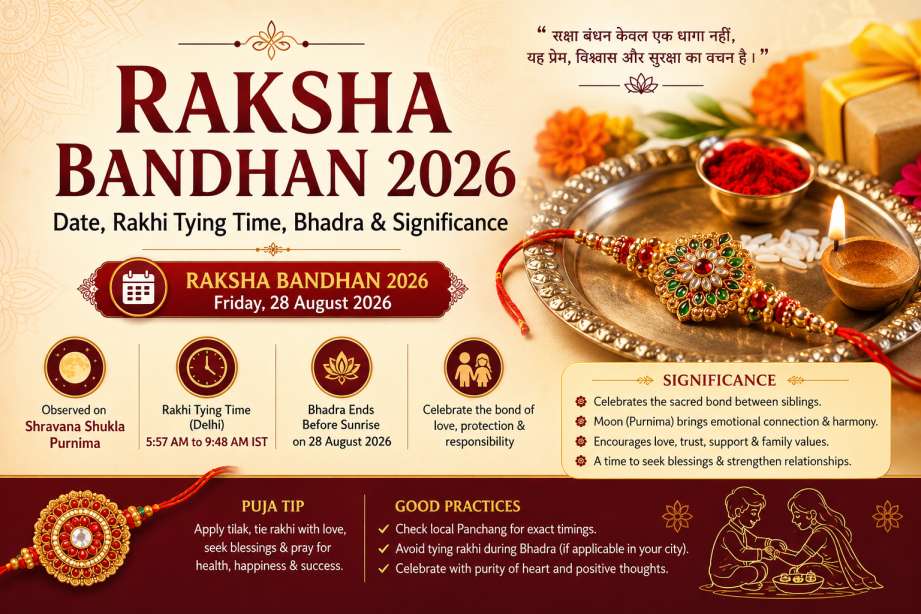
In 2026, Raksha Bandhan falls on Friday, August 28. The Purnima Tithi begins on August 27 at 9:08 AM IST and ends on August 28 at 9:48 AM IST. According to the New Delhi Panchang, the Bhadra period has ended before sunrise on Raksha Bandhan day, making the morning suitable for the Rakhi ceremony.
Beyond the ritual, Raksha Bandhan has an interesting astrological dimension. The full Moon represents emotional connection, while the sacred thread symbolises a conscious commitment to care, support and mutual responsibility.
Raksha Bandhan 2026 Date and Timings
For New Delhi and nearby regions, the important Panchang details are:
- Raksha Bandhan: Friday, August 28, 2026
- Purnima Tithi begins: August 27 at 9:08 AM IST
- Purnima Tithi ends: August 28 at 9:48 AM IST
- Bhadra: Ends before sunrise on August 28
- Rakhi tying ceremony: Approximately 5:57 AM to 9:48 AM IST in New Delhi
The exact Rakhi Muhurat can vary slightly from city to city because sunrise and local Panchang calculations differ. Therefore, people outside Delhi should check their city-specific Panchang before performing the ceremony.
Is There Bhadra on Raksha Bandhan 2026?
No significant Bhadra restriction remains during the Raksha Bandhan ceremony in New Delhi in 2026.
Bhadra is traditionally associated with the Vishti Karana and is generally avoided for important auspicious activities, including Rakhi tying. Traditional Panchang guidance recommends waiting until Bhadra has ended before beginning the Raksha Bandhan ritual.
For 2026, the important point is that Bhadra has ended before sunrise on August 28 in New Delhi. This means families do not need to postpone Rakhi tying because of Bhadra on that morning.
Astrological Significance of Raksha Bandhan
Full Moon and Emotional Bonds
Raksha Bandhan occurs on Purnima, when the Moon is fully illuminated. In Vedic astrology, the Moon signifies the mind, emotions, nurturing nature, memory and family attachments.
This makes the festival naturally associated with emotional reconnection. It is an appropriate occasion to resolve misunderstandings, express gratitude and strengthen family relationships.
Role of Venus and Jupiter
Raksha Bandhan also carries symbolic associations with Venus and Jupiter.
- Venus represents affection, harmony, relationships and appreciation.
- Jupiter represents wisdom, blessings, protection, ethics and guidance.
- Moon represents emotional security and family bonding.
From an astrological perspective, the festival can therefore be viewed as an opportunity to consciously cultivate qualities represented by these planets rather than as a guarantee of a particular material outcome.
The Third and Eleventh Houses
In an individual horoscope, relationships with siblings are primarily examined through the 3rd house, while the 11th house can provide additional information about elder siblings, networks and supportive relationships.
The condition of these houses, their lords and relevant planetary influences may be considered when analysing sibling relationships. However, a festival ritual should not be interpreted as a substitute for a complete birth-chart analysis.
Raksha Bandhan Puja Vidhi
A simple and meaningful Rakhi ceremony can be performed as follows:
- Clean the puja area and prepare a Raksha Bandhan thali.
- Keep rakhi, roli or kumkum, rice, diya, sweets and flowers.
- The sister or family member applies tilak on the brother’s forehead.
- Tie the Rakhi while offering prayers for wellbeing and protection.
- Perform aarti and offer sweets.
- Exchange blessings, gifts and heartfelt wishes.
A traditional spirit of the ceremony is captured by the idea of Raksha, or protection—not merely physical protection, but emotional, moral and familial support.
Practical Astrological Remedies for Raksha Bandhan
Raksha Bandhan can also become a day for simple, positive spiritual practices.
- For family harmony: Offer prayers to your family deity and consciously avoid arguments.
- For emotional balance: Spend a few quiet minutes in prayer or meditation before the ceremony.
- For sibling relationships: Resolve one old misunderstanding through respectful conversation.
- For Jupiter-related blessings: Donate food, books or useful educational material to someone in need.
- For Moon-related peace: Offer water to Shiva or spend time in calm reflection.
These practices are best understood as traditional spiritual disciplines rather than guaranteed methods for changing destiny.
What Should You Avoid?
While celebrating Raksha Bandhan, keep the focus on the relationship rather than excessive ritual anxiety.
Avoid:
- Tying Rakhi during a locally applicable Bhadra period.
- Treating astrology as a replacement for genuine communication.
- Turning the festival into a competition over expensive gifts.
- Ignoring city-specific Panchang differences.
- Using fear-based predictions about family relationships.
The most meaningful “remedy” is often simple: respect, forgiveness, gratitude and consistent support.
Conclusion
Raksha Bandhan 2026 will be celebrated on Friday, August 28, with the New Delhi Rakhi tying window extending from approximately 5:57 AM to 9:48 AM IST. Purnima ends at 9:48 AM IST, while Bhadra has already ended before sunrise, so the major Bhadra-related restriction does not interfere with the ceremony in New Delhi.
Astrologically, the festival offers a meaningful opportunity to reflect on the Moon’s emotional symbolism, the 3rd house of siblings and the broader principles of Venusian harmony and Jupiterian guidance. Ultimately, Raksha Bandhan is less about prediction and more about consciously strengthening relationships.
Before the festival, check your local Panchang for city-specific timings and use the occasion to express something that is often left unsaid: gratitude for the people who stand beside you.
FAQs
1. When is Raksha Bandhan 2026?
Raksha Bandhan 2026 falls on Friday, August 28.
It is observed on Shravana Purnima. In 2026, Purnima begins on August 27 at 9:08 AM IST and ends on August 28 at 9:48 AM IST.
Tips: Check your local Panchang because sunrise-based timings can vary by location.
2. What is the Rakhi tying time in Delhi in 2026?
In New Delhi, the Rakhi ceremony window is approximately 5:57 AM to 9:48 AM IST on August 28.
This timing is based on the New Delhi Panchang, where Bhadra has ended before sunrise.
Tips: If you live elsewhere, use your city-specific Muhurat rather than copying Delhi timings.
3. Is Bhadra applicable on Raksha Bandhan 2026?
For New Delhi, Bhadra has ended before sunrise on August 28, so it does not restrict the Rakhi ceremony that morning.
Traditionally, Rakhi tying is avoided during Bhadra because it is considered unsuitable for auspicious activities.
Tips: Always check Bhadra locally because its timing depends on the Panchang and location.
4. Why is Raksha Bandhan astrologically connected with the Moon?
Raksha Bandhan falls on Purnima, making the Moon an important symbolic influence for the festival.
In Vedic astrology, the Moon represents emotions, mental peace, nurturing and family attachment. The festival therefore provides a natural occasion for emotional reconnection and strengthening family bonds.
Simple practice: Spend a few peaceful moments with family and avoid unnecessary conflict.
5. Which house represents siblings in Vedic astrology?
The 3rd house is primarily associated with younger siblings, courage, communication and sibling relationships.
Astrologers may also examine the 11th house and the condition of the relevant house lords when assessing sibling dynamics. A complete interpretation requires the individual birth chart rather than a single planetary placement.
Practical takeaway: Use astrology as a reflective tool while giving equal importance to communication and mutual respect.
6. What can I do on Raksha Bandhan for family harmony?
The simplest remedy is to combine prayer with a genuine effort to improve communication and understanding.
Traditional practices such as lighting a diya, praying to the family deity, donating useful items and seeking elders’ blessings can add spiritual meaning to the occasion.
Easy remedies:
- Pray together as a family.
- Donate food or educational materials.
- Forgive an old misunderstanding.
- Express gratitude to siblings and elders.