
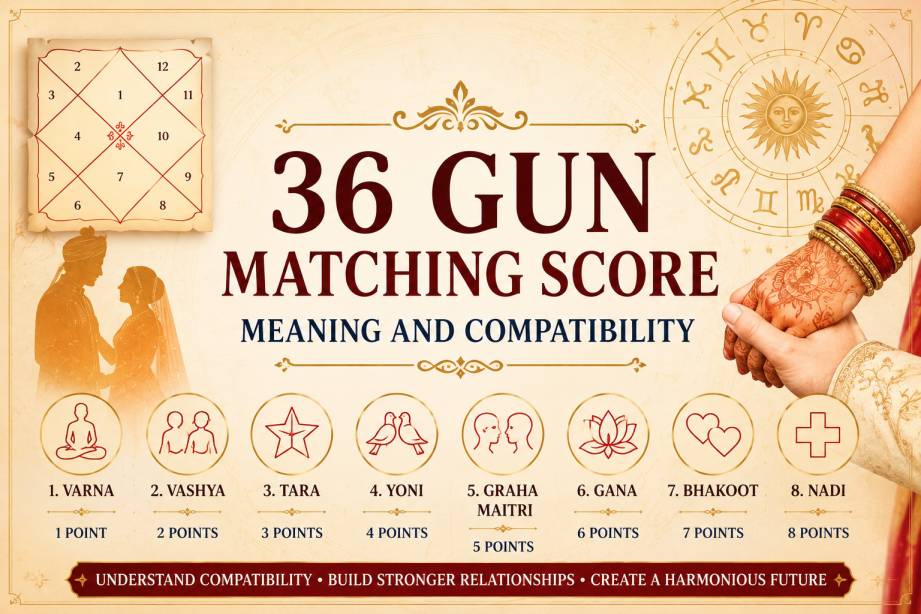
In traditional Vedic astrology, 36 Gun Matching is one of the most commonly used methods for assessing marriage compatibility. Also known as Ashtakoota Milan or Guna Milan, it compares the Moon Nakshatra and Rashi of two individuals through eight compatibility factors, collectively carrying a maximum of 36 points.
A higher score generally indicates greater compatibility in areas such as temperament, communication, emotional bonding, health-related considerations and family harmony. However, the score should not be treated as a standalone prediction of marital success.
A meaningful Kundli matching process also considers the 7th house, its lord, Venus, Jupiter, Navamsa chart, planetary aspects, Dashas and important Doshas. Therefore, the 36 Gun score is best understood as an initial compatibility framework rather than a final verdict on a relationship.
What Is the 36 Gun Matching System?
The traditional Ashtakoota system evaluates eight areas of compatibility between prospective partners. These eight Kootas together add up to 36 Gunas.
| Koota | Maximum Points | Main Area |
| Varna | 1 | Values and spiritual compatibility |
| Vashya | 2 | Mutual influence and attraction |
| Tara | 3 | Birth-star compatibility |
| Yoni | 4 | Physical and instinctive compatibility |
| Graha Maitri | 5 | Mental and intellectual bonding |
| Gana | 6 | Temperament and nature |
| Bhakoot | 7 | Emotional and family compatibility |
| Nadi | 8 | Health and biological compatibility |
The calculation is traditionally based primarily on the Janma Nakshatra and Moon sign of both individuals.
36 Gun Matching Score: What Does It Mean?
The total score can provide a broad indication of compatibility, but different scores should be interpreted carefully.
0–17 Gunas
A score below 18 is traditionally considered less favourable for marriage compatibility under Ashtakoota Milan.
However, this does not automatically mean that marriage will fail. Other strengths in the birth charts can significantly influence the overall picture.
18–23 Gunas
A score of 18 or above traditionally crosses the commonly used minimum benchmark for Guna Milan.
This range suggests that basic compatibility may be present, but detailed horoscope analysis is particularly useful before reaching a conclusion.
24–28 Gunas
This range is generally viewed as a good level of compatibility under the traditional scoring system.
The partners may have favourable similarities or complementary qualities, depending on which Kootas contribute to the score.
29–32 Gunas
A score in this range is traditionally considered very favourable.
Nevertheless, a high score cannot compensate for serious challenges elsewhere in the birth charts, particularly concerning marriage houses or major planetary afflictions.
33–36 Gunas
A score close to 36 is often described as highly compatible.
Yet 36/36 does not guarantee a perfect marriage. Marriage involves communication, emotional maturity, financial expectations, family dynamics and individual choices that cannot be measured entirely through Guna Milan.
Understanding the Eight Kootas
1. Varna – 1 Guna
Varna examines traditional value and spiritual compatibility. It carries only one point, so it has relatively limited weight in the overall calculation.
2. Vashya – 2 Gunas
Vashya relates to mutual attraction, influence and interpersonal dynamics. It can offer insight into how naturally two individuals may respond to each other.
3. Tara – 3 Gunas
Tara Koota compares the birth stars and is traditionally associated with wellbeing, fortune and the supportive quality of the relationship.
4. Yoni – 4 Gunas
Yoni Koota represents instinctive and physical compatibility. It is traditionally used to understand attraction and intimate temperament.
5. Graha Maitri – 5 Gunas
Graha Maitri evaluates the friendship between the planetary lords of the Moon signs. It is particularly relevant to mental compatibility, communication and mutual understanding.
6. Gana – 6 Gunas
Gana represents temperament and behavioural nature. Traditional classifications include Deva, Manushya and Rakshasa Gana.
The purpose is not to label one personality as good or bad, but to understand differences in temperament and behavioural patterns.
7. Bhakoot – 7 Gunas
Bhakoot is one of the higher-weighted Kootas and is associated traditionally with emotional compatibility, family life and long-term relationship dynamics.
Certain combinations may produce what is traditionally called Bhakoot Dosha. However, cancellation rules and the wider horoscope must be examined before interpreting it negatively.
8. Nadi – 8 Gunas
Nadi carries the highest weight, with eight points. Traditional astrology associates it with health, biological compatibility and progeny-related considerations.
When both individuals have the same Nadi, it may be classified as Nadi Dosha. However, classical interpretation includes various exceptions and cancellation principles, so simply seeing a zero in Nadi Koota should not be treated as an automatic rejection.
Is 36 Gun Matching Enough for Marriage?
No. A Guna score alone is not sufficient for a complete marriage prediction.
A detailed Kundli matching should ideally examine:
- 7th house and 7th lord
- Venus and Jupiter
- Moon and emotional compatibility
- Navamsa or D9 chart
- Manglik or Kuja Dosha
- Major planetary aspects
- Mahadasha and Antardasha
- Bhakoot and Nadi considerations
- Longevity and overall marital stability indicators
For example, two people may score 30 Gunas but have challenging planetary periods affecting marriage. Conversely, a couple with a moderate score may have strong 7th-house connections and supportive Dashas.
This is why experienced astrologers generally avoid judging a marriage solely from the final number.
Practical Remedies for Compatibility Concerns
Traditional remedies should be approached as spiritual practices rather than guaranteed methods for changing an astrological result.
Depending on the individual horoscope, an astrologer may suggest:
- Regular prayers to Lord Shiva and Goddess Parvati
- Reciting “Om Namah Shivaya” with devotion
- Offering prayers to the family deity
- Charity and service on suitable days
- Respecting parents and elders
- Maintaining honest communication between partners
- Performing traditional Dosha-specific remedies only after examining the complete Kundli
The most useful real-life remedy is often better communication, realistic expectations and mutual respect.
Conclusion
The 36 Gun Matching Score provides a structured traditional method for examining marriage compatibility through eight Kootas. A score of 18 or more is commonly regarded as the basic benchmark, while higher scores are generally viewed as more favourable.
However, the number alone cannot describe the complete potential of a marriage. Nadi, Bhakoot, Gana and other Kootas need contextual interpretation, while the 7th house, Venus, Jupiter, Navamsa and planetary periods can provide deeper insights.
For couples considering marriage, Kundli Milan should therefore be used as a tool for understanding strengths, differences and potential challenges—not as a substitute for personal compatibility, communication and informed decision-making.
FAQs
1. Is 18 Gunas enough for marriage?
Traditionally, 18 Gunas is considered the minimum acceptable benchmark in Ashtakoota Milan, but it is not a guarantee of marital compatibility.
The final score only represents the combined result of eight Kootas. A detailed horoscope comparison can reveal strengths or challenges that the Guna score does not capture.
Related tip: Check the 7th house, 7th lord, Venus, Jupiter and Navamsa before making a final assessment.
2. Is 36 out of 36 Gun Matching perfect?
A 36/36 score is considered highly favourable under the traditional Guna Milan system, but it does not guarantee a perfect marriage.
A relationship also depends on emotional maturity, communication, values, finances, family expectations and individual choices. Astrology itself should therefore not be reduced to a single compatibility number.
Practical insight: Treat a high score as one positive indicator rather than a promise of lifelong harmony.
3. Which Guna is most important in Kundli Matching?
Nadi carries the highest weight at 8 points, followed by Bhakoot at 7 and Gana at 6 points.
Nadi is traditionally associated with health and progeny-related considerations, while Bhakoot and Gana address broader relationship and temperament factors. Their interpretation requires context.
Remember: A zero in one Koota should not automatically be treated as a reason to reject a match.
4. What if the Kundli has Nadi Dosha?
Nadi Dosha should be assessed through the complete horoscope rather than interpreted solely from the Guna score.
Traditional astrology describes several circumstances in which the effect of Nadi Dosha may be reduced or cancelled. The relevant Nakshatras, planetary placements and classical exceptions should therefore be checked carefully.
Possible traditional practices: Prayer, charity and Shiva-Parvati worship may be recommended depending on the complete horoscope.
5. Can a low Gun score still lead to a successful marriage?
Yes, a lower Guna score does not by itself prove that a marriage will be unsuccessful.
Ashtakoota Milan is only one part of Vedic marriage astrology. Strong 7th-house factors, supportive planetary relationships and favourable Dashas can provide important additional context.
Best approach: Combine Guna Milan with complete Kundli analysis and practical relationship considerations.
6. What is the difference between Guna Milan and Kundli Matching?
Guna Milan is one component of the broader Kundli Matching process.
Guna Milan primarily compares the Moon Nakshatra and Rashi through eight Kootas, while complete Kundli matching can examine the 7th house, planets, Doshas, Navamsa and planetary periods.
In simple terms: Guna Milan gives a compatibility score; detailed Kundli matching provides the wider astrological picture.