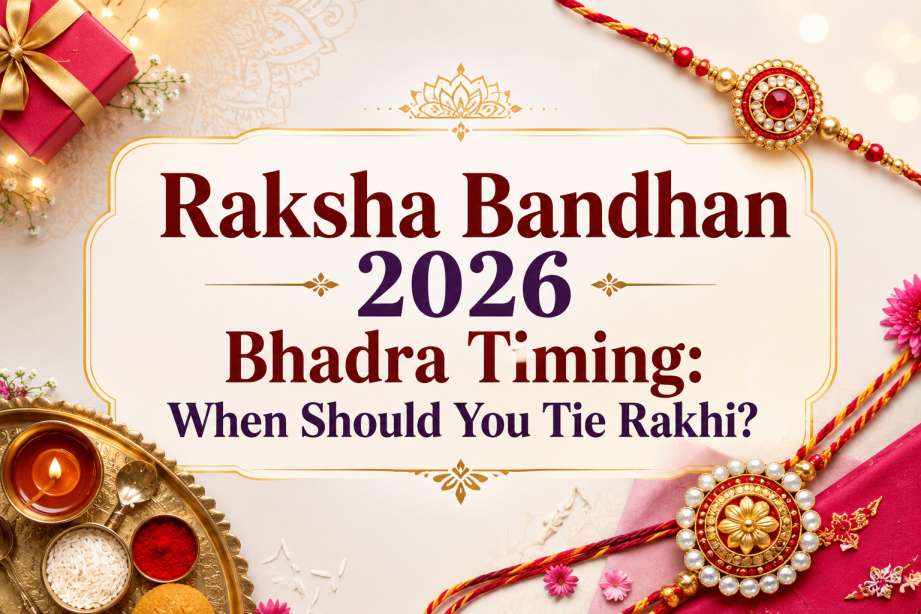
Raksha Bandhan is one of India’s most cherished festivals, celebrating the bond of love, protection and responsibility between siblings. In the Hindu calendar, Rakhi is observed on the Shravana Purnima, or full moon day of the Shravan month.
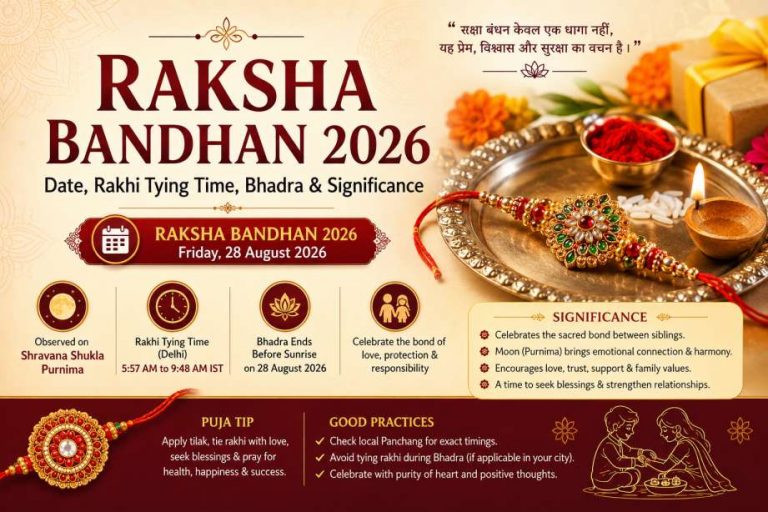
In 2026, Raksha Bandhan falls on Friday, August 28. The key question for families is whether Bhadra will affect the Rakhi ceremony. According to the Delhi Panchang calculation, Bhadra ends before sunrise on August 28, so devotees do not need to postpone the Rakhi ceremony because of Bhadra on the festival morning.
The timing of Rakhi is traditionally determined by the lunar tithi and avoidance of Bhadra. Understanding these details can help families perform the ceremony with greater confidence and according to established Panchang traditions.
Raksha Bandhan 2026: Date and Key Timings
For Delhi/New Delhi, India, the important timings are:
- Raksha Bandhan: Friday, August 28, 2026
- Shravana Purnima Begins: August 27, 2026 at 09:08 AM IST
- Shravana Purnima Ends: August 28, 2026 at 09:48 AM IST
- Rakhi Thread Ceremony Window: 05:57 AM to 09:48 AM IST
- Bhadra: Ends before sunrise on August 28
- Bhadra-related restriction: No Bhadra obstruction remains during the Rakhi ceremony window
The exact sunrise and ceremony start time can vary slightly from city to city. For example, Gurgaon has a Rakhi thread ceremony window beginning at 05:58 AM IST, while Bengaluru begins at 06:08 AM IST. Therefore, families should ideally consult their local Panchang rather than applying Delhi timings everywhere.
What Is Bhadra and Why Is It Avoided?
In traditional Hindu Panchang, Bhadra refers to a portion associated with Vishti Karana, one of the Karanas used in calculating auspicious and inauspicious periods.
For many auspicious activities, Bhadra is traditionally avoided. Raksha Bandhan is particularly associated with this rule because classical festival traditions advise against tying Rakhi while Bhadra is active. The reasoning is primarily muhurta-based, rather than a claim that Bhadra causes unavoidable negative events.
Panchang notes that Raksha Bandhan rituals should not be performed during Bhadra and that Bhadra can occur during the first part of Purnima. In 2026, however, the Bhadra period has already ended before sunrise in Delhi, removing this particular restriction from the morning ceremony.
Should You Wait for Bhadra in 2026?
No, not on the morning of August 28 in Delhi.
Since Bhadra is over before sunrise, families can perform the Rakhi ceremony during the available auspicious morning window. There is no need to delay the ceremony specifically because of Bhadra.
This is an important distinction because people sometimes assume that every Raksha Bandhan automatically requires waiting until afternoon. The actual muhurta depends on the Purnima Tithi, Bhadra status and local Panchang calculations.
When Should You Tie Rakhi in 2026?
For Delhi, the available Rakhi tying window is 05:57 AM to 09:48 AM IST on August 28, 2026. This is the practical window given by the Panchang for the thread ceremony.
Interestingly, the Purnima Tithi ends at 09:48 AM. Therefore, the morning becomes particularly important this year.
A common misconception is that Rakhi must always be tied during Aparahna, or late afternoon. Traditionally, Aparahna is preferred when it is available. However, when the relevant Purnima period does not extend into the afternoon, Panchang-based calculations determine the suitable alternative. In 2026, the available Rakhi ceremony window is in the morning.
Simple Rakhi Puja Sequence
Families can keep the ceremony simple and meaningful:
- Prepare the Rakhi thali with Rakhi, roli or kumkum, rice, diya and sweets.
- The brother may sit facing an appropriate direction according to family tradition.
- Apply tilak on the brother’s forehead.
- Perform a brief aarti.
- Tie the Rakhi on the brother’s right wrist.
- Offer sweets and exchange blessings or gifts.
- Recite a prayer for mutual well-being and family harmony.
The focus should remain on affection, gratitude and the traditional Raksha Sutra symbolism rather than complicated rituals.
Astrological Significance of Raksha Bandhan
Raksha Bandhan occurs on Purnima, making the Moon particularly important from a Vedic astrology perspective. The Moon represents emotions, nurturing, family connections and the mind.
A strong lunar symbolism naturally fits the emotional character of Rakhi. The festival encourages siblings to strengthen trust, emotional support and family communication.
The 2026 festival also falls on Friday, traditionally associated with Venus or Shukra. In Jyotish symbolism, Venus represents affection, harmony, relationships, beauty and social bonding. This does not mean Friday automatically creates a special planetary yoga for every person, but its traditional symbolism complements the relationship-oriented nature of Raksha Bandhan.
For an individual horoscope, the significance can differ depending on the Moon, Venus, third house, eleventh house and relevant dashas. The third house is especially relevant to siblings, courage and communication, while the eleventh house can represent elder siblings and supportive social connections.
Practical Remedies for Raksha Bandhan
Rather than relying on exaggerated claims, families can choose simple traditional practices that promote positivity.
- Light a diya before beginning the Rakhi ceremony.
- Offer a simple prayer for your sibling’s health and prosperity.
- Donate food, clothes or essential items to someone in need.
- Avoid arguments or harsh speech during the festival.
- If possible, spend some meaningful time together rather than treating Rakhi only as a formal ritual.
- Those following a family tradition may recite a short protection prayer or Vishnu/Ganesha mantra.
A traditional Raksha mantra is sometimes associated with the Rakhi ceremony:
“येन बद्धो बलिराजा दानवेन्द्रो महाबलः।
तेन त्वामनुबध्नामि रक्षे मा चल मा चल॥”
The verse invokes the symbolism of a protective bond and adds traditional depth to the ceremony.
What If You Cannot Tie Rakhi in the Morning?
Modern families may face practical challenges because of work, travel or distance. If the ideal window is missed, avoid making the situation unnecessarily stressful.
The best approach is to consult the local Panchang for your city and select the next suitable muhurta. Timing can vary geographically because sunrise and other Panchang calculations are location-sensitive.
If siblings live in different cities or countries, the ceremony should preferably be planned using the local time and Panchang relevant to the person performing the ritual.
Conclusion
Raksha Bandhan 2026 will be celebrated on Friday, August 28, and for Delhi, Bhadra ends before sunrise. The available Rakhi thread ceremony window is 05:57 AM to 09:48 AM IST, making the morning the key period for tying Rakhi.
The most important lesson is to follow the actual Panchang rather than assumptions about Raksha Bandhan timing. Since festival timings can vary by location, checking a city-specific Panchang is advisable.
Ultimately, Rakhi is more than a muhurta. Its deeper purpose is to honour sibling affection, protection, responsibility and lifelong emotional support.
FAQs
1. When is Raksha Bandhan 2026?
Raksha Bandhan 2026 falls on Friday, August 28.
It is observed on Shravana Purnima, the full moon day of the Shravan month. In Delhi, the Purnima Tithi ends at 09:48 AM IST on August 28.
Tip: Check your local Panchang if you live outside Delhi.
2. When does Bhadra end on Raksha Bandhan 2026?
For Delhi, Bhadra ends before sunrise on August 28, 2026.
Therefore, Bhadra does not obstruct the morning Rakhi ceremony in Delhi. Traditional Panchang guidance recommends avoiding Rakhi tying while Bhadra is active.
Remember: Bhadra timing can differ by location.
3. What is the best time to tie Rakhi in 2026?
In Delhi, the Rakhi thread ceremony window is 05:57 AM to 09:48 AM IST on August 28.
This window corresponds with the available auspicious period for the Rakhi ceremony. Since Purnima ends at 09:48 AM, families should plan the ritual without unnecessary delay.
Practical tip: Keep the Rakhi thali ready the previous night.
4. Can Rakhi be tied in the afternoon on August 28, 2026?
Families should not automatically assume that the afternoon is suitable because the main Panchang window ends at 09:48 AM IST in Delhi.
Although Aparahna is traditionally preferred when available, the 2026 Purnima timing ends in the morning. Therefore, following the city-specific Panchang is more appropriate than applying a fixed afternoon rule.
Best practice: Complete the ceremony within the published morning window where possible.
5. Does Bhadra affect every city in India in exactly the same way?
No, local Panchang timings can vary slightly between cities.
Sunrise differs geographically, which can change the beginning of a local ceremony window. For example, the 2026 Rakhi ceremony begins at 05:57 AM IST in Delhi and 06:08 AM IST in Bengaluru.
Tip: Use the Panchang calculated for your own city.
6. What should be included in a Raksha Bandhan puja thali?
A traditional Rakhi thali can include Rakhi, kumkum or roli, rice, diya, sweets and a small aarti plate.
The ritual does not need to be elaborate. A sincere prayer, tilak, Rakhi and blessings capture the central spirit of the festival.
Simple additions:
- Roli or kumkum
- Akshat
- Diya
- Rakhi
- Sweets
- Optional flowers
7. Is Raksha Bandhan connected with astrology?
Yes, its timing is determined through the Hindu lunar calendar, while its symbolism connects strongly with the Moon, relationships and family bonds.
Purnima gives the festival its lunar foundation, while Jyotish traditionally associates the third house with siblings and communication. Individual horoscope interpretations, however, require a complete birth chart rather than festival symbolism alone.
Astrological focus: Moon, third house, eleventh house, Venus and relevant dashas.
Source note: Timings above are based primarily on the Delhi/New Delhi Panchang calculation published by Drik Panchang; local timings should be verified for the city where the ritual is performed.