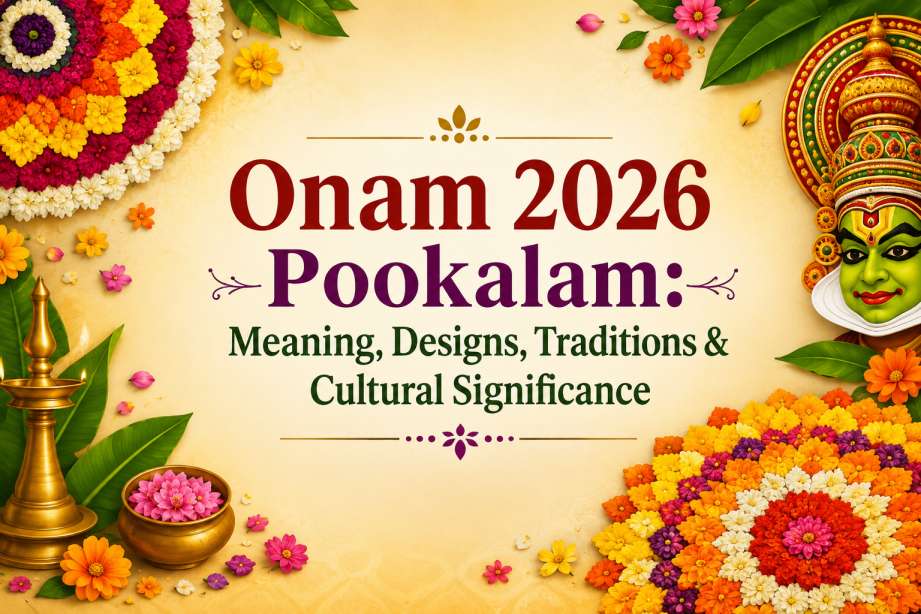
Onam 2026 Pookalam is more than a beautiful floral decoration. In Kerala, the colourful flower carpet known as Athapookalam or Pookkalam is an important part of the ten-day Onam celebration. It is traditionally created in front of homes and is associated with welcoming King Mahabali, prosperity, joy and community harmony. Kerala Tourism describes Pookkalam as a symbol of prosperity and happiness, with the design traditionally developing from Atham towards Thiruvonam.
In 2026, Thiruvonam falls on Wednesday, August 26. For Thiruvananthapuram, the Thiruvonam Nakshatra begins at 10:51 PM IST on August 25 and ends at 12:48 AM IST on August 27.
From a traditional astrological perspective, the connection between Pookalam, the Shravana (Thiruvonam) Nakshatra, Vishnu symbolism and the solar month of Chingam gives the celebration an additional spiritual dimension.
What Is Pookalam?
Pookalam literally refers to a floral arrangement or flower carpet made using fresh flowers. Traditionally, families collect locally available flowers and arrange them in circular or geometric patterns.
The practice begins around Atham, the first day of the ten-day Onam period. Kerala Tourism notes that the Pookalam traditionally becomes larger and more elaborate as the days progress, culminating around Uthradam and Thiruvonam.
The gradual expansion has a practical as well as symbolic meaning: every day adds another layer of colour, participation and anticipation.
Onam 2026 Pookalam: Traditional Meaning
Pookalam is traditionally associated with the welcoming of King Mahabali, whose annual return is central to the Onam story. The floral carpet is therefore not simply decorative; it represents hospitality, abundance and the joy of welcoming an honoured guest.
Kerala Tourism records that earlier Pookkalams primarily used flowers available locally, reflecting the close connection between Onam traditions and Kerala’s natural environment.
The symbolism can be understood through three broad ideas:
- Prosperity: Fresh flowers represent abundance and growth.
- Welcome: The arrangement traditionally prepares the household to receive Mahabali.
- Harmony: Creating Pookalam collectively encourages family and community participation.
Astrological Significance of Pookalam
Connection With Thiruvonam Nakshatra
In Indian astrology, Thiruvonam is known as Shravana Nakshatra. It is traditionally connected with listening, learning, knowledge, discipline and the preservation of wisdom.
The 2026 Onam celebration takes place when Thiruvonam prevails during the Chingam month. Panchang identifies Thiruvonam as the Nakshatra used to determine the principal Onam day.
Shravana is traditionally associated with Vishnu, making the spiritual atmosphere of Onam particularly relevant to Vaishnava traditions.
Vishnu and Vamana Connection
Onam is traditionally linked with the story of Vamana, an incarnation of Lord Vishnu, and King Mahabali. The festival also remembers Mahabali’s annual homecoming.
Kerala Tourism’s account of Thrikkakara Appan highlights the regional tradition of placing and worshipping a clay representation associated with Vishnu, Maveli or related forms, although interpretations vary between regions.
Therefore, it is better to view the Pookalam’s astrological significance as symbolic and devotional rather than as a guaranteed mechanism for changing planetary results.
Popular Onam 2026 Pookalam Designs
Modern Pookalam designs combine traditional motifs with creative patterns. Some popular choices include:
1. Circular Floral Designs
Concentric circles are among the most recognisable Pookalam patterns. Different flower colours can be arranged in successive rings to create symmetry.
2. Geometric Pookalam
Triangles, diamonds, stars and other geometric shapes can create a contemporary appearance while retaining the traditional floral base.
3. Lotus-Inspired Design
The lotus is widely associated with purity and spiritual symbolism in Indian traditions. A lotus-inspired Pookalam can therefore create a devotional aesthetic.
4. Mahabali-Themed Pookalam
Some designs feature symbolic representations of Maveli/Mahabali, traditional Kerala motifs or miniature figures.
5. Minimalist Pookalam
For apartments and urban homes, a smaller circular design using three or four flower varieties can preserve the tradition without requiring a large courtyard.
Traditional Flowers Used in Pookalam
Flower selection varies according to local availability and family tradition. Kerala Tourism describes a gradual introduction of different flowers during the Onam period, including thumba, mukkutti, kolambi and hibiscus.
Common choices include:
- Thumba
- Mukkutti
- Hibiscus
- Chrysanthemum
- Marigold
- Jasmine
- Ixora
- Local seasonal flowers
Using locally available flowers is often more culturally appropriate than choosing flowers solely for visual appeal.
How to Make a Simple Pookalam at Home
A traditional-inspired Pookalam does not require expensive materials.
- Clean the entrance area and choose a flat surface.
- Mark a central point and lightly outline a circular design.
- Separate flowers according to colour.
- Begin from the centre and work outward.
- Keep the pattern symmetrical where possible.
- Use natural petals rather than artificial plastic decorations.
- Refresh wilted flowers during the celebration.
- Keep the surrounding area clean and safe.
The process can become a family activity, especially when children participate in collecting flowers and designing the pattern.
Practical and Spiritual Tips
For those who want to include a gentle spiritual dimension, the focus should remain on gratitude, cleanliness, charity and community harmony, rather than superstition.
You may:
- Begin the day with a simple prayer to Lord Vishnu.
- Keep the entrance clean before creating the Pookalam.
- Offer fresh flowers respectfully.
- Share food with family, neighbours or people in need.
- Avoid wasting flowers merely for decoration.
- Encourage children to learn the cultural story behind Onam.
A simple Vishnu prayer such as “Om Namo Narayanaya” may be recited according to personal tradition. No particular mantra is required to make a Pookalam meaningful.
Cultural Significance of Pookalam Today
Pookalam remains relevant because it connects traditional culture with everyday family life. It brings together art, nature, storytelling and community participation.
Kerala Tourism identifies Pookalam as one of the defining features of Onam celebrations and describes it as part of a wider festival that includes Sadya, Vallamkali and traditional performing arts.
In modern cities, apartment communities, schools and workplaces increasingly use Pookalam competitions to preserve this cultural tradition. These activities also demonstrate how an old household practice can adapt to contemporary lifestyles without losing its essential meaning.
Conclusion
Onam 2026 Pookalam represents much more than an attractive floral pattern. Its layers of flowers symbolise welcome, prosperity, creativity and togetherness, while the association with Mahabali and Thiruvonam Nakshatra adds a traditional spiritual dimension.
The most meaningful Pookalam does not have to be the largest or most expensive. A simple arrangement created with fresh flowers, respect for tradition and participation from family members can capture the true spirit of Onam. As Thiruvonam approaches on August 26, 2026, creating a Pookalam can become a beautiful opportunity to celebrate Kerala’s heritage while practising gratitude, generosity and harmony.
FAQs
1. What is the meaning of Pookalam in Onam?
Pookalam symbolises prosperity, happiness and the traditional welcome given to King Mahabali.
It is a floral carpet created in front of homes during the Onam season. Kerala Tourism specifically describes Athappookalam as symbolic of prosperity and joy.
Tips:
- Use fresh, locally available flowers.
- Keep the entrance clean.
- Make the design with family participation.
2. When should Pookalam be made for Onam 2026?
The traditional Pookalam season begins with Atham and develops over the ten-day Onam celebration, culminating around Thiruvonam.
In 2026, Thiruvonam is observed on August 26, while the first Atham day falls on August 16.
Tips:
- Start with a simple design.
- Add layers gradually.
- Create the most elaborate design according to your family tradition.
3. Which flowers are traditionally used in Pookalam?
Traditional Pookkalams use seasonal and locally available flowers such as thumba, mukkutti, kolambi and hibiscus.
Flower selection has historically depended on what grows locally and is available during the season. Kerala Tourism documents the gradual addition of different flowers as the Onam days progress.
Tips:
- Prefer natural flowers.
- Avoid unnecessary plastic decorations.
- Choose colours that create clear patterns.
4. What is the astrological connection of Pookalam?
Its astrological connection comes primarily through Thiruvonam or Shravana Nakshatra and the festival’s traditional association with Lord Vishnu.
Shravana is an important Nakshatra in Vedic astrology and is traditionally connected with Vishnu. Onam is celebrated when Thiruvonam prevails in the Chingam month.
However, Pookalam should not be treated as a guaranteed remedy for planetary problems.
Tips:
- Use the occasion for prayer and gratitude.
- Focus on cleanliness and positive conduct.
- Combine tradition with practical actions.
5. Can Pookalam be made in an apartment?
Yes, a small Pookalam can easily be created in an apartment entrance, balcony or community space.
The essence of Pookalam lies in participation and cultural meaning rather than size. A compact circular arrangement can preserve the tradition even where outdoor space is limited.
Tips:
- Use a small circular template.
- Choose three to five flower colours.
- Avoid blocking common walkways.
6. Is Pookalam a religious ritual or cultural tradition?
Pookalam is both a cultural tradition and, in many households, part of devotional Onam observances.
Practices vary across Kerala and between families. In some traditions, representations such as Thrikkakara Appan or Mathevar are placed on the Pookalam and worshipped, with regional differences in the exact form and timing.
Tips:
- Follow your family’s established tradition.
- Respect regional differences.
- Learn the meaning behind the ritual instead of focusing only on decoration.