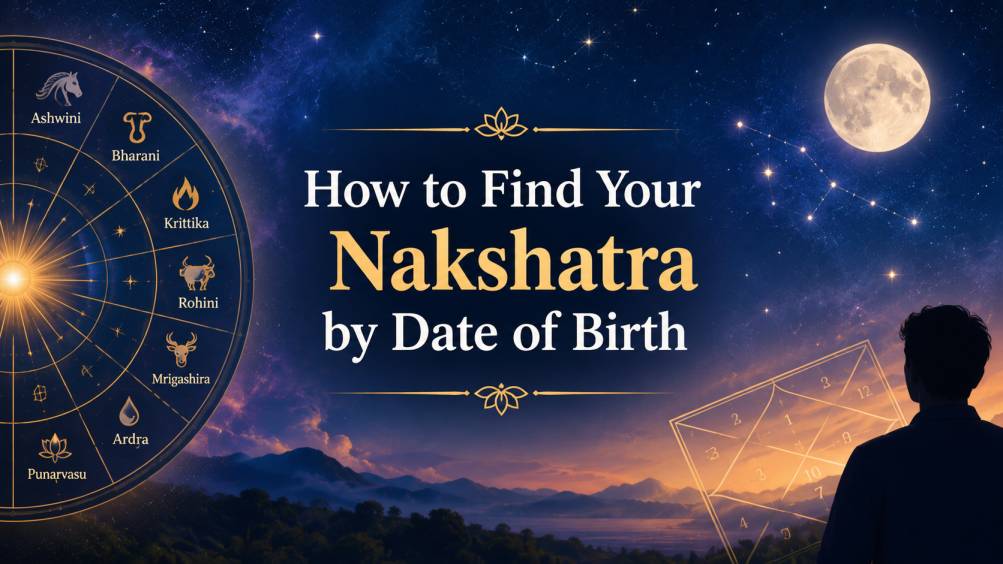
In Vedic astrology, a Nakshatra is one of the 27 lunar constellations used to understand an individual’s birth chart, emotional tendencies, and traditional astrological influences. If you want to find your Nakshatra by date of birth, you generally need three details: your date of birth, exact birth time, and birthplace.
The Moon’s position at the time of birth determines your Janma Nakshatra, also known as your birth star. Unlike your Sun sign, which is associated with the Sun’s position, your Nakshatra is based on the Moon’s position along the zodiac.
Knowing your birth Nakshatra can help you explore traditional Vedic astrology concepts, including personality characteristics, naming syllables, compatibility, and the timing of important activities. This guide explains how to calculate your Nakshatra, understand its meaning, and use the information thoughtfully in everyday life.
What Is a Nakshatra in Vedic Astrology?
A Nakshatra is a lunar division of the zodiac. Traditional Vedic astrology divides the 360-degree zodiac into 27 Nakshatras, each covering 13 degrees and 20 minutes.
The Moon travels through these divisions during its approximately 27.3-day sidereal cycle. Consequently, the Moon usually changes Nakshatra roughly once a day, although the exact duration varies.
Each Nakshatra has specific traditional associations, including a ruling planet, a symbol, and a presiding deity. These associations form part of the interpretive framework used in Jyotish.
Why Is Your Janma Nakshatra Important?
Your birth Nakshatra is traditionally used to explore several aspects of a horoscope:
- Personality: Astrologers interpret Nakshatra symbolism alongside the Moon sign and other chart placements.
- Baby naming: Each Nakshatra has four padas, or quarters, associated with traditional starting syllables for names.
- Marriage compatibility: Nakshatras are used in certain Kundli matching systems, including Ashtakoota Guna Milan.
- Dasha calculations: The Moon’s Nakshatra at birth determines the starting point of the Vimshottari Dasha sequence in traditional Vedic astrology.
- Muhurat selection: Nakshatras are considered when selecting auspicious timings for certain activities.
These are traditional astrological applications, not scientifically established methods for predicting personality or future events.
How to Find Your Nakshatra by Date of Birth
The easiest way to identify your Nakshatra is to use a reliable Vedic astrology calculator.
Step 1: Collect Your Birth Details
Keep the following information ready:
- Date of birth: Your exact birth date.
- Time of birth: The recorded local time, preferably from a birth certificate or hospital record.
- Place of birth: The city or town where you were born.
The birth time is particularly important because the Moon may move from one Nakshatra to another on the same calendar day.
Step 2: Use a Nakshatra Calculator
Enter your birth details into a calculator that follows Vedic or sidereal astrology.
Check that the calculator uses the appropriate time zone and a clearly stated ayanamsha, such as Lahiri, which is widely used in Indian astrology.
The calculator should provide your Janma Nakshatra, Moon sign (Chandra Rashi), and sometimes your Nakshatra pada.
Step 3: Check Your Moon’s Position
The Moon’s sidereal longitude determines your birth Nakshatra.
Each Nakshatra spans 13 degrees and 20 minutes of the zodiac. The zodiac’s 360 degrees are therefore divided into 27 equal sections.
For example, Ashwini occupies the first 13 degrees and 20 minutes of Aries in the sidereal zodiac. The following Nakshatra, Bharani, occupies the next 13 degrees and 20 minutes.
An astrology calculator performs this calculation automatically, but understanding the division helps you see how the result is determined.
Step 4: Identify Your Nakshatra Pada
Each Nakshatra contains four padas, each measuring 3 degrees and 20 minutes.
Your pada provides a more specific division of your birth Nakshatra. In traditional astrology, it is used in detailed chart interpretation and in selecting the initial syllable for a baby’s name.
If your birth time is close to a Nakshatra or pada boundary, verify the result using accurate birth details.
The 27 Nakshatras and Their Ruling Planets
The following table lists the 27 Nakshatras and their traditional planetary rulers in the Vimshottari Dasha system.
| Nakshatra | Ruling Planet |
| Ashwini | Ketu |
| Bharani | Venus |
| Krittika | Sun |
| Rohini | Moon |
| Mrigashira | Mars |
| Ardra | Rahu |
| Punarvasu | Jupiter |
| Pushya | Saturn |
| Ashlesha | Mercury |
| Magha | Ketu |
| Purva Phalguni | Venus |
| Uttara Phalguni | Sun |
| Hasta | Moon |
| Chitra | Mars |
| Swati | Rahu |
| Vishakha | Jupiter |
| Anuradha | Saturn |
| Jyeshtha | Mercury |
| Mula | Ketu |
| Purva Ashadha | Venus |
| Uttara Ashadha | Sun |
| Shravana | Moon |
| Dhanishtha | Mars |
| Shatabhisha | Rahu |
| Purva Bhadrapada | Jupiter |
| Uttara Bhadrapada | Saturn |
| Revati | Mercury |
These planetary rulers are part of the traditional Vimshottari Dasha framework. Individual Nakshatra interpretations also consider their deities, symbols, padas, and the wider birth chart.
What If You Know Only Your Date of Birth?
You can still begin exploring your birth Nakshatra, but the result may be uncertain.
Because the Moon moves continuously, two people born on the same date may have different Nakshatras. Even births separated by several hours can produce different results when the Moon crosses a Nakshatra boundary.
If you do not know your birth time:
- Check hospital records, birth certificates, or family documents.
- Use a calculator to examine the Moon’s Nakshatra at different times on your birth date.
- If the Nakshatra remains unchanged throughout that day, the date may be sufficient to identify it, provided the location and calculation settings are appropriate.
- If the Moon crosses a boundary that day, you will need a more accurate birth time to determine your Janma Nakshatra confidently.
Birth time rectification is sometimes used by astrologers, but it is an interpretive process and cannot guarantee recovery of the exact historical time.
How to Use Your Nakshatra in Everyday Life
Your Nakshatra can serve as a starting point for exploring traditional Jyotish concepts without treating astrological interpretations as fixed outcomes.
1. Explore Your Traditional Characteristics
Read about your Nakshatra’s symbol, deity, and ruling planet. Compare these traditional descriptions with your own experiences rather than assuming that every characteristic must apply to you.
2. Understand Naming Traditions
Parents often consult the baby’s Nakshatra pada to identify recommended starting syllables for a name. This is a cultural naming practice, and families may combine it with personal preferences and the meaning of the chosen name.
3. Explore Kundli Matching Carefully
Nakshatra compatibility is one component of traditional marriage matching. A complete assessment may consider several factors in both birth charts, along with the couple’s values, communication, and expectations.
4. Follow Simple Spiritual Practices
Some people use Nakshatra traditions as a way to develop reflection, gratitude, or spiritual discipline.
Depending on personal beliefs, these practices may include:
- Praying to the deity associated with the Nakshatra.
- Chanting a familiar mantra as part of a regular spiritual routine.
- Practising meditation, charity, or acts of kindness.
- Reflecting on personal goals and habits.
These practices should be approached as personal or religious choices, not guaranteed remedies for problems.
Conclusion
Finding your Nakshatra by date of birth is a straightforward way to begin exploring Vedic astrology. For a more reliable result, use your exact date, birth time, and birthplace with a calculator based on a clearly stated sidereal system. Your Janma Nakshatra can then help you understand traditional concepts such as the Moon sign, Nakshatra pada, baby naming, Kundli matching, and Vimshottari Dasha.
Remember that astrology is a cultural and interpretive tradition rather than a scientifically validated method of predicting individual outcomes. Use Nakshatra information as an opportunity to learn about Indian astrological heritage and reflect on your life, while making important personal, financial, and relationship decisions through practical reasoning and reliable information.
If you are exploring your birth chart for the first time, start by finding your Nakshatra and Moon sign, then learn how they fit into the broader Kundli.
Frequently Asked Questions (FAQs)
1. How can I find my Nakshatra by date of birth?
You can find your Nakshatra using a Vedic astrology calculator that accepts your birth date, time, and place.
The calculator determines the Moon’s sidereal position and identifies the corresponding Nakshatra. If you know only your birth date, the result may be uncertain when the Moon changes Nakshatra during that day.
Helpful tip: Use the most accurate birth time available and check the calculator’s ayanamsha setting.
2. Can I find my Nakshatra without knowing my birth time?
Yes, in some cases, but you cannot always determine it accurately without the birth time.
If the Moon stays within one Nakshatra throughout your local birth date, the date may be sufficient. If it crosses a boundary, different birth times may produce different results.
Helpful tip: Check your birth records or compare the Moon’s position at different times on the birth date.
3. What is the difference between a Nakshatra and a Rashi?
A Nakshatra is one of 27 lunar divisions, while a Rashi is one of the 12 zodiac signs used in Vedic astrology.
The Moon’s position determines both your Janma Nakshatra and your Chandra Rashi. One Rashi spans 30 degrees, whereas one Nakshatra spans 13 degrees and 20 minutes.
Helpful tip: Check both details when exploring your Vedic birth chart.
4. How many Nakshatras are there in Vedic astrology?
Vedic astrology traditionally recognises 27 main Nakshatras, each divided into four padas.
Some traditional systems also discuss Abhijit as an additional Nakshatra in particular contexts. However, the standard 27-Nakshatra framework is commonly used for birth Nakshatra calculations and Vimshottari Dasha.
Helpful tip: Confirm which system a calculator or astrologer follows before comparing results.
5. Does my Nakshatra influence my personality?
In traditional Vedic astrology, a Nakshatra is interpreted as one factor associated with personality and emotional tendencies.
Astrologers generally examine the Nakshatra alongside the Moon sign, planetary placements, houses, and other chart factors. There is no strong scientific evidence establishing that Nakshatras determine personality.
Helpful tip: Treat traditional descriptions as prompts for reflection rather than fixed labels.
6. Can my Nakshatra help in choosing a baby’s name?
Yes, traditional Hindu naming practices often use the baby’s Nakshatra pada to suggest an initial syllable.
Each of the four padas has associated naming sounds, and families may consult a Panchang or astrologer to identify them. The final name can also reflect its meaning, family traditions, and personal preference.
Helpful tip: Confirm the baby’s birth time before selecting a syllable based on the pada.
7. Does the Nakshatra change every day?
No, the Nakshatra does not change exactly at midnight or at the same time every day.
The Moon moves continuously through the zodiac, generally remaining in a Nakshatra for about one day. The transition time varies, so two people born on the same calendar date may have different birth Nakshatras.
Helpful tip: Use the birth time and location rather than relying only on the date.
8. Are there remedies for an unfavourable Nakshatra?
Traditional astrology recommends different spiritual practices depending on the Nakshatra and the overall birth chart, but no remedy is scientifically proven to change a person’s destiny.
People who follow these traditions may choose prayer, mantra recitation, meditation, charity, or other meaningful practices. Expensive rituals or gemstones should not be treated as necessary guarantees of success.