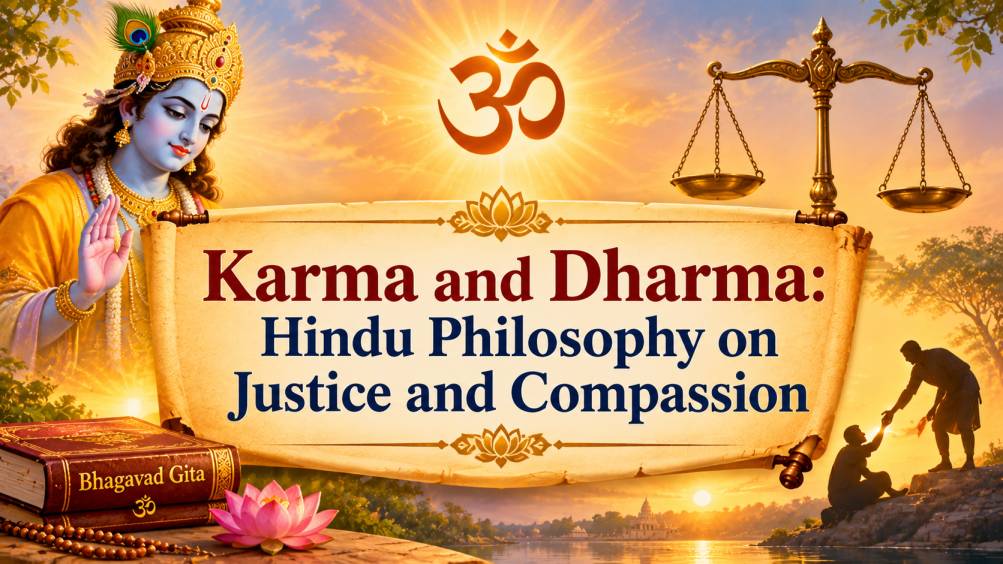
Karma and Dharma are two fundamental concepts of Hindu philosophy that explain how human actions, moral responsibilities, and ethical choices shape life. Karma refers to actions and their consequences, while Dharma represents righteousness, duty, and the principles that guide responsible behaviour. Together, they provide a framework for understanding justice, compassion, accountability, and personal growth. These concepts are discussed extensively in Hindu scriptures, including the Bhagavad Gita, Upanishads, and Mahabharata. From a Vedic astrology perspective, karma is also associated with planetary influences, particularly Saturn, while the 9th and 10th houses are traditionally connected with Dharma and professional duties. Understanding these principles can help individuals make thoughtful decisions and develop a more balanced approach towards everyday life.
What Is Karma in Hindu Philosophy?
Karma is derived from the Sanskrit word meaning action or deed. In Hindu philosophy, it refers not only to physical actions but also to intentions, thoughts, and words.
The principle of karma suggests that actions have consequences, although those consequences may not always appear immediately.
Three Main Types of Karma
Hindu philosophical traditions commonly explain karma through three categories:
- Sanchita Karma: The accumulated results of actions from previous lives.
- Prarabdha Karma: The portion of accumulated karma traditionally understood as bearing fruit in the present life.
- Kriyamana or Agami Karma: Actions performed in the present that contribute to future consequences.
These concepts are particularly important in understanding the relationship between personal responsibility, free will, and destiny.
Karma should not be interpreted as a simplistic system in which every difficulty is punishment for a past action. Hindu philosophical traditions recognise the complexity of human circumstances, individual choices, and moral responsibility.
What Is Dharma and Why Is It Important?
Dharma is commonly translated as righteousness, duty, moral order, or the right way of living.
Unlike a single fixed rule, Dharma considers an individual’s responsibilities, circumstances, relationships, and stage of life.
Different Dimensions of Dharma
- Svadharma (Personal Duty)
Svadharma refers to responsibilities associated with an individual’s nature, abilities, and circumstances. It encourages people to fulfil their duties sincerely rather than blindly imitate others.
- Samanya Dharma (Universal Values)
Samanya Dharma includes ethical principles that apply broadly to human conduct, such as:
- Truthfulness (Satya).
- Non-violence (Ahimsa).
- Compassion (Daya).
- Forgiveness (Kshama).
- Self-control (Dama).
- Raja Dharma (Duty of Leadership)
Raja Dharma describes the responsibilities of rulers and leaders. It emphasises justice, public welfare, fairness, and protection of society.
These principles remain relevant to modern leadership, governance, business ethics, and social responsibility.
How Are Karma and Dharma Connected?
Karma and Dharma are closely connected because Dharma guides actions, while Karma explains their consequences.
For example, a business owner who treats employees fairly, pays wages honestly, and avoids misleading customers follows principles of Dharma. These actions also create positive social and professional consequences.
The Bhagavad Gita explains the importance of performing one’s duties without becoming excessively attached to the results.
One of its best-known teachings is:
कर्मण्येवाधिकारस्ते मा फलेषु कदाचन।
Bhagavad Gita 2.47
Meaning: You have the right to perform your actions, but not to claim control over their results.
This teaching encourages sincere effort, responsibility, and emotional balance. It does not mean that people should ignore outcomes or avoid planning. Instead, it highlights the importance of focusing on ethical action without allowing attachment to success or failure to dominate one’s decisions.
What Does Hindu Philosophy Teach About Justice?
Justice is an important dimension of Dharma. Hindu philosophical literature repeatedly discusses fairness, responsibility, truth, and the protection of others.
The Mahabharata presents several situations in which individuals must make difficult moral decisions. Its narratives demonstrate that Dharma is not always easy to identify, especially when personal interests conflict with social responsibilities.
Three Important Principles of Justice
- Fairness: Treat people without discrimination or unnecessary favouritism.
- Accountability: Accept responsibility for decisions and their consequences.
- Protection of the Vulnerable: Support those who face injustice or exploitation.
The concept of Raja Dharma also teaches that leadership should prioritise public welfare rather than personal gain.
In modern society, these principles can guide ethical governance, workplace conduct, family relationships, and community participation.
Role of Compassion in Karma and Dharma
Compassion, known as Daya in Sanskrit, is an essential quality in Hindu ethical thought.
Following Dharma is not simply about obeying rules. It also involves understanding the difficulties of others and responding with kindness.
Practical examples include:
- Helping people facing financial difficulties.
- Respecting elderly family members.
- Treating workers with dignity.
- Avoiding unnecessary harm to animals and nature.
- Supporting education and community welfare.
The Bhagavad Gita also describes qualities such as kindness, forgiveness, humility, and freedom from hatred as characteristics of a spiritually mature person.
Compassion makes Dharma meaningful because it connects moral principles with real human experiences.
Karma and Dharma in Vedic Astrology
Vedic astrology provides a symbolic framework for examining duty, responsibility, and karmic tendencies through planetary positions and houses.
Certain planets and houses are traditionally associated with these themes.
1. Saturn (Shani): Karma and Responsibility
Saturn represents discipline, patience, hard work, accountability, and long-term consequences.
Its placement in a birth chart is traditionally examined to understand responsibilities, delays, perseverance, and lessons associated with personal growth.
2. Jupiter (Guru): Dharma and Wisdom
Jupiter represents knowledge, ethics, spirituality, teachers, and higher principles.
It is associated with the 9th house, which represents Dharma, fortune, higher education, and spiritual guidance.
3. Sun (Surya): Authority and Duty
The Sun symbolises leadership, confidence, authority, and personal integrity.
Its position may be examined when studying an individual’s approach towards responsibility and leadership.
4. Important Houses
- 5th House: Purva Punya, intelligence, and creative potential.
- 9th House: Dharma, spiritual values, teachers, and fortune.
- 10th House: Karma, profession, public responsibilities, and actions.
- 12th House: Spiritual liberation, detachment, and expenditure.
These associations are traditional astrological interpretations, not scientifically established methods of determining moral character or predicting justice.
Practical Ways to Follow Karma and Dharma in Daily Life
The principles of Karma and Dharma can be applied through small but meaningful actions.
Some practical approaches include:
- Speak truthfully, even when honesty is difficult.
- Perform professional and family responsibilities sincerely.
- Avoid harming others for personal advantage.
- Practise generosity without expecting rewards.
- Respect different perspectives and circumstances.
- Accept mistakes and make genuine efforts to correct them.
- Balance personal ambitions with social responsibilities.
Traditional spiritual practices such as meditation, prayer, charity, and reading the Bhagavad Gita may also help develop self-awareness and ethical discipline.
Conclusion
Karma and Dharma offer valuable guidance for understanding justice, responsibility, and compassion in Hindu philosophy. Karma highlights the significance of actions and their consequences, while Dharma encourages individuals to follow righteousness and fulfil their responsibilities. Together, they emphasise that ethical living involves more than personal success; it also requires fairness, kindness, accountability, and concern for others. From the perspective of Vedic astrology, Saturn, Jupiter, the Sun, and the 9th and 10th houses provide traditional symbolic connections with these principles. Ultimately, the practical message is simple: make thoughtful choices, perform your duties sincerely, and treat others with compassion. A meaningful life is built not only through what we achieve but also through how we act towards others.
FAQs: Karma and Dharma in Hindu Philosophy
1. What is the difference between Karma and Dharma?
Karma refers to actions and their consequences, whereas Dharma refers to righteousness, moral duty, and ethical living.
Karma explains how actions influence outcomes, while Dharma provides guidance about which actions are appropriate. Both concepts work together in Hindu philosophy to encourage responsible living.
Key points:
- Karma focuses on actions and consequences.
- Dharma focuses on duties and righteousness.
- Both encourage personal accountability.
2. What does the Bhagavad Gita teach about Karma?
The Bhagavad Gita teaches that individuals should perform their duties sincerely without becoming excessively attached to the results.
In Chapter 2, Verse 47, Lord Krishna explains the importance of focusing on one’s actions rather than demanding control over their outcomes. This teaching encourages discipline, dedication, and emotional balance.
Practical lessons:
- Perform duties honestly.
- Avoid excessive attachment to success.
- Learn from failures and continue making efforts.
3. What are the three types of Karma?
The three commonly discussed categories are Sanchita Karma, Prarabdha Karma, and Kriyamana or Agami Karma.
They represent accumulated actions, karma traditionally understood to be bearing fruit in the present life, and actions being performed now that contribute to future consequences.
Remember:
- Sanchita: Accumulated karma.
- Prarabdha: Karma currently bearing fruit.
- Agami: Future consequences associated with present actions.
4. How is Dharma relevant in modern life?
Dharma remains relevant because it provides ethical guidance for personal relationships, professional responsibilities, leadership, and social behaviour.
For example, honesty in business, fairness towards employees, respect for parents, and helping disadvantaged communities can all reflect principles of Dharma.
Ways to practise Dharma:
- Be honest in professional dealings.
- Respect other people’s rights.
- Fulfil personal responsibilities.
- Support justice and equality.
5. Which planet represents Karma in Vedic astrology?
Saturn (Shani) is traditionally associated with Karma, discipline, responsibility, hard work, and consequences in Vedic astrology.
Its placement in a horoscope is examined to understand areas involving patience, perseverance, accountability, and long-term responsibilities.
Traditional considerations:
- Examine Saturn’s house placement.
- Study its sign and planetary aspects.
- Consider its Mahadasha and Antardasha.
6. Which house represents Dharma in Vedic astrology?
The 9th house is primarily associated with Dharma, higher knowledge, spirituality, teachers, and fortune in Vedic astrology.
The 10th house is associated with Karma, profession, actions, and public responsibilities. Together, these houses are important when examining the relationship between duty and action.
Important houses:
- 9th house: Dharma and spiritual values.
- 10th house: Karma and professional responsibilities.
- 5th house: Purva Punya and intelligence.
7. Does good Karma always produce immediate positive results?
No, Hindu philosophical traditions do not suggest that the consequences of every action must appear immediately.
The concept of different types of Karma explains why some consequences may be understood as unfolding over different periods. However, this should not be used to blame people for misfortune or justify injustice.
Practical approach:
- Continue performing ethical actions.
- Avoid expecting immediate rewards.
- Take responsibility for present decisions.
- Help others without judging their circumstances.
8. How can a person follow Dharma in everyday life?
A person can follow Dharma by acting truthfully, fulfilling responsibilities, respecting others, and making decisions based on fairness and compassion.
Dharma is not limited to religious rituals. It also involves everyday choices, such as keeping promises, treating employees fairly, caring for family members, and helping people in need.
Simple practices:
- Speak with honesty and kindness.
- Avoid unnecessary harm.
- Practise forgiveness and generosity.
- Balance personal interests with social welfare.