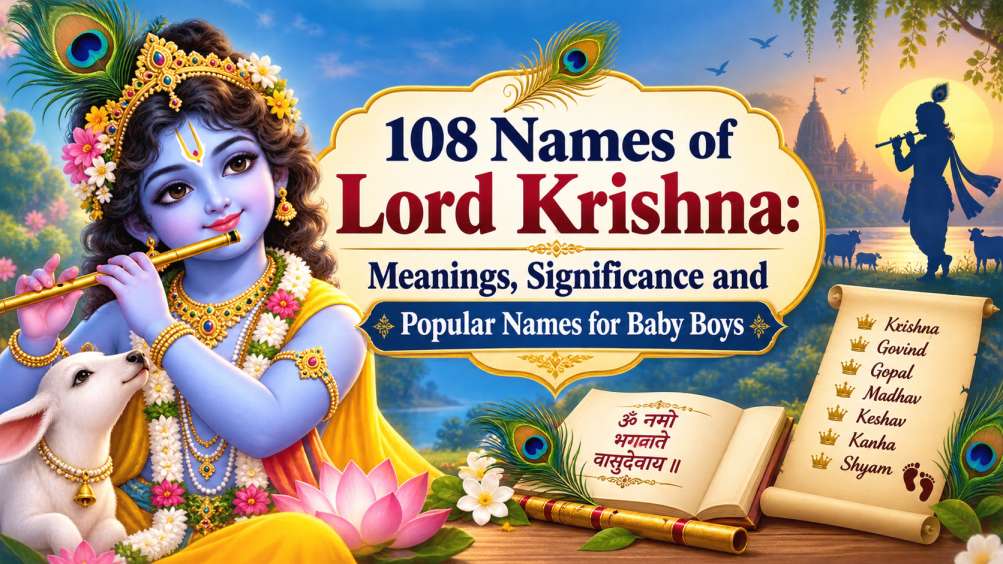
Lord Krishna is one of the most revered deities in Hindu tradition and is associated with wisdom, compassion, devotion, protection, love and dharma. His many names describe different aspects of his personality, divine stories and teachings.
The 108 names of Lord Krishna are traditionally recited as a form of devotion and remembrance. For Indian families, these names also hold special relevance when choosing a meaningful name for a baby boy. In Vedic naming traditions, the child’s Janma Nakshatra, Pada, Moon sign (Rashi) and the recommended starting syllable are generally considered before finalising a name.
A Krishna-inspired name can therefore combine spiritual meaning, cultural heritage and astrological naming principles without treating the name itself as a guarantee of future outcomes.
108 Names of Lord Krishna With Meanings
Traditional lists of Krishna’s 108 names can vary slightly in spelling and ordering across texts and regional traditions. The following is a commonly used devotional compilation.
Names 1–27
- Krishna – All-attractive; dark-complexioned
- Kamalanatha – Lord of Goddess Lakshmi
- Vasudeva – Son of Vasudeva; divine one
- Sanatana – Eternal
- Vasudevatmaja – Son of Vasudeva
- Punya – Embodiment of sacred merit
- Lila-manusha-vigraha – One who assumes a human-like form for divine play
- Srivatsakaustubhadhara – Bearer of Srivatsa and Kaustubha gem
- Yashoda-vatsala – Beloved of Yashoda
- Hari – Remover of suffering and obstacles
- Devakinandana – Joy of Devaki
- Nandagopa-priyatmaja – Beloved son of Nanda
- Yamuna-vega-samharin – One who subdued the force of Yamuna
- Balabhadra-priyanvaya – Dear relative of Balarama
- Putana-jivita-hara – Destroyer of Putana
- Shakatasura-bhanjana – Destroyer of Shakatasura
- Sachidananda-vigraha – Embodiment of existence, consciousness and bliss
- Navanita-viliptanga – Whose body is smeared with fresh butter
- Anagha – Pure and sinless
- Navanita-navahara – Stealer of fresh butter
- Muchukunda-prasadaka – Bestower of grace upon Muchukunda
- Shodasha-stri-sahasresha – Lord associated with sixteen thousand wives
- Tribhangi – One standing in the three-bent posture
- Madhurakriti – Of enchanting form
- Govinda – Knower and protector of cows and senses
- Yoginampati – Lord of yogis
- Vatsa-vata-charan – One who wandered with calves
Names 28–54
- Ananta – Infinite and endless
- Dhenukasura-bhanjana – Destroyer of Dhenukasura
- Trinavarta-bhanjana – Destroyer of Trinavarta
- Yamal-arjuna-bhanjana – Breaker of the twin Arjuna trees
- Tamala-shyamala-akriti – Dark-hued like the Tamala tree
- Gopa-gopishvara – Lord of cowherds and Gopis
- Yogavat – Master of yoga
- Koti-surya-sama-prabha – Radiant like millions of suns
- Paranjyoti – Supreme light
- Yadavendra – Chief of the Yadavas
- Yadudvaha – Leader of the Yadu clan
- Vanamalin – Wearing a forest-flower garland
- Pitavasas – Wearing yellow garments
- Parijata-apaharaka – One who brought the Parijata tree
- Govardhanachala-uddharta – Lifter of Govardhana Hill
- Gopalaka – Protector of cows
- Sarva-palaka – Protector of all
- Aja – Unborn
- Niranjana – Pure and stainless
- Kama-janaka – Source of divine love
- Kanja-lochana – Lotus-eyed
- Madhu-ghna – Destroyer of Madhu
- Mathura-natha – Lord of Mathura
- Dvarakanayaka – Lord of Dvaraka
- Bali – Powerful
- Vrindavananta-sanchari – One who roams through Vrindavana
- Tulasi-dama-bhushana – Adorned with a Tulasi garland
Names 55–81
- Syamantaka-mani-hara – Bearer or retriever of the Syamantaka jewel
- Nara-Narayana-atmaka – Manifestation of Nara and Narayana
- Kubja-kripambodhi – Ocean of mercy toward Kubja
- Mayi – Master of divine Maya
- Paramapurusha – Supreme person
- Mushtikasura-chanura-malla-yuddha-visharada – Expert in wrestling with Mushtika and Chanura
- Samsara-vairi – Enemy of worldly bondage
- Kamsarati – Enemy of Kamsa
- Murari – Enemy of Mura
- Narakantaka – Destroyer of Narakasura
- Anadi-brahmachari – Beginningless spiritual master
- Krishnavyasana-karshaka – One who draws devotees away from worldly affliction
- Shishupala-shira-chedi – One who defeated Shishupala
- Duryodhana-kulantaka – Destroyer of Duryodhana’s lineage
- Vidurakrura-varada – Bestower of grace upon Vidura and Akrura
- Vishvarupa-pradarshaka – Revealer of the universal form
- Satyavak – Truth-speaking
- Satyasankalpa – One whose resolve is true
- Satyabhama-rata – Beloved of Satyabhama
- Jayi – Victorious
- Subhadra-purvaja – Elder brother of Subhadra
- Jishnu – Victorious
- Bhishmamukti-pradayaka – Giver of liberation to Bhishma
- Jagadguru – Teacher of the world
- Jagannatha – Lord of the universe
- Venunada-visharada – Expert in playing the flute
- Vrishabhasura-vidhvamsi – Destroyer of Vrishabhasura
Names 82–108
- Banasura-bhujangha-bhedi – One who broke Banasura’s arms
- Yudhishthira-pratishthata – One who established Yudhishthira
- Barhavatamsaka – Wearing a peacock-feather ornament
- Parthasarathi – Charioteer of Arjuna
- Avyakta – The unmanifest
- Gita-amrita-mahodadhi – Ocean of the nectar of the Bhagavad Gita
- Kaliyaphani-manikkya-ranjita-shri-padambuja – Whose lotus feet are adorned by the jewel of Kaliya’s hood
- Damodara – One whose waist was bound with a rope
- Yajna-bhokta – Recipient of sacrificial offerings
- Danavendra-vinashaka – Destroyer of mighty demons
- Narayanatmaja – Embodiment of Narayana
- Parabrahma – Supreme absolute reality
- Pannaga-ashana-vahana – Whose vehicle is Garuda
- Jalakridashamasakta-gopikavastra-haraka – One associated with the playful Gopi water-sport episode
- Punyashloka – Praised in sacred verses
- Tirthapada – Whose feet are holy places
- Vedavedya – Known through the Vedas
- Dayanidhi – Treasure of compassion
- Sarvatirthatmaka – Embodiment of all holy places
- Paratpara – Supreme beyond the supreme
- Sarvagraha-vinashaka – Remover of planetary afflictions
- Vishnave – The all-pervading Lord
- Vishvarupa – Universal form
- Vasudeva-priya – Beloved of Vasudeva
- Sthiradhriti – Steadfast in resolve
- Kripalu – Compassionate
- Bhaktavatsala – Affectionate toward devotees
Astrological Significance of Krishna-Inspired Names
In Vedic astrology, naming a child is traditionally connected with the Moon’s position at birth. The Janma Nakshatra and Pada can indicate suitable starting sounds for the baby’s name.
This is important because a beautiful Krishna name should ideally also fit the child’s traditional naming syllable.
Planetary and Spiritual Associations
Krishna is traditionally connected with several qualities that can be interpreted symbolically through Jyotish:
- Jupiter (Guru): wisdom, dharma, guidance and spiritual knowledge.
- Moon (Chandra): compassion, emotional connection, devotion and nurturing qualities.
- Mercury (Budha): intelligence, communication, diplomacy and learning.
- Venus (Shukra): beauty, music, love and artistic expression.
These associations should be understood as symbolic and traditional, rather than as proof that choosing a particular name will automatically change a child’s horoscope.
Houses Relevant to Naming
A detailed Vedic astrology assessment may consider:
- 2nd house: speech, family traditions and values.
- 5th house: intelligence, creativity, children and learning.
- 9th house: dharma, blessings, higher knowledge and tradition.
- 1st house: personality and overall life orientation.
For personalised naming, astrologers generally combine these factors with Nakshatra, Rashi, planetary strength and the recommended syllables.
Popular Krishna Names for Baby Boys
For parents looking for shorter and modern Krishna-inspired baby names, these are especially appealing:
- Krishna – Divine and all-attractive
- Govind – Protector and knower of the senses
- Gopal – Protector of cows
- Madhav – A revered name associated with Krishna
- Keshav – A popular traditional name of Krishna
- Damodar – Krishna whose waist was bound by a rope
- Murari – Enemy of the demon Mura
- Hari – Remover of suffering
- Parthasarathi – Charioteer of Arjuna
- Vasudev – Associated with Vasudeva and Krishna’s divine identity
- Mohan – Enchanting one
- Shyam – Dark-hued and beautiful
- Kanha – Affectionate traditional name for Krishna
- Murlidhar – Bearer of the flute
Practical Naming Tips for Parents
Choosing a baby name can balance astrology, meaning, pronunciation and family preference.
- Check the baby’s birth Nakshatra and Pada.
- Identify the traditionally recommended starting syllable.
- Shortlist Krishna names that begin with the suitable sound.
- Check the name’s meaning and cultural context.
- Consider pronunciation in both Hindi and English.
- Choose a name that feels natural for the child to use throughout life.
A name can carry cultural and emotional significance, but a child’s complete horoscope involves much more than the name alone.
Simple Krishna-Inspired Spiritual Practices
Families who feel connected to Krishna’s tradition may incorporate simple devotional practices into daily life:
- Recite “Om Namo Bhagavate Vasudevaya” with devotion.
- Read or listen to selected teachings from the Bhagavad Gita.
- Offer Tulasi leaves to Krishna where this is part of the family’s tradition.
- Practice kindness, honesty and self-discipline—the practical values emphasised in Krishna’s teachings.
- On Krishna-related festivals, encourage children to learn the stories and their ethical lessons rather than focusing only on rituals.
Conclusion
The 108 names of Lord Krishna represent different dimensions of his divine personality—from Govinda and Gopala to Jagadguru, Parthasarathi and Bhaktavatsala. For parents, these names offer a rich collection of meaningful baby boy names inspired by Krishna, combining spirituality with Indian cultural heritage.
From an astrological perspective, the most useful approach is to first determine the child’s Janma Nakshatra, Pada and Rashi, then shortlist names that match the recommended syllables. This makes the naming process both traditional and practical. Ultimately, the best Krishna-inspired name is one whose meaning, pronunciation and cultural significance genuinely resonate with the family.