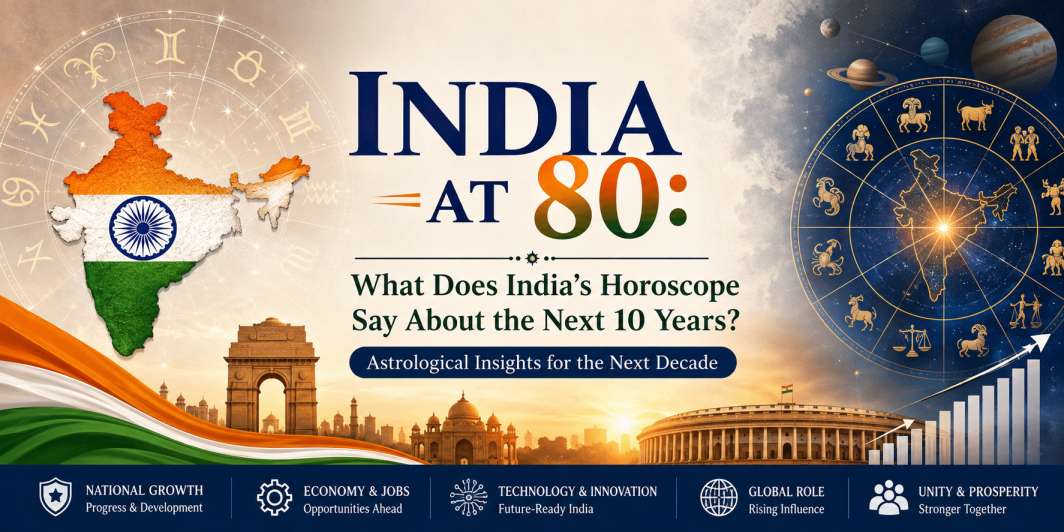
India will complete 80 years of independence on 15 August 2027, marking an important milestone in the nation’s modern history. From a Vedic astrology perspective, such milestones can be studied through the national horoscope cast for 15 August 1947 at 00:00 IST in Delhi. This is commonly used as India’s Independence chart, although different astrologers may use slightly different chart settings and ayanamsas.
The commonly used Vedic chart places Taurus (Vrishabha) Lagna, with Rahu in the first house, Mars in Gemini, and the Moon in Cancer. A strong concentration of planets in the third house is traditionally associated with communication, neighbours, courage, transport and national initiatives.
Astrology cannot guarantee political, economic or social outcomes. Instead, it offers a traditional symbolic framework for examining periods of expansion, pressure, restructuring and opportunity.
India’s Horoscope at 80: The Astrological Foundation
Taurus Lagna and National Stability
Taurus is a fixed earth sign ruled by Venus. In mundane astrology, a strong fixed-sign influence can be interpreted as an emphasis on stability, material development, resources, infrastructure and long-term institution building.
This symbolism is particularly relevant as India approaches its 80th year. The coming decade may therefore be less about sudden transformation alone and more about turning earlier investments in infrastructure, manufacturing, technology and human capital into durable national capabilities.
Mars Mahadasha: The Decade Begins With Action
One of the most important themes in the Independence chart is the transition into Mars Mahadasha, generally dated by astrologers to approximately September 2025–September 2032, depending on the precise calculation method. Mars is placed in Gemini in the commonly used Taurus-Lagna chart.
Mars represents energy, engineering, courage, competition, land, defence and decisive action. Gemini adds themes of communication, technology, commerce, information and connectivity.
Therefore, the first part of India’s next decade can symbolically favour:
- Defence and strategic technology
- Manufacturing and engineering
- Railways, roads and infrastructure
- Digital communication
- Space and advanced research
- Entrepreneurship and competitive industries
- Skill-based employment
The same Mars influence can also correspond to sharper competition and greater pressure. From an astrological perspective, diplomacy, institutional discipline and responsible communication will be important national strengths.
2027–2030: A Period of Building and Restructuring
The years around India’s 80th Independence anniversary may represent a high-action phase rather than a quiet consolidation period.
Mars encourages speed, but Saturn rewards patience. Their interaction in mundane astrology can be interpreted as a need to balance ambitious projects with regulation, accountability and long-term planning.
For India, this could translate into greater attention toward:
- Infrastructure and urban development
- Defence preparedness
- Domestic manufacturing
- Employment and technical education
- Energy security
- Border management
- Institutional reforms
The astrological message is not that every forecasted event will occur, but that the period favours structured action over impulsive decisions.
2030–2032: Consolidating National Strength
As the Mars period approaches its conclusion, the emphasis may gradually shift from expansion to consolidation.
India’s ability to convert technological progress into employment, productivity and broader prosperity could become especially important. The traditional symbolism of Mars in the second house also connects the period with wealth, national resources and speech, making fiscal discipline and responsible public communication significant themes.
This phase may favour practical questions such as:
Can growth become more inclusive? Can infrastructure create sustainable productivity? Can technology strengthen both economic opportunity and national resilience?
These questions may matter more than headline achievements alone.
2032–2037: From Mars-Led Action to Rahu-Led Transformation
Many astrologers place India’s subsequent Rahu Mahadasha from around 2032 onward, though exact dates vary according to the chart methodology used.
Rahu is traditionally associated with technology, unconventional thinking, foreign connections, mass communication, ambition and sudden shifts.
This makes the second half of the decade potentially more focused on:
- Artificial intelligence and automation
- Advanced digital systems
- Global trade and diplomacy
- Emerging technologies
- Space and scientific innovation
- New economic models
- International partnerships
Rahu can also create confusion when growth becomes disconnected from ethics. For that reason, cybersecurity, misinformation control, data protection and institutional transparency could become increasingly important.
India’s Global Role in the Next 10 Years
The Independence chart has traditionally been interpreted as giving considerable importance to communication, neighbours and international relationships.
Over the next decade, India may therefore continue balancing three objectives:
- Economic expansion
- Strategic autonomy
- International cooperation
Astrologically, the period does not necessarily suggest isolation. Rather, it can be read as a phase in which India increasingly seeks to negotiate from a position of greater capability.
The practical challenge will be maintaining diplomatic flexibility while protecting national interests.
Economy, Jobs and Technology
India’s economic horoscope for this period should be read through both Mars and Rahu symbolism.
Mars supports industries requiring engineering, physical infrastructure, manufacturing and technical expertise, while Rahu favours digital transformation and unconventional technologies.
For ordinary citizens, the broader lesson is straightforward: the coming decade may reward adaptability and specialised skills.
Students and professionals can focus on:
- Artificial intelligence
- Data and cybersecurity
- Engineering
- Electronics and semiconductors
- Healthcare technology
- Renewable energy
- Defence technology
- Digital finance
- Advanced manufacturing
Astrology should not replace economic research or career planning, but it can provide a cultural framework for reflecting on changing priorities.
Social Harmony and National Well-Being
A strong Mars-Rahu period should not automatically be interpreted negatively. In traditional astrology, difficult planetary symbolism often indicates areas requiring maturity and conscious management.
Mars can increase courage but also impatience. Rahu can encourage innovation but also exaggeration.
Therefore, the social remedy is not fear but balance:
- Verify information before sharing it.
- Avoid unnecessary arguments.
- Encourage constructive public dialogue.
- Support education and skill development.
- Respect constitutional and institutional processes.
Practical Astrological Remedies for India
Traditional remedies can be approached as spiritual practices rather than guarantees of political or economic outcomes.
For Mars Balance
- Recite “Om Angarakaya Namah” on Tuesdays.
- Read the Hanuman Chalisa with devotion.
- Practise disciplined physical activity.
- Donate food or useful items to people in need.
For Rahu Balance
- Maintain ethical conduct in digital and financial matters.
- Avoid spreading rumours or unverified information.
- Recite “Om Rahave Namah” traditionally on Saturdays.
- Practise meditation and mindful communication.
A Broader National Remedy
The most meaningful collective remedy is responsible citizenship—education, environmental responsibility, social harmony, respect for law and constructive participation in society.
Conclusion
India at 80 represents more than a symbolic anniversary. From the perspective of the commonly used Independence horoscope, the next decade combines the energetic themes of Mars with the transformative symbolism of Rahu.
The period from 2027 to 2032 can be viewed as a time of action, infrastructure, strategic capability and competitive growth, while the years after 2032 may place greater emphasis on technology, global influence and unconventional innovation.
The most useful interpretation is neither overly optimistic nor fearful. India’s horoscope suggests a decade in which discipline, technological capability, social cohesion and wise leadership can determine how successfully opportunities are converted into lasting progress.
For readers interested in Vedic astrology, India’s 80th year offers an opportunity not simply to predict the future, but to reflect on the choices that can shape it.
FAQs
1. What is India’s horoscope based on?
India’s commonly used Independence horoscope is based on 15 August 1947 at 00:00 IST in Delhi.
This chart represents the birth of modern independent India as a sovereign political entity. Different astrologers may use different chart settings, so interpretations can vary.
Related tip: Use the Independence chart consistently when comparing long-term national cycles.
2. What does India’s Taurus Lagna indicate?
Taurus Lagna is traditionally associated with stability, resources, material development and persistence.
For national astrology, this can symbolically support interpretations involving economic foundations, infrastructure and institutional continuity.
Related themes: stability, agriculture, finance, infrastructure and long-term development.
3. What does Mars Mahadasha mean for India?
Mars Mahadasha is traditionally interpreted as a period of greater action, competition, courage, defence, engineering and decisive initiatives.
Astrologers commonly place India’s Mars Mahadasha around 2025–2032, making it an important background cycle for the early part of the next decade.
Practical focus: discipline, technical skills, physical infrastructure and responsible decision-making.
4. Will India become a global technology leader according to astrology?
India’s upcoming planetary cycles can symbolically support technology, communication, innovation and international connections, but astrology cannot guarantee a specific economic ranking.
The Rahu period commonly associated with the years after 2032 is traditionally linked with unconventional technology and rapid change.
Practical focus: invest in education, research, cybersecurity and advanced technical skills.
5. What challenges could India face between 2027 and 2037?
The astrological symbolism suggests that managing competition, rapid technological change, geopolitical pressure and social communication could be important challenges.
Mars can symbolise impatience and confrontation, while Rahu can represent misinformation or excessive ambition when poorly managed.
Helpful remedies:
- Encourage responsible communication.
- Verify information before sharing it.
- Support education and social harmony.
- Practise traditional Hanuman or Rahu remedies with faith and consistency.
6. Can astrology accurately predict India’s future?
Astrology is best understood as a traditional interpretive system rather than a scientifically validated forecasting method.
National astrology can provide symbolic themes and historical perspectives, but actual outcomes depend on governance, economics, technology, international relations, natural events and decisions made by people and institutions.
Best approach: Treat astrological predictions as reflection and cultural guidance, not as certainty.