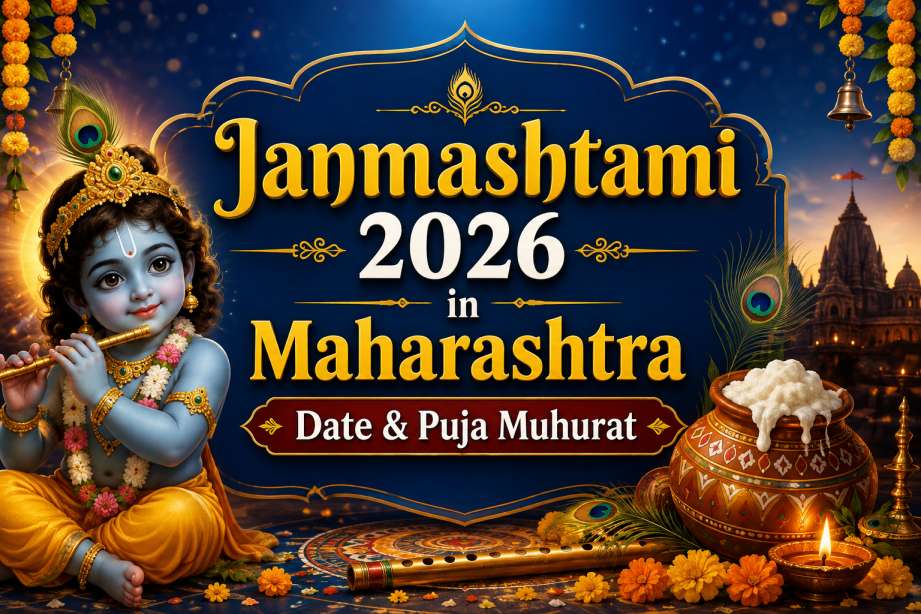
Krishna Janmashtami 2026 in Maharashtra will be observed on Friday, September 4, 2026, marking the birth of Lord Krishna on the Ashtami Tithi of Krishna Paksha in the month of Bhadrapada. In Mumbai and other parts of Maharashtra, devotees traditionally observe a fast, perform Krishna Puja around midnight and celebrate the divine birth with devotional songs, bhajans and Jhanki decorations.
According to the Mumbai Panchang, Ashtami Tithi begins at 2:25 AM on September 4 and ends at 12:13 AM on September 5, 2026. Rohini Nakshatra begins at 12:29 AM on September 4 and ends at 11:04 PM the same day.
Janmashtami is not only a religious festival but also a reminder of Krishna’s teachings on dharma, self-discipline, devotion and detached action. The midnight celebration symbolically represents the appearance of divine consciousness during the darkest part of the night.
Janmashtami 2026 Date in Maharashtra
For Maharashtra, including Mumbai, the principal Krishna Janmashtami date is September 4, 2026.
Important Panchang Timings
| Event | Time in IST |
| Janmashtami | Friday, September 4, 2026 |
| Ashtami Tithi Begins | 2:25 AM, September 4 |
| Ashtami Tithi Ends | 12:13 AM, September 5 |
| Rohini Nakshatra Begins | 12:29 AM, September 4 |
| Rohini Nakshatra Ends | 11:04 PM, September 4 |
| Nishita Puja Muhurat, Mumbai | 12:14 AM–1:01 AM, September 5 |
| Mid-Night Moment | 12:37 AM, September 5 |
| Chandrodaya | 12:12 AM, September 5 |
| Parana | After 6:24 AM, September 5 |
The exact timing can vary slightly across Maharashtra because sunrise and geographical coordinates differ between cities. For example, Pune’s Nishita Puja period is approximately 12:10 AM to 12:57 AM IST, while Mumbai’s is 12:14 AM to 1:01 AM IST.
Nishita Puja Muhurat in Mumbai
The most important worship period for Krishna Janmashtami is Nishita Kaal, the Hindu midnight period associated with Lord Krishna’s birth.
For Mumbai in 2026, the Nishita Puja Muhurat is:
12:14 AM to 1:01 AM IST on September 5, 2026
The midnight moment falls at approximately 12:37 AM IST. Devotees can perform the main Krishna Janmashtami Puja during this period.
Why is Midnight Important?
Traditional accounts describe Krishna’s birth at midnight in Mathura. Therefore, the Nishita period has special devotional importance. Rather than viewing the timing as a guarantee of a particular worldly result, devotees can treat it as a spiritually significant period for prayer, meditation and devotion.
A simple prayer such as:
“ॐ नमो भगवते वासुदेवाय।”
may be chanted with concentration during the Puja.
Janmashtami Fasting Rules 2026
Fasting is an important part of Krishna Janmashtami observance. Traditional fasting practices vary between families and communities, so devotees should follow their established Sampradaya or local Panchang guidance.
Common fasting principles include:
- Take Sankalpa after completing morning rituals.
- Avoid grains during the fast.
- Many devotees consume fruits, milk, nuts or traditional fasting foods.
- Avoid onion, garlic and regular grain-based meals if following a strict devotional fast.
- Spend some time in Krishna Naam Jap, Bhagavad Gita reading or devotional singing.
- Avoid excessive food intake after breaking the fast.
- Elderly people, children, pregnant women and those with medical requirements should not undertake a restrictive fast without appropriate professional advice.
Panchang notes that Janmashtami fasting traditionally follows strict fasting principles and that Parana is generally performed after sunrise when the relevant Tithi and Nakshatra conditions have been fulfilled.
Janmashtami Puja Vidhi
A simple home Puja can be performed without making the ritual unnecessarily complicated.
Step-by-Step Puja
- Clean the Puja space and place a clean cloth on the altar.
- Keep an image or idol of Bal Gopal/Krishna.
- Light a diya and offer incense.
- Take a Sankalpa for observing Janmashtami.
- Offer water, flowers, Tulsi leaves and sandalwood.
- Perform Abhishekam of the Krishna idol, if appropriate for the idol.
- Offer fresh clothes and ornaments to Bal Gopal.
- Offer fruits, Makhan-Mishri and other permissible Bhog items.
- Chant “Om Namo Bhagavate Vasudevaya” or Krishna’s other traditional names.
- Read or listen to selected portions of Shrimad Bhagavata Purana describing Krishna’s birth.
- Perform Krishna Aarti around Nishita Kaal.
- Distribute Prasad among family members.
The traditional Shodashopachara approach includes sixteen forms of devotional offering, although a simple household Puja performed with sincerity is also meaningful.
Astrological Significance of Janmashtami
From a Vedic astrology perspective, Janmashtami provides an opportunity for Chandra-related spiritual practices, because the festival is observed according to lunar Tithi and Nakshatra.
The Moon represents the mind, emotions, mental habits and inner receptivity. Krishna worship can therefore be used as a symbolic practice for developing emotional balance and clarity.
Devotees interested in astrology may use Janmashtami for:
- Moon-related meditation for emotional stability.
- Krishna Naam Jap for mental concentration.
- Reading the Bhagavad Gita for guidance during difficult decisions.
- Offering Tulsi to Krishna as a devotional practice.
- Practising restraint from anger, excessive speech and impulsive decisions.
These practices should be understood as spiritual disciplines rather than guaranteed methods for producing specific material outcomes.
Simple Janmashtami Remedies
Traditional devotional practices can be kept simple and practical:
- Chant “Om Namo Bhagavate Vasudevaya” 108 times.
- Offer Tulsi leaves to Lord Krishna.
- Donate food or fruits to someone in need.
- Read a chapter or selected verses from the Bhagavad Gita.
- Spend time in peaceful prayer instead of excessive celebration.
- Practise forgiveness and avoid unnecessary arguments.
- Offer Makhan-Mishri as Bhog and share the Prasad with family.
The deeper remedy is to apply Krishna’s teachings in daily life—particularly self-control, duty, compassion and equanimity.
Maharashtra Janmashtami and Dahi Handi
In Maharashtra, Janmashtami celebrations are closely connected with the popular Dahi Handi tradition. While Janmashtami focuses on Krishna’s birth and midnight worship, Dahi Handi celebrations are commonly associated with the following day.
In 2026, Dahi Handi is observed on Saturday, September 5.
The tradition reflects the playful childhood stories of Krishna and his friends attempting to reach pots of curd or butter. Modern celebrations often involve Govinda teams, music and large public gatherings, making crowd safety and responsible participation particularly important.
Conclusion
Janmashtami 2026 in Maharashtra falls on Friday, September 4, with the main midnight worship taking place after midnight on September 5. In Mumbai, the Nishita Puja Muhurat is 12:14 AM to 1:01 AM IST, making this the key period for devotees planning their home Krishna Puja. Along with fasting and rituals, the festival offers an opportunity to reflect on Krishna’s teachings about duty, wisdom, devotion and emotional balance. Families can observe the occasion through a simple Puja, Krishna Naam Jap, Bhagavad Gita reading and charitable acts. Since Panchang timings can differ by location, devotees should verify the local timings for their exact Maharashtra city before beginning the fast or planning Parana.
FAQs
1. When is Janmashtami 2026 in Maharashtra?
Janmashtami 2026 will be celebrated in Maharashtra on Friday, September 4, 2026.
In Mumbai, the Ashtami Tithi begins at 2:25 AM on September 4 and ends at 12:13 AM on September 5. Rohini Nakshatra continues until 11:04 PM on September 4.
Tips:
- Follow the local city Panchang.
- Plan fasting and Puja according to the relevant Tithi.
- Keep the midnight worship period free for Krishna Puja.
2. What is the Nishita Puja Muhurat for Janmashtami in Mumbai?
The Nishita Puja Muhurat in Mumbai is 12:14 AM to 1:01 AM IST on September 5, 2026.
This period represents the midnight worship window associated with Krishna’s birth. The calculated midnight moment is around 12:37 AM IST.
Related practice:
- Bathe and prepare the idol.
- Offer Tulsi and Bhog.
- Chant Krishna Mantras.
- Perform Aarti during Nishita Kaal.
3. What can be eaten during Janmashtami fasting?
Devotees following a fasting tradition generally avoid grains and choose permitted fasting foods such as fruits, milk, nuts and other regional fasting preparations.
Fasting rules differ between traditions. A strict fast may involve greater restrictions, while some households follow a fruit or single-meal approach.
Tips:
- Avoid regular grain-based meals.
- Stay adequately hydrated if your fasting tradition permits it.
- Do not undertake restrictive fasting if it conflicts with medical or nutritional requirements.
4. When should the Janmashtami fast be broken in Maharashtra?
For Mumbai, the traditional Parana time is after 6:24 AM IST on September 5, 2026, subject to the applicable Panchang conditions.
Traditional guidance considers the completion of relevant Tithi and Nakshatra conditions before Parana. Local Panchang calculations should therefore be followed rather than using one time for every city.
Remember:
- Check your city’s Panchang.
- Follow your family tradition.
- Break the fast gradually with suitable food.
5. What is the main Puja mantra for Krishna Janmashtami?
“Om Namo Bhagavate Vasudevaya” is one of the most widely used devotional mantras associated with Lord Krishna.
Devotees may repeat it during meditation or Janmashtami Puja. The emphasis should be on concentration and devotion rather than simply counting repetitions.
Simple practice:
- Chant 108 times.
- Sit quietly afterward for a few minutes.
- Reflect on Krishna’s teachings about duty and self-control.
6. Is Dahi Handi celebrated on the same day as Janmashtami in Maharashtra?
In 2026, Dahi Handi falls on Saturday, September 5, the day after Janmashtami.
Dahi Handi represents Krishna’s playful childhood tradition of reaching butter and curd pots and has become a major cultural celebration in Maharashtra.
For a meaningful celebration:
- Follow local safety guidelines.
- Avoid overcrowded or unsafe participation.
- Enjoy the cultural tradition while respecting its devotional roots.