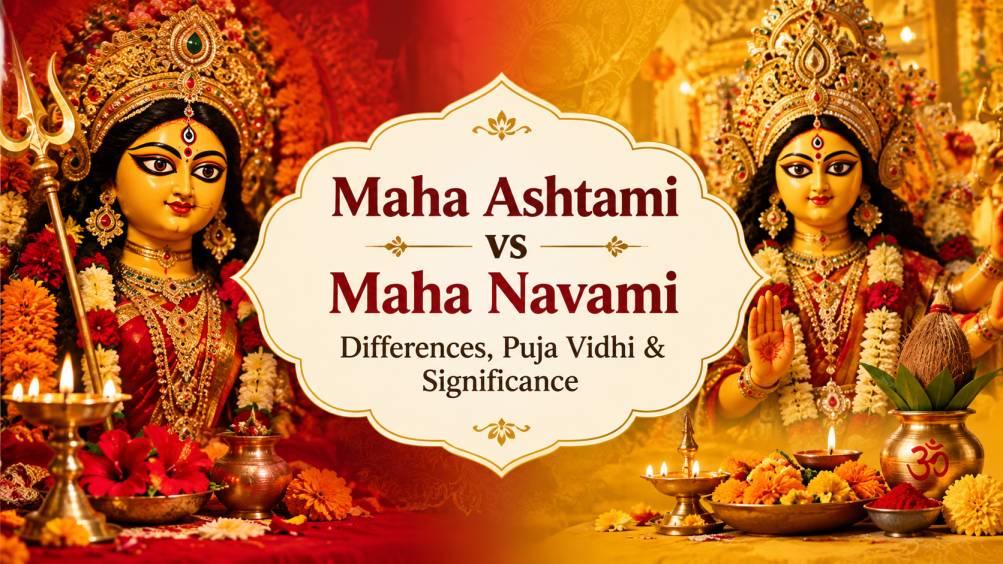
Maha Ashtami and Maha Navami are two important days of Shardiya Navratri, dedicated to the worship of Goddess Durga in Hindu tradition. Although both days honour the divine feminine energy, they have distinct religious significance, rituals, and regional customs. Maha Ashtami falls on the eighth lunar day (Ashtami Tithi), while Maha Navami is observed on the ninth lunar day (Navami Tithi) of the bright fortnight of Ashwin.
For devotees, these occasions represent the victory of good over evil, the removal of negativity, and the cultivation of courage, wisdom, and devotion. Rituals such as Durga Ashtami Puja, Sandhi Puja, Kanya Puja, and Navami Havan are important in many households and temples.
Understanding Maha Ashtami vs Maha Navami helps devotees follow the appropriate traditions and appreciate the cultural and spiritual meaning of both days.
Maha Ashtami vs Maha Navami: Key Differences
Maha Ashtami and Maha Navami are closely connected, but their emphasis differs according to regional traditions and religious texts.
| Aspect | Maha Ashtami | Maha Navami |
| Tithi | Eighth lunar day | Ninth lunar day |
| Main significance | Worship of Goddess Durga and her protective power | Worship of Durga’s victory and divine strength |
| Important rituals | Durga Ashtami Puja, Sandhi Puja, Kanya Puja | Navami Puja, Kanya Puja, Havan |
| Common observance | Fasting, mantra chanting, offerings | Fasting, devotional worship, completion rituals |
| Regional importance | Especially significant during Durga Puja in Bengal | Associated with the culmination of Durga Puja and Navratri worship |
The exact rituals vary by region, family tradition, and temple practice. Kanya Puja, for example, may be performed on Ashtami, Navami, or both days.
Religious Significance of Maha Ashtami
Why Is Maha Ashtami Celebrated?
Maha Ashtami is one of the most sacred days of Navratri. It celebrates the power of Goddess Durga to protect dharma and overcome destructive forces. In many traditions, devotees worship Maa Mahagauri on the eighth day of Navratri, although the specific form associated with Ashtami may vary according to the calendar and regional customs.
The day is particularly important for devotees seeking courage, emotional strength, protection, and spiritual discipline.
Important Maha Ashtami Rituals
Common rituals include:
- Durga Puja: Offer flowers, incense, fruits, and traditional bhog to Goddess Durga.
- Sandhi Puja: In the Bengali Durga Puja tradition, this special worship takes place at the junction of Ashtami and Navami, traditionally during the final 24 minutes of Ashtami and the first 24 minutes of Navami. Actual timings depend on the local Panchang.
- Kanya Puja: Worship young girls as symbolic representations of the divine feminine.
- Fasting and prayer: Many devotees observe a fast and recite Durga Chalisa, Durga Saptashati, or other devotional prayers according to their tradition.
Sandhi Puja is particularly prominent in Bengal and should not be confused with a ritual that every Hindu household is required to perform.
Religious Significance of Maha Navami
Why Is Maha Navami Important?
Maha Navami marks the ninth day of Navratri and is associated with the culmination of Goddess Durga’s worship. In the widely known Mahishasura Mardini tradition, the Goddess’s battle against the buffalo demon represents the triumph of divine order over destructive forces.
In many Navratri traditions, devotees worship Maa Siddhidatri on the ninth day. She is associated with spiritual accomplishment, wisdom, and divine blessings. In parts of India, Maha Navami also includes Ayudha Puja, during which tools, instruments, books, or work equipment are honoured.
Important Maha Navami Rituals
- Navami Puja: Offer flowers, fruits, sweets, and other traditional offerings to the Goddess.
- Kanya Puja: Honour young girls with food, gifts, and respectful gestures.
- Navami Havan: Perform a sacred fire ritual where this is part of the family’s tradition.
- Ayudha Puja: Worship tools, machinery, books, or professional equipment in regions where this custom is observed.
- Prasad distribution: Share food with family members, neighbours, and people in need.
Maha Navami is also a time for reflection on the qualities associated with Goddess Durga, including determination, compassion, and the responsible use of strength.
Maha Ashtami and Maha Navami Puja Vidhi
Although the main rituals differ slightly, devotees can follow a simple home-worship routine on either day.
Step-by-Step Puja Vidhi
- Clean the puja area: Arrange the altar, images or idols of Goddess Durga, and the required offerings.
- Take a sankalp: Begin with a sincere intention to worship with devotion and gratitude.
- Light a diya: Use a lamp and incense if appropriate for your household tradition.
- Offer bhog: Present fruits, sweets, flowers, and other permitted offerings.
- Chant prayers: Recite a Durga mantra, Durga Chalisa, or selected verses from the Durga Saptashati.
- Perform aarti: Conclude the main worship with aarti and prayers for the well-being of the family.
- Complete additional rituals: Perform Kanya Puja, Havan, or other observances on the day prescribed by your tradition.
Devotees should consult a reliable local Panchang for the relevant tithi and ritual timings, particularly when Sandhi Puja or other time-sensitive ceremonies are planned.
Astrological and Spiritual Significance
In Vedic astrology, Navratri is often viewed as a period for discipline, devotion, self-reflection, and spiritual practices. However, Maha Ashtami and Maha Navami are lunar-calendar observances, not events defined by a particular planetary transit or zodiac sign.
Their spiritual relevance can be understood through the qualities associated with Goddess Durga:
- Courage and discipline: Use the occasion to address a difficult task or develop a healthier routine.
- Emotional balance: Combine prayer with mindfulness, gratitude, and thoughtful decision-making.
- Wisdom and responsibility: Reflect on personal habits, relationships, and professional choices.
- Service and compassion: Donate food, support people in need, or help someone in your community.
Traditional remedies may include chanting Durga mantras, offering flowers, lighting a diya safely, and performing charitable acts. These practices can support devotion and personal reflection, but they should not be presented as guaranteed ways to change planetary outcomes or solve every life problem.
Conclusion
Maha Ashtami and Maha Navami are two meaningful stages of Shardiya Navratri, united by devotion to Goddess Durga but distinguished by their tithis and regional rituals. Maha Ashtami is especially associated with Durga worship and Sandhi Puja, while Maha Navami is widely observed through Navami Puja, Kanya Puja, Havan, and, in some regions, Ayudha Puja.
The correct observance depends on the local Panchang, family tradition, and regional customs. Rather than focusing only on rituals, devotees can use both days to cultivate courage, compassion, self-discipline, and gratitude. Whether you celebrate at home or visit a temple, the central purpose remains devotion and the effort to bring positive values into everyday life.
Before planning a time-sensitive ritual, check the local tithi and muhurat for your city and follow the tradition practised by your family.
FAQs: Maha Ashtami vs Maha Navami
1. What is the main difference between Maha Ashtami and Maha Navami?
Maha Ashtami falls on the eighth lunar day of Navratri, while Maha Navami falls on the ninth. Both days are dedicated to Goddess Durga, but their rituals and regional observances may differ.
Ashtami is associated with Durga worship and Sandhi Puja in Bengali traditions. Navami is associated with special Goddess worship, Havan, and the completion of many Navratri observances.
Tip: Check your local Panchang before deciding which day to perform a particular ritual.
2. Is Maha Ashtami more important than Maha Navami?
Neither day is universally considered more important; both hold special significance within Hindu traditions.
Some devotees give greater importance to Ashtami and perform Kanya Puja on that day, while others observe Navami with Havan and special offerings. Regional customs and family traditions influence these choices.
Tip: Follow the observance traditionally practised by your family or local temple.
3. Can Kanya Puja be performed on both Ashtami and Navami?
Yes, Kanya Puja may be performed on either day, and some families observe it on both.
The ritual honours young girls as symbolic representations of the divine feminine. Devotees traditionally offer food, gifts, and respectful prayers as an expression of gratitude and devotion.
Tip: Prepare food according to your family’s custom, maintain appropriate hygiene, and ensure that every child participates willingly and comfortably.
4. What is Sandhi Puja, and why is it performed?
Sandhi Puja is a special Durga worship performed at the transition between Ashtami and Navami in the Bengali Durga Puja tradition.
It is traditionally observed during the final 24 minutes of Ashtami and the first 24 minutes of Navami. This makes the local tithi timings particularly important when planning the ritual.
Tip: Consult a reliable local Panchang for the exact Sandhi Puja window rather than relying on a fixed clock time.
5. What should devotees offer to Goddess Durga on Maha Ashtami and Maha Navami?
Common offerings include flowers, fruits, sweets, incense, and other items prescribed by the family’s religious tradition.
The exact bhog varies by region and household. Devotion, cleanliness, and sincerity are generally emphasised more than the expense of the offerings.
Tip: Choose fresh, appropriate offerings and distribute prasad respectfully after the puja.
6. Which mantra can be chanted on Maha Ashtami and Maha Navami?
Devotees may chant the traditional Durga mantra, “Om Dum Durgayei Namaha,” as part of their worship.
Regular chanting can serve as a focus for prayer, reflection, and mental discipline. People may also recite Durga Chalisa or selected passages from the Durga Saptashati according to their tradition.
Tip: Chant calmly and consistently, without assuming that a particular number of repetitions guarantees a specific result.
7. Is fasting necessary on Maha Ashtami and Maha Navami?
No, fasting is not compulsory for everyone; devotees may choose an observance suited to their health, age, and circumstances.
Some people observe a full fast, while others consume fruits, milk, or permitted foods according to their tradition. Prayer and charitable acts are also meaningful ways to participate.
Tip: Prioritise health and hydration, and consult a healthcare professional if you have a medical condition that may affect fasting.
8. What is the astrological significance of Maha Ashtami and Maha Navami?
Their primary significance comes from Hindu religious and lunar-calendar traditions rather than a specific planetary transit.
In a broader spiritual context, devotees associate Goddess Durga with courage, protection, discipline, and the ability to overcome personal challenges. Prayer and charitable activities can help people reflect on these qualities.
Tip: Use the occasion to practise patience, improve daily habits, and make thoughtful decisions rather than relying on rituals alone to resolve practical difficulties.