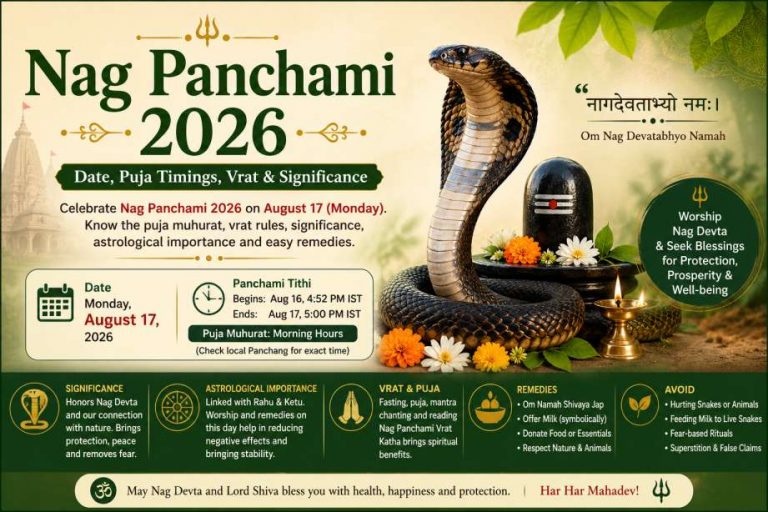
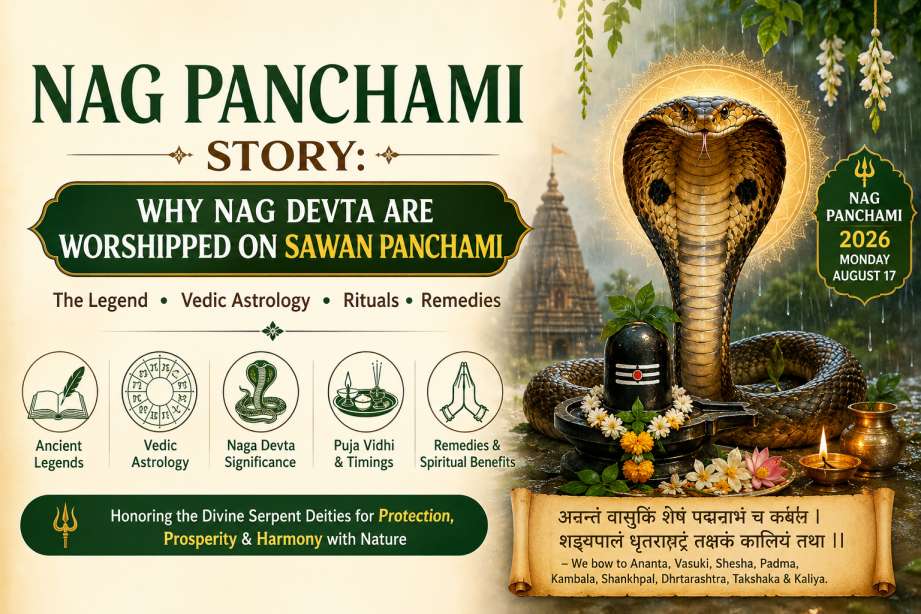
Nag Panchami is one of the important festivals observed during Sawan (Shravana) Shukla Panchami, when devotees worship Nag Devta, the divine serpent deities associated with protection, fertility, nature and spiritual transformation. In North India, Nag Panchami 2026 falls on Monday, August 17, according to the regional Panchang for Delhi.
The tradition is not simply about worshipping snakes. In Hindu thought, Nagas represent powerful natural and cosmic forces, while serpent symbolism is also connected with kundalini, hidden energies and transformation.
From a Vedic astrology perspective, Nag Panchami can be viewed as a spiritually significant occasion for reflecting on Rahu-Ketu themes, ancestral patterns, fear, transformation and karmic tendencies. The festival therefore combines mythology, devotion, ecological awareness and symbolic astrology.
Nag Panchami Story: The Legend of Astika and the Nagas
One of the most important stories connected with serpent worship is found in the Astika Parva of the Mahabharata.
King Parikshit, the father of King Janamejaya, died after being bitten by the serpent king Takshaka. Seeking revenge, Janamejaya decided to conduct a massive Sarpa Satra, or snake sacrifice, intending to destroy the Nagas. The Mahabharata describes the sacrifice and the fear it created among the serpent race.
The sage Astika, who had connections with both the human and Naga lineages, eventually approached Janamejaya. Through wisdom, restraint and a carefully requested boon, Astika persuaded the king to stop the sacrifice and thereby saved many Nagas, including Takshaka.
This story gives Nag Panchami an important philosophical message: revenge can create a cycle of destruction, while wisdom and compassion can restore balance.
Why Is This Story Important?
The Astika story explains why Nagas are treated with reverence rather than simply as feared creatures.
Traditional serpent worship acknowledges the dual nature of the Naga symbol:
- Power and protection
- Fear and courage
- Destruction and renewal
- Hidden knowledge and transformation
- Nature and ecological balance
The festival therefore encourages respect for forces that humans cannot completely control.
Why Are Nag Devta Worshipped in Sawan?
Sawan is traditionally associated with Lord Shiva, and serpent imagery is closely connected with Shiva, who is depicted wearing a serpent around his neck.
Monsoon conditions also have a practical cultural connection with snake worship. During the rainy season, snakes and other animals may move from flooded or disturbed habitats into human settlements. Traditional festivals developed within this broader seasonal environment, encouraging people to acknowledge and respect living beings.
Nag Panchami thus combines religious symbolism with seasonal awareness.
In traditional worship, devotees may offer flowers, turmeric, sandalwood, milk or other naivedya to an image or representation of Nag Devta. Importantly, devotees should avoid handling or feeding wild snakes directly.
Nag Panchami and Vedic Astrology
Serpent symbolism has a strong place in Jyotish, particularly through Rahu and Ketu, the lunar nodes.
Rahu and Ketu are not physical planets but shadow points calculated from the Moon’s orbit. In astrology, they are often associated with karmic patterns, unusual experiences, attachment, detachment and transformation.
Rahu, Ketu and Serpent Symbolism
The connection between Nag worship and the lunar nodes is primarily symbolic and traditional rather than a universal astrological rule.
Rahu may represent:
- Obsession and intense desires
- Fear and uncertainty
- Unconventional experiences
- Material fascination
- Hidden influences
Ketu may represent:
- Detachment
- Spiritual inquiry
- Past patterns
- Sudden changes
- Inner transformation
Because serpent imagery can represent hidden energy and transformation, Nag Panchami is sometimes considered an appropriate day for spiritual practices related to these themes.
Which Houses Can Be Considered?
Astrologers may examine certain houses when discussing serpent symbolism or Sarpa-related beliefs:
5th House: Children, past-life impressions, intelligence and mantra practice.
8th House: Transformation, hidden matters, mysteries, sudden events and occult subjects.
12th House: Detachment, spiritual retreat, subconscious patterns and liberation-oriented practices.
However, the presence of Rahu or Ketu in one of these houses does not automatically indicate a problem or dosha. A complete horoscope requires examination of the ascendant, planetary strength, aspects, conjunctions, divisional charts and dashas.
Nag Panchami Remedies and Spiritual Practices
Nag Panchami remedies are best approached as devotional practices rather than guaranteed solutions to specific problems.
Simple Traditional Practices
- Worship an image or symbolic representation of Nag Devta.
- Offer flowers, sandalwood and traditional naivedya according to local custom.
- Chant “Om Namah Shivaya” with a calm and focused mind.
- Read or listen to the Nag Panchami Vrat Katha.
- Visit a Shiva temple if convenient.
- Donate food or useful items to someone in need.
- Practice restraint, forgiveness and non-violence.
Traditional Nag Panchami texts also mention worship of several Naga names, including Ananta, Vasuki, Shesha, Padma, Karkotaka and Takshaka.
A Practical Modern Remedy
One meaningful way to observe Nag Panchami today is to combine spiritual practice with environmental responsibility.
Do not attempt to catch, touch or feed wild snakes. If a snake enters a residential area, contact trained wildlife rescuers or local forest authorities rather than trying to remove it yourself.
Nag Panchami 2026: Date and Puja Timing
For Delhi, India, Nag Panchami 2026 is observed on Monday, August 17, 2026.
Panchami Tithi from 4:52 PM IST on August 16 to 5:00 PM IST on August 17, with a listed Nag Panchami Puja Muhurat of 5:22 AM to 7:58 AM IST for the referenced location.
Panchang timings can vary by city, sunrise and regional calendar traditions, so devotees should check their local Panchang before planning the puja.
Conclusion
The Nag Panchami story is ultimately a story of balance, wisdom and respect for life. The Mahabharata’s account of Astika stopping Janamejaya’s destructive snake sacrifice highlights the importance of compassion over revenge.
In Sawan, Nag Devta worship also connects with the symbolism of Lord Shiva, nature and transformation. From a Jyotish perspective, serpent imagery can provide a useful framework for reflecting on Rahu-Ketu themes, hidden fears and karmic patterns, but astrology should not be used to create unnecessary fear.
Nag Panchami can therefore be observed as a day of devotion, self-reflection, environmental awareness and respect for the natural world.
FAQs
1. Why are Nag Devta worshipped on Nag Panchami?
Nag Devta are worshipped on Nag Panchami as a traditional expression of reverence toward the Naga deities and the natural forces they symbolically represent.
The tradition is supported by several strands of Hindu mythology, including the Mahabharata’s Astika story and traditional Nag Panchami vrat literature.
Related practice:
- Worship a symbolic Naga image.
- Offer flowers and traditional naivedya.
- Recite a Shiva mantra.
- Avoid harming snakes or other animals.
2. What is the main Nag Panchami story?
The best-known story involves Astika Muni stopping King Janamejaya’s snake sacrifice and saving the Nagas from destruction.
According to the Mahabharata’s Astika Parva, Janamejaya performed the sacrifice because he wanted revenge against Takshaka, who was responsible for the death of his father Parikshit. Astika intervened and persuaded the king to end the sacrifice.
Key lesson: Wisdom and compassion can break a cycle of anger and revenge.
3. Is Nag Panchami connected with Rahu and Ketu?
Nag Panchami is symbolically associated with serpent imagery, which some Jyotish traditions relate to Rahu and Ketu, but the festival is not exclusively a Rahu-Ketu remedy.
Rahu and Ketu are lunar nodes associated in Jyotish with karmic themes, attachment, detachment and transformation. Their interpretation depends on the complete horoscope rather than on one placement alone.
Astrological approach:
- Examine Rahu and Ketu’s signs and houses.
- Consider planetary aspects and conjunctions.
- Review the current Mahadasha and Antardasha.
- Avoid assuming a dosha from one placement.
4. Can Nag Panchami remedies remove Sarpa Dosha?
Traditional devotees may perform Naga worship for spiritual relief, but no single ritual should be presented as a guaranteed cure for Sarpa Dosha.
In Jyotish, interpretations involving Sarpa Dosha or related combinations require examination of the entire birth chart. Different astrological schools may also use different criteria.
For a balanced approach:
- Understand the actual horoscope combination first.
- Prefer simple devotional practices.
- Avoid fear-based or expensive remedies.
- Combine spiritual practice with responsible real-life action.
5. Should devotees offer milk directly to live snakes?
Devotees should not attempt to feed milk to wild snakes because it can be unsafe for both humans and the animal.
Nag Panchami worship can be performed using a Naga image, idol, drawing or temple representation. This preserves the devotional tradition without disturbing wildlife.
Safer observance:
- Worship a symbolic Naga representation.
- Offer milk as naivedya where customary.
- Do not approach wild snakes.
- Contact trained rescuers if a snake enters a home.
6. What is the spiritual meaning of worshipping snakes?
Serpent worship can symbolise transformation, hidden energy, protection, fertility, nature and the movement from fear toward awareness.
The Naga is neither simply a symbol of danger nor merely a supernatural figure. In Hindu traditions, serpent imagery appears in diverse contexts, including Shiva symbolism and the Mahabharata’s Naga narratives.
Reflection for Nag Panchami:
- Overcome unnecessary fear.
- Practice restraint instead of revenge.
- Respect nature.
- Focus on inner transformation.
7. When is Nag Panchami 2026?
Nag Panchami 2026 falls on Monday, August 17, in the North Indian Sawan calendar.
For Delhi, the referenced Panchang gives the Panchami Tithi and a morning puja period, but exact timings should be checked locally because Panchang calculations can differ by location.
Tip: Follow the local regional Panchang for the most appropriate puja timing.