
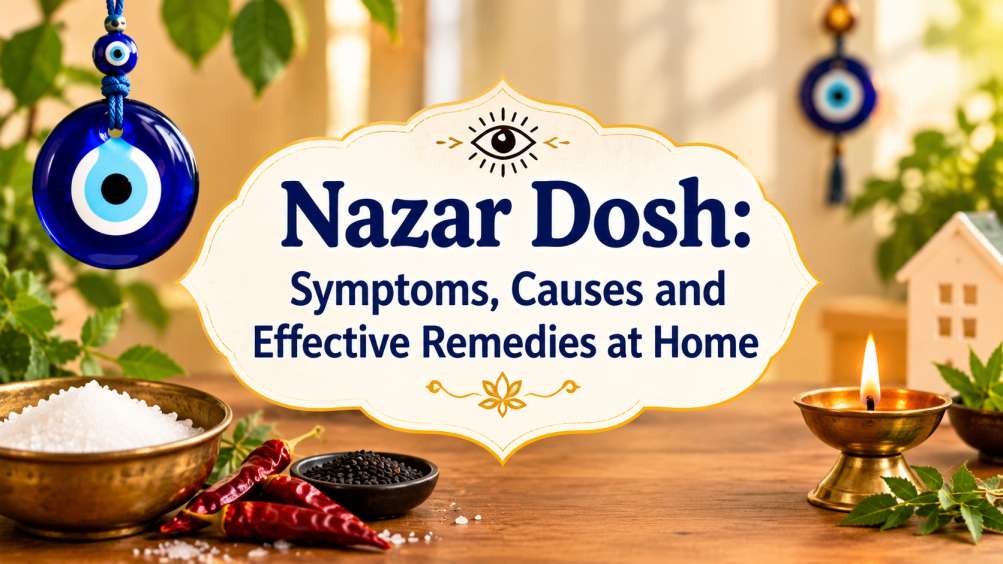
Nazar Dosh, commonly known as the evil eye, is a traditional belief that excessive admiration, jealousy, or negative attention may create an uncomfortable or disruptive influence on a person, child, relationship, home, or business. In Indian culture, remedies for Nazar Dosh are often connected with household traditions, Vastu practices, and spiritual beliefs.
From an astrological perspective, Nazar is not universally treated as a specific planetary dosha in classical Vedic astrology in the same way as Mangal Dosh, Kaal Sarp Dosh, or Pitru Dosh. However, astrologers may examine the Moon, Rahu, Ketu, the Ascendant, and relevant houses when interpreting sensitivity, anxiety, unexplained obstacles, or perceived negative influences.
It is important to approach the subject thoughtfully. Traditional remedies can provide spiritual comfort and cultural reassurance, but persistent physical, emotional, or financial problems should not automatically be attributed to Nazar.
What Is Nazar Dosh?
Nazar Dosh refers to the traditional idea that a person’s negative gaze, jealousy, excessive praise, or intense attention can disturb another person’s well-being or circumstances.
The concept is deeply rooted in Indian folk traditions and varies between regions and families. Some households use salt, mustard seeds, lemon, chilli, camphor, or specific prayers as protective practices.
In astrology, the idea is sometimes associated symbolically with planets such as Rahu and Ketu, which are traditionally connected with uncertainty, illusion, sudden changes, and unusual experiences.
Nazar Dosh and Vedic Astrology
There is no single universally accepted planetary combination called “Nazar Dosh” in classical Vedic astrology. Instead, an astrologer may assess:
- Moon: Emotional sensitivity, mental peace, and reactions to the environment.
- Rahu: Illusion, fear, unusual circumstances, and psychological uneasiness.
- Ketu: Detachment, uncertainty, and sudden disturbances.
- Lagna and its lord: Overall vitality and resilience.
- Fourth house: Peace, comfort, and domestic environment.
- Eighth house: Sudden changes and unexpected difficulties.
- Twelfth house: Losses, isolation, sleep, and expenditure.
These factors should be assessed as a complete horoscope rather than using one planetary placement to declare Nazar Dosh.
Common Nazar Dosh Symptoms
Traditionally, people associate several sudden changes with the evil eye. However, these signs are not proof of Nazar Dosh and can have ordinary physical, emotional, or environmental explanations.
Commonly reported signs include:
- Sudden tiredness or lack of motivation
- Irritability or unexplained mood changes
- Disturbed sleep
- Feeling unusually restless or uncomfortable
- Sudden disagreements within the family
- A child becoming unusually cranky
- Temporary decline in concentration
- Repeated minor obstacles in routine activities
- Feeling mentally drained after social interactions
- Sudden loss of enthusiasm after receiving considerable attention or praise
For example, poor sleep, stress, dehydration, workload, anxiety, or an underlying health issue can produce similar symptoms. Therefore, practical causes should always be considered first.
What Causes Nazar Dosh?
According to traditional Indian belief, Nazar may be associated with:
Jealousy and Negative Attention
The most common explanation is exposure to intense jealousy, resentment, or unwanted attention. This belief is particularly common when someone experiences sudden success, wealth, popularity, or positive changes.
Excessive Praise
Some traditions believe that excessive admiration without a balancing protective practice can attract Nazar. This is one reason families sometimes use traditional protective symbols for newborns and children.
Social and Environmental Energy
Spiritual traditions often consider a person’s surroundings important. Frequent conflict, negativity, stressful interactions, or an uncomfortable environment may affect one’s emotional state.
From a practical perspective, however, stress and social pressure themselves can explain many of these experiences without requiring a supernatural explanation.
Effective Nazar Dosh Remedies at Home
Several simple remedies are traditionally used in Indian households. These should be viewed as spiritual or cultural practices rather than scientifically proven treatments.
Salt Remedy
Rock salt or common salt is traditionally associated with purification.
A commonly followed practice is to take a small amount of salt and move it around the person from head to toe before disposing of it appropriately.
Traditional tip: Perform such practices with a calm mindset rather than fear.
Lemon and Green Chillies
A lemon-and-green-chilli arrangement is widely seen outside homes and shops in India.
Traditionally, it is considered a protective symbol against negative influences. It should not, however, replace practical security, hygiene, financial planning, or other necessary precautions.
Camphor
Lighting camphor during a prayer or puja is a common household spiritual practice.
The ritual can create a peaceful atmosphere and serve as a reminder to maintain a positive and disciplined environment. Ensure proper ventilation and follow fire-safety precautions.
Hanuman Prayer
Devotees who follow Hanuman worship may recite the Hanuman Chalisa or offer a simple prayer on Tuesday or Saturday.
A commonly remembered devotional line is:
“बुद्धिहीन तनु जानिके, सुमिरौं पवन-कुमार।”
The emphasis should be on devotion, courage, and mental strength rather than fear of Nazar.
Maintain a Positive Home Environment
One of the most practical remedies is to keep the home clean, well-ventilated, and peaceful.
You can also:
- Reduce unnecessary arguments.
- Keep clutter under control.
- Maintain regular sleep and meal schedules.
- Avoid excessive comparison with others.
- Limit unnecessary sharing of private achievements.
- Spend time with supportive family members.
- Practice prayer, meditation, or quiet reflection if spiritually meaningful.
When Should You Seek Practical Help?
Not every unexplained problem is caused by Nazar Dosh. If someone experiences persistent fatigue, sleep problems, anxiety, mood changes, pain, or other concerning symptoms, professional medical advice is more appropriate than relying exclusively on spiritual remedies.
Similarly, repeated financial losses, relationship conflicts, or career difficulties should be examined through practical factors such as planning, communication, skills, expenses, and decision-making.
Astrology can be used as a reflective or spiritual framework, but it should not encourage fear or prevent sensible action.
Conclusion
Nazar Dosh remains an important cultural belief in many Indian families, but it should be approached with balance and awareness. Traditional signs such as sudden tiredness, restlessness, disturbed sleep, or unexpected obstacles are often associated with Nazar, yet they can also have completely practical explanations.
In Vedic astrology, Nazar is not a universally defined classical dosha, so a complete horoscope should be considered before making astrological conclusions. Simple practices such as prayer, maintaining a peaceful home, devotional recitation, and traditional purification rituals may provide spiritual comfort.
The most useful approach is to combine cultural wisdom with practical reasoning: do not live in fear of Nazar, but use meaningful traditions to cultivate positivity, discipline, and peace of mind.
FAQs
1. What are the common symptoms of Nazar Dosh?
Commonly believed symptoms include sudden tiredness, disturbed sleep, irritability, restlessness, and unexplained obstacles.
These signs are part of traditional belief rather than medically established evidence of an evil eye. Similar symptoms can result from stress, poor sleep, illness, or lifestyle changes.
Related tips:
- Observe when the symptoms started.
- Check practical causes first.
- Use spiritual remedies only as supportive practices.
2. How can I remove Nazar Dosh at home?
Traditional home practices include salt rituals, prayers, camphor, and devotional practices such as Hanuman worship.
Different Indian communities follow different methods, so there is no single universally prescribed Nazar Dosh remedy. Choose simple practices that align with your family traditions and do not cause harm.
Home remedies traditionally used:
- Salt purification ritual
- Hanuman Chalisa
- Prayer or meditation
- Keeping the home clean and peaceful
- Reducing unnecessary negativity
3. Is Nazar Dosh mentioned in Vedic astrology?
Nazar Dosh is not universally recognized as a specific classical planetary dosha in Vedic astrology.
Astrologers may nevertheless examine Rahu, Ketu, Moon, Lagna, and certain houses when interpreting experiences involving anxiety, uncertainty, sudden disturbances, or sensitivity.
Astrological approach:
- Assess the complete birth chart.
- Examine planetary periods.
- Consider transits.
- Avoid judging Nazar from one planetary placement alone.
4. Can Nazar Dosh affect children?
Indian traditions commonly believe that children can be particularly sensitive to Nazar, especially after receiving considerable attention or praise.
However, symptoms such as crying, poor sleep, appetite changes, fever, or unusual behavior should never automatically be attributed to Nazar. Children should receive appropriate medical attention when needed.
For children:
- Maintain regular sleep and feeding routines.
- Keep their environment comfortable.
- Follow safe family traditions if desired.
- Consult a pediatrician for persistent symptoms.
5. Does lemon and chilli really remove Nazar?
Lemon and green chilli are traditional protective symbols, but there is no established scientific evidence that they remove an evil eye.
They remain culturally significant in many Indian homes and businesses. Their use can be understood as a traditional symbolic practice rather than a guaranteed supernatural remedy.
Remember:
- Treat it as a cultural tradition.
- Do not let it replace practical precautions.
- Avoid fear-based interpretations.
6. Can Nazar Dosh cause financial or career problems?
Traditional beliefs sometimes associate Nazar with sudden obstacles, but financial or career difficulties should first be examined through practical and astrological factors.
Job changes, market conditions, poor planning, expenses, workplace issues, or business decisions can all affect financial outcomes. If astrology is consulted, the complete horoscope and planetary periods should be assessed rather than assuming Nazar.
Practical focus:
- Review expenses and decisions.
- Improve professional skills.
- Track recurring problems.
- Use spiritual practices for personal confidence and peace.