
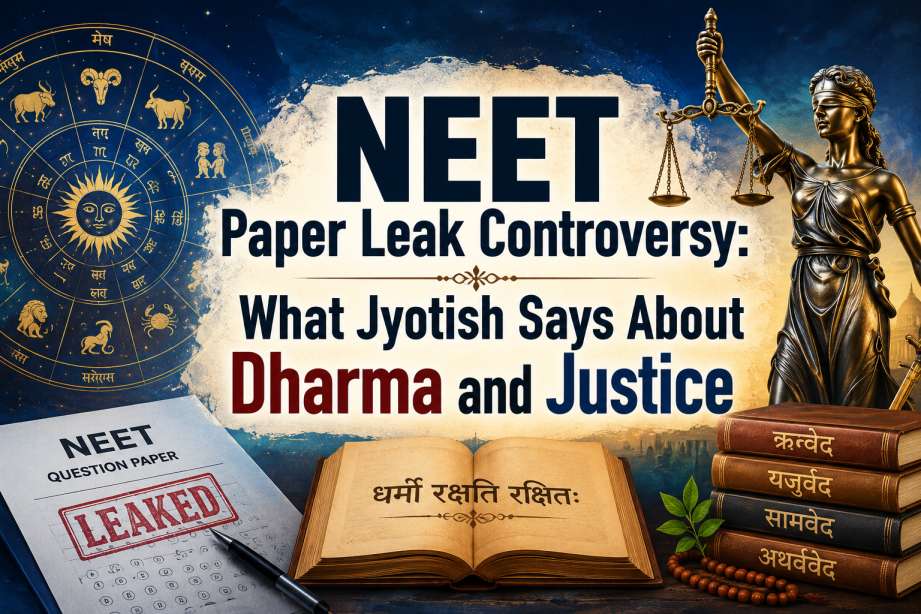
The NEET paper leak controversy has sparked widespread debate across India, raising important questions about fairness, accountability, and the future of lakhs of students. While legal investigations, administrative reforms, and judicial proceedings address the issue in practical terms, many people also look toward Vedic astrology (Jyotish) to understand the deeper karmic and ethical dimensions of such events.
In Jyotish, incidents involving examination irregularities, misuse of power, deception, and delayed justice are often viewed through the lens of Dharma (righteous conduct) and Karma (cause and effect). Astrology does not predict guilt or innocence in specific cases, nor can it replace legal evidence. However, it offers a symbolic framework for understanding how societies maintain balance when ethical principles are challenged.
Understanding Dharma in Vedic Astrology
Dharma is one of the foundational concepts of Sanatana Dharma. It refers to righteousness, duty, truthfulness, and actions that support social harmony.
A famous verse from the Mahabharata states:
“धर्मो रक्षति रक्षितः”
“Dharma protects those who protect Dharma.”
In Jyotish, dharma is primarily associated with:
- The 9th House (Bhagya Bhava)
- Jupiter (Guru)
- The Sun (Surya)
- Strong ethical influences in a horoscope
When these factors are respected collectively within society, institutions tend to function transparently. When dharmic principles are weakened, controversies, mistrust, and systemic challenges can emerge.
The Astrological Symbolism of Educational Controversies
Education in Vedic astrology is commonly linked with:
The 4th House
Represents basic education, learning environment, and academic foundations.
The 5th House
Associated with intelligence, examinations, merit, and competitive success.
Mercury (Budh)
Represents intellect, communication, analysis, and academic performance.
Jupiter (Guru)
Signifies wisdom, ethics, teachers, and higher learning.
When discussions arise about examination fraud, paper leaks, or manipulation, astrologers often examine symbolic combinations involving Mercury, Jupiter, Rahu, and Saturn.
Rahu and the Theme of Deception
Among all planets, Rahu is frequently associated with:
- Secrecy
- Manipulation
- Shortcuts
- Hidden networks
- Technological misuse
- Sudden scandals
This does not mean Rahu is always negative. Rahu also governs innovation and unconventional thinking. However, when its energy becomes imbalanced, individuals or institutions may seek results without following proper processes.
In symbolic terms, controversies involving leaked information often resemble Rahu’s tendency to blur ethical boundaries.
Saturn’s Role in Justice and Accountability
Saturn (Shani) represents:
- Law
- Discipline
- Consequences
- Delayed justice
- Institutional accountability
A common observation in Jyotish is that while Rahu may create confusion, Saturn eventually demands responsibility.
This principle aligns with the traditional belief that actions produce results over time. Investigations, audits, judicial reviews, and reforms often reflect Saturn’s slow but persistent influence.
For this reason, many astrologers consider Saturn the great karmic auditor.
Jupiter and the Restoration of Trust
Jupiter symbolizes:
- Wisdom
- Moral guidance
- Teachers
- Educational institutions
- Ethical leadership
When trust in an examination system is shaken, Jupiter’s symbolism becomes particularly important.
Restoration occurs through:
- Transparent processes
- Honest leadership
- Stronger regulations
- Ethical decision-making
- Public accountability
From a Jyotish perspective, strengthening Jupiterian values helps rebuild confidence in educational systems.
What Can Students Learn from This Event?
The NEET controversy has been emotionally challenging for many students. Yet Jyotish emphasizes personal effort alongside destiny.
The Bhagavad Gita teaches:
“कर्मण्येवाधिकारस्ते मा फलेषु कदाचन”
“You have the right to perform your duty, but not to the fruits of your actions.”
For students, this message remains highly relevant.
Practical Lessons
- Focus on preparation rather than speculation.
- Verify information through official sources.
- Avoid shortcuts and unethical practices.
- Maintain consistency in study habits.
- Trust long-term effort over temporary advantages.
These principles align with both academic success and dharmic living.
Simple Jyotish Remedies for Clarity and Confidence
Astrological remedies should be viewed as spiritual practices that support discipline and mental balance rather than guaranteed solutions.
For Students
- Offer water to the Sun at sunrise.
- Recite the Gayatri Mantra daily.
- Maintain honesty in academic work.
- Read educational material at a fixed time each day.
- Respect teachers and mentors.
For Mental Stability
- Chant “Om Namah Shivaya” for inner calm.
- Practice meditation for 10–15 minutes daily.
- Limit excessive consumption of rumours and social media debates.
For Strengthening Jupiter
- Help younger students with studies.
- Donate educational materials when possible.
- Participate in knowledge-sharing activities.
Dharma, Karma, and Social Responsibility
The broader lesson from controversies such as paper leaks is that society functions best when individuals and institutions uphold ethical standards.
Jyotish teaches that every action contributes to a larger karmic cycle. Whether one is a student, teacher, administrator, parent, or policymaker, adherence to dharma creates trust and stability.
Rather than focusing solely on prediction, astrology encourages reflection on personal responsibility and collective integrity.
Conclusion
The NEET paper leak controversy highlights concerns about fairness, transparency, and accountability in India’s educational system. From a Vedic astrology perspective, such events can be understood through the symbolic interplay of Rahu, Saturn, Jupiter, karma, and dharma.
While astrology cannot determine legal outcomes, it offers valuable insights into ethical conduct, personal responsibility, and the importance of maintaining trust in institutions. Ultimately, Jyotish reminds us that justice may sometimes move slowly, but dharma remains a guiding force for individuals and society alike.
As students and citizens, the most constructive response is to strengthen integrity, continue sincere effort, and support systems that uphold fairness for everyone.
FAQs
1. Can Vedic astrology predict the outcome of the NEET paper leak investigation?
No, astrology cannot reliably determine legal outcomes or identify specific individuals responsible.
Jyotish provides symbolic insights into broader themes such as ethics, accountability, and social consequences. Legal investigations depend on evidence, judicial review, and official procedures.
Tips:
- Follow official announcements.
- Avoid relying on rumors.
- Separate astrological reflection from legal facts.
2. Which planet is associated with justice in Vedic astrology?
Saturn is most commonly associated with justice, discipline, and karmic accountability.
Shani represents the principle that actions eventually produce consequences. Many astrologers view Saturn as a symbol of delayed but meaningful correction.
Helpful Practices:
- Maintain honesty in daily life.
- Respect rules and responsibilities.
- Practice patience during uncertain periods.
3. Why is Rahu often linked with controversies?
Rahu is associated with secrecy, confusion, manipulation, and unconventional methods.
When imbalanced, Rahu can symbolize situations where shortcuts or hidden actions create public concern. However, Rahu also governs innovation and technological advancement.
Remedies:
- Verify information carefully.
- Avoid unethical shortcuts.
- Maintain clarity in decision-making.
4. How can students stay mentally strong during examination controversies?
Students can remain grounded by focusing on preparation, discipline, and emotional balance.
External events may create uncertainty, but consistent effort remains within personal control. Jyotish emphasizes self-discipline as a powerful remedy.
Suggestions:
- Follow a fixed study schedule.
- Limit social media distractions.
- Practice meditation and prayer.
5. What does Dharma mean in the context of education?
Dharma in education refers to honesty, fairness, responsibility, and respect for learning.
Students, teachers, institutions, and authorities all share a role in maintaining educational integrity. When these values are protected, trust grows within society.
Key Principles:
- Earn success ethically.
- Respect teachers and knowledge.
- Support transparency and fairness.