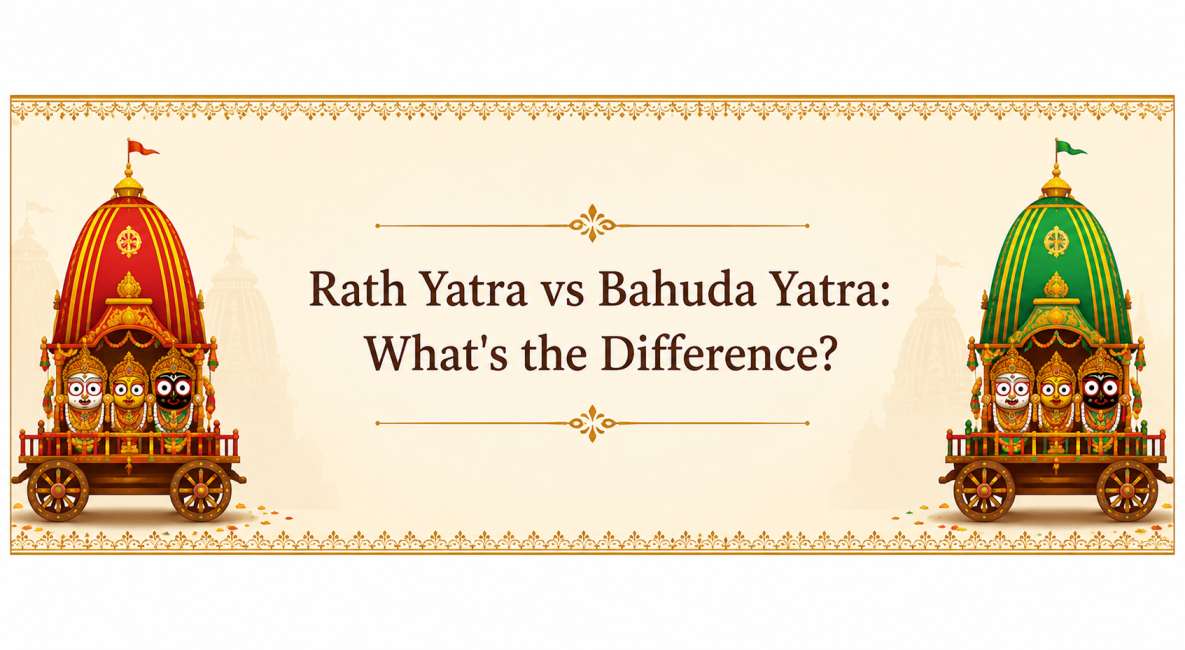
The annual Rath Yatra of Lord Jagannath is one of India’s most celebrated Hindu festivals, drawing millions of devotees to Puri and countless others across the country. While most people are familiar with the grand procession known as Rath Yatra, many are less aware of Bahuda Yatra, the equally significant return journey of Lord Jagannath, Lord Balabhadra, and Devi Subhadra.
From a Vedic astrology perspective, both journeys symbolize different phases of the soul’s spiritual evolution. Rath Yatra represents moving toward divine consciousness, while Bahuda Yatra signifies returning to worldly life with renewed wisdom and blessings. These festivals remind devotees that spiritual growth is not only about seeking God but also about living a righteous life after receiving divine guidance. Understanding the distinction between these two sacred processions helps devotees appreciate their deeper cultural, spiritual, and astrological significance.
What is Rath Yatra?
Rath Yatra is the annual chariot festival during which Lord Jagannath, Lord Balabhadra, and Devi Subhadra travel from the Jagannath Temple in Puri to the Gundicha Temple.
Traditionally celebrated during Ashadha Shukla Dwitiya, the festival symbolizes:
- The Lord coming out to bless all devotees.
- Equality, as everyone gets an opportunity for darshan.
- The journey of the soul toward spiritual awakening.
- Divine compassion reaching every devotee without distinction.
The pulling of the chariots is considered an act of devotion and humility, representing surrender to divine will.
What is Bahuda Yatra?
Bahuda Yatra literally means “the return journey.” It marks the return of the three deities from Gundicha Temple back to the Jagannath Temple after their stay.
This procession takes place on Ashadha Shukla Dashami according to the Hindu calendar.
The return journey symbolizes:
- Completion of a spiritual pilgrimage.
- Bringing divine blessings back into daily life.
- The victory of dharma through inner transformation.
- Returning home with wisdom, gratitude, and renewed faith.
Bahuda Yatra is not merely the end of the festival—it is considered the fulfillment of the entire spiritual journey.
Rath Yatra vs Bahuda Yatra: Key Differences
| Aspect | Rath Yatra | Bahuda Yatra |
| Meaning | Outward journey | Return journey |
| Direction | Jagannath Temple to Gundicha Temple | Gundicha Temple to Jagannath Temple |
| Symbolism | Seeking divine grace | Returning with divine blessings |
| Hindu Tithi | Ashadha Shukla Dwitiya | Ashadha Shukla Dashami |
| Spiritual Message | Beginning of inner transformation | Completion of spiritual growth |
| Emotional Significance | Excitement and devotion | Gratitude and fulfillment |
Spiritual Symbolism in Vedic Astrology
Although Rath Yatra is primarily a religious and cultural festival, several symbolic astrological concepts align with its teachings.
Sun: The Soul’s Journey
The Sun represents the Atma (soul) in Vedic astrology.
Rath Yatra symbolizes:
- Moving toward higher consciousness.
- Seeking truth.
- Strengthening self-confidence through devotion.
Bahuda Yatra reflects bringing spiritual wisdom into everyday responsibilities.
Moon: Emotional Purification
The Moon governs emotions and inner peace.
Participating in or meditating during these festivals encourages:
- Emotional healing.
- Mental calmness.
- Compassion.
- Stronger family bonds.
The return journey particularly signifies emotional maturity after spiritual experiences.
Jupiter: Divine Wisdom
Jupiter is the planet of:
- Dharma
- Spiritual knowledge
- Guru’s blessings
- Higher learning
Listening to scriptures, chanting mantras, or engaging in charity during Rath Yatra and Bahuda Yatra aligns with Jupiter’s qualities and encourages ethical living.
Astrological Lessons from Both Festivals
The combined symbolism of Rath Yatra and Bahuda Yatra teaches valuable life lessons.
Rath Yatra reminds us to:
- Begin our spiritual journey.
- Leave behind ego.
- Accept divine guidance.
- Practice humility.
Bahuda Yatra teaches us to:
- Apply spiritual lessons in everyday life.
- Remain grateful after success.
- Maintain balance between worldly duties and devotion.
- Share blessings through kindness and service.
Practical Spiritual Remedies During Rath Yatra and Bahuda Yatra
Devotees often observe simple practices to deepen their spiritual connection during these festivals.
Recommended practices
- Chant “ॐ नमो भगवते वासुदेवाय” 108 times.
- Offer seasonal fruits and flowers to Lord Jagannath.
- Read or listen to the Bhagavad Gita.
- Donate food, clothes, or essentials to those in need.
- Feed cows, birds, or other animals.
- Practice gratitude before beginning new work.
These remedies are rooted in devotional traditions and are intended to cultivate discipline, compassion, and mindfulness rather than guarantee specific outcomes.
Traditional Shloka Associated with Lord Jagannath
A popular prayer recited by devotees is:
जगन्नाथ स्वामी नयनपथगामी भवतु मे।
Meaning:
“O Lord Jagannath, may You always remain within the sight of my eyes and heart.”
This simple prayer reflects constant remembrance of the Divine rather than asking for material gains.
Why Both Festivals Matter Today
Modern life often emphasizes achievement but overlooks reflection and gratitude.
Rath Yatra represents setting out with faith, while Bahuda Yatra reminds us that every spiritual experience should positively transform our thoughts, relationships, and actions.
Whether one participates physically in the procession or observes the festivals from home, these occasions inspire values that remain relevant today:
- Compassion
- Service
- Equality
- Self-discipline
- Gratitude
- Community harmony
Their enduring significance lies in encouraging individuals to integrate spiritual wisdom into daily life.
Conclusion
Rath Yatra and Bahuda Yatra are two inseparable parts of one sacred journey. Rath Yatra symbolizes moving toward the Divine with faith and surrender, while Bahuda Yatra represents returning to everyday life with renewed wisdom, humility, and purpose. From an astrological perspective, they beautifully reflect the soul’s cycle of seeking higher knowledge and applying it through righteous actions.
Rather than viewing these festivals as separate events, devotees can see them as complementary stages of spiritual evolution. By practicing devotion, charity, gratitude, and self-reflection during both occasions, one can honor the deeper message of Lord Jagannath’s divine journey and bring its timeless values into daily life.
FAQs
1. What is the main difference between Rath Yatra and Bahuda Yatra?
Rath Yatra is the outward journey of Lord Jagannath, while Bahuda Yatra is His return journey to the Jagannath Temple.
Rath Yatra marks the beginning of the annual pilgrimage from the Jagannath Temple to the Gundicha Temple. Bahuda Yatra, celebrated several days later, signifies the return of the deities after their stay.
Both processions are spiritually connected and together represent the complete cycle of devotion, transformation, and return to daily life with renewed purpose.
Related tips:
- Attend both processions if possible.
- Reflect on personal growth during the festival period.
- Offer prayers with gratitude rather than only making wishes.
2. Does Vedic astrology assign special planetary significance to Rath Yatra?
Yes, astrologically the festival is symbolically associated with the Sun, Moon, and Jupiter.
The Sun represents the soul’s journey, the Moon signifies emotional purification, and Jupiter symbolizes wisdom and dharma. These associations are interpretive and rooted in traditional astrological symbolism rather than festival-specific scriptures.
Helpful practices:
- Chant Vishnu mantras.
- Read sacred texts.
- Perform acts of charity.
- Practice meditation.
3. Is Bahuda Yatra considered as important as Rath Yatra?
Yes, Bahuda Yatra is considered equally important because it completes the sacred journey.
The return procession symbolizes bringing divine teachings into everyday life. Many devotees believe that witnessing both journeys offers a more complete understanding of Lord Jagannath’s blessings.
Remember to:
- Offer prayers with gratitude.
- Spend time in self-reflection.
- Continue devotional practices after the festival.
4. Can people who cannot visit Puri still observe these festivals?
Yes, devotees can participate spiritually from anywhere.
Watching live telecasts, visiting nearby Jagannath temples, chanting the Lord’s names, reading devotional literature, or performing simple home prayers are meaningful ways to observe both festivals.
Simple observances:
- Light a ghee lamp.
- Chant “Om Namo Bhagavate Vasudevaya.”
- Donate food or essentials.
- Read a chapter from the Bhagavad Gita.
5. What spiritual lesson do Rath Yatra and Bahuda Yatra teach?
They teach that true spirituality combines devotion with righteous action in everyday life.
Rath Yatra inspires devotees to seek divine guidance, while Bahuda Yatra reminds them to return to family, work, and society with compassion, humility, and gratitude. Together, they emphasize that spiritual experiences are most meaningful when reflected in one’s conduct.
Key takeaways:
- Practice humility.
- Serve others selflessly.
- Maintain gratitude.
- Balance worldly duties with spiritual values.
- Continue good deeds beyond the festival season.