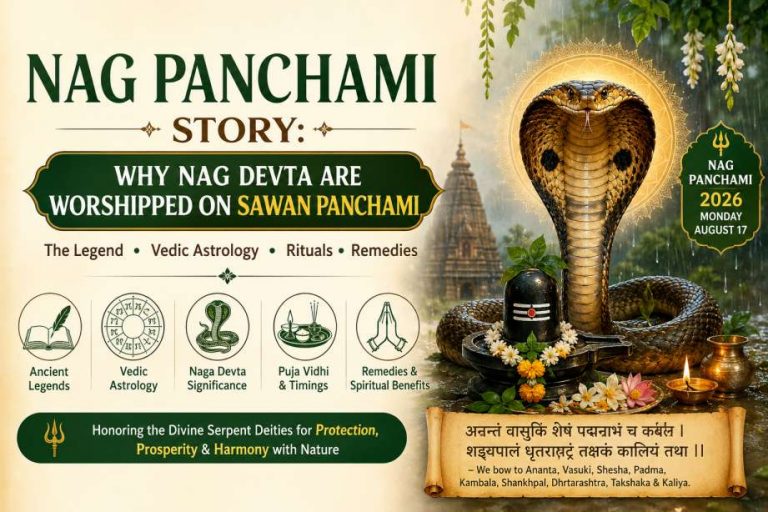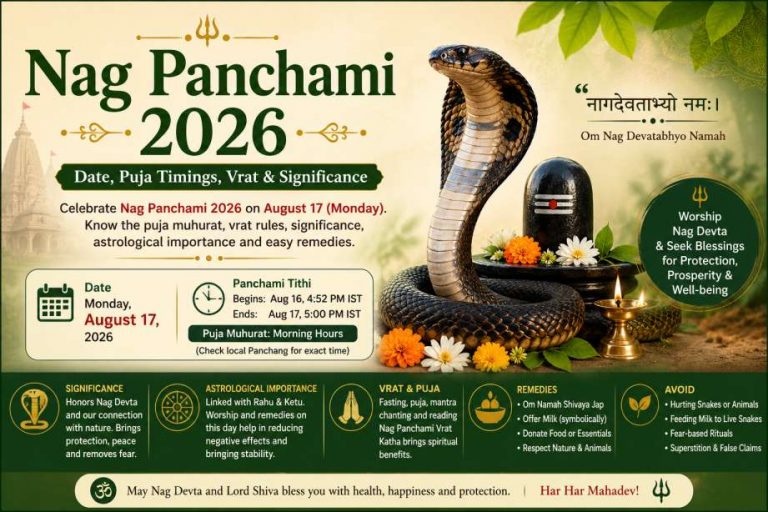
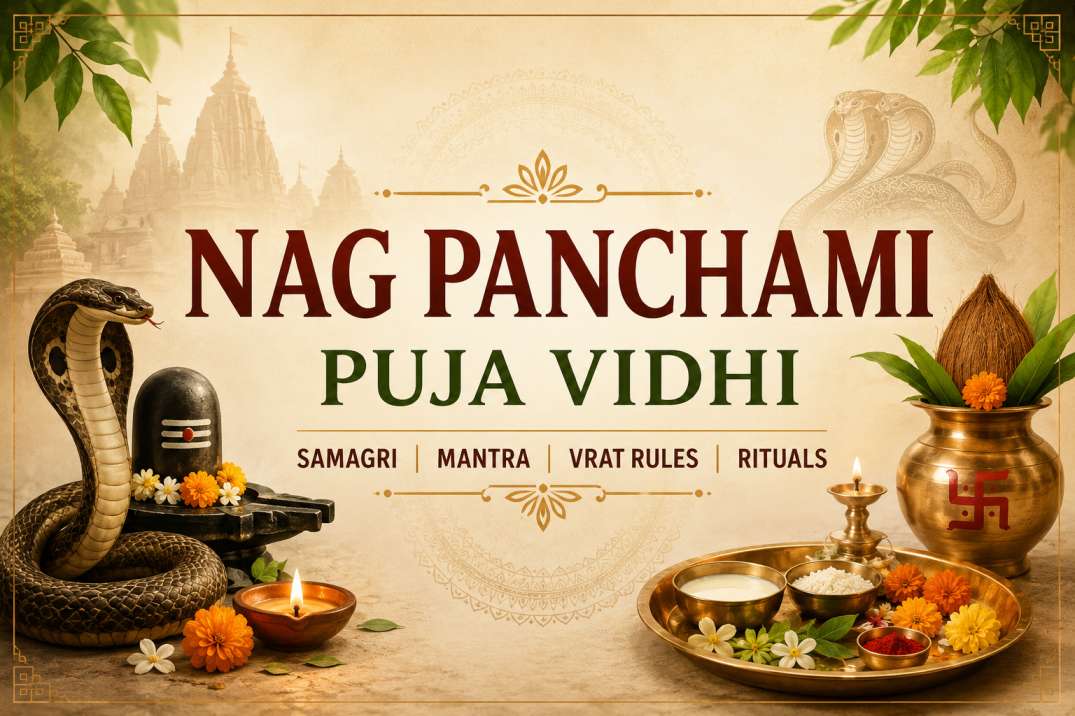
Nag Panchami is an important Hindu festival dedicated to the worship of Nagas, or serpent deities. It is traditionally observed during Shukla Paksha Panchami of the Shravan month. Devotees perform Nag Panchami puja to express respect toward serpent deities and seek protection, harmony and spiritual well-being.
In Vedic tradition, Naga worship is also associated symbolically with Rahu, Ketu, ancestral influences and hidden karmic patterns. However, these associations should not be treated as a guarantee of specific results. The deeper purpose of the ritual is devotion, gratitude toward nature and disciplined spiritual practice.
The exact Nag Panchami date, puja muhurat and local customs can differ according to the regional Panchang. Therefore, devotees should follow the Panchang applicable to their location.
Nag Panchami Puja Vidhi
Nag Panchami puja can be performed at home with simple, respectful rituals. The method may vary between families and regions, but the following sequence is widely suitable.
1. Prepare the Puja Space
Clean the puja area and take a bath before beginning the ritual. Wear clean clothes and place an image, idol or traditional representation of Nag Devata on a clean platform.
If your family follows a particular regional tradition, give priority to that custom rather than combining unrelated rituals.
2. Take Sankalp
Sit peacefully before the deity and take a simple sankalp for the puja. Mentally state your name, location and intention to perform the worship with devotion and sincerity.
The purpose may be spiritual peace, family well-being, gratitude toward nature or seeking strength to overcome fears and anxieties.
3. Offer Traditional Puja Items
Common Nag Panchami puja samagri includes:
- Clean water
- Milk, where traditionally offered
- Flowers
- Akshat (uncooked rice)
- Sandalwood paste
- Turmeric and kumkum
- Incense and diya
- Fruits
- Sweets or traditional naivedya
- Durva or other locally prescribed offerings
- A picture or idol of Nag Devata
Important: Never pour milk into snake holes or offer food directly to live snakes. Worship should be performed symbolically through an image, idol or established temple practice. This is safer for both people and wildlife.
4. Perform Abhishek and Puja
Offer water and other traditional offerings to the deity according to your family custom. Apply sandalwood paste and offer flowers, akshat and naivedya.
Light a diya and incense, then perform aarti with a calm mind. The emphasis should remain on devotion rather than the quantity or expense of offerings.
Nag Panchami Mantra
A commonly recited mantra is:
“ॐ नागदेवताभ्यो नमः।”
Om Nagadevatabhyo Namah.
It may be repeated 11, 21 or 108 times, according to personal practice and available time.
Devotees can also recite traditional Naga stotras or prayers prescribed by their family tradition or temple. The value of mantra practice lies in focused repetition, faith and disciplined spiritual attention.
Nag Panchami Vrat Rules
Many devotees observe a fast or partial fast on Nag Panchami. Vrat rules vary considerably by region and family tradition.
Common practices include:
- Eat sattvic food according to your regional custom.
- Avoid alcohol and non-vegetarian food.
- Maintain cleanliness and self-discipline.
- Avoid unnecessary arguments and negative speech.
- Spend some time in prayer, meditation or scripture reading.
- Break the fast according to the local Panchang and family tradition.
Fasting should be practiced according to one’s physical capacity. It is not necessary to undertake extreme fasting to demonstrate devotion.
Astrological Significance of Nag Panchami
From an astrological perspective, Nag Panchami is often connected with themes represented by the lunar nodes Rahu and Ketu. These planets are associated in Jyotish with karmic patterns, uncertainty, attachments, transformation and experiences that can be difficult to understand through ordinary reasoning.
Naga symbolism also has a broader connection with kundalini, transformation and the hidden dimensions of consciousness in Indian spiritual traditions.
Rahu-Ketu and Naga Worship
Some astrologers recommend Naga-related prayers when a person’s horoscope shows concerns traditionally associated with Rahu or Ketu. However, a responsible interpretation requires examining the complete Janma Kundli, including:
- Lagna and its lord
- Rahu and Ketu placement
- Houses occupied by the lunar nodes
- Planetary aspects
- Mahadasha and Antardasha
- Relevant yogas and conjunctions
Nag Panchami puja should therefore be viewed as a spiritual remedy rather than a substitute for complete horoscope analysis.
Practical Nag Panchami Remedies
Simple devotional remedies can make the festival more meaningful:
- Recite “Om Nagadevatabhyo Namah” with concentration.
- Visit a Shiva temple if this is part of your local tradition.
- Offer water to a Shiva Lingam according to temple rules.
- Practice compassion toward animals and nature.
- Donate food or essential items to someone in need.
- Spend time in prayer for family peace and emotional stability.
- Avoid harming snakes or disturbing their natural habitats.
A particularly meaningful modern interpretation of Nag Panchami is to combine religious observance with wildlife awareness and environmental responsibility.
Regional Traditions and Precautions
Nag Panchami rituals are not identical throughout India. In some areas, people worship Naga idols or paintings; elsewhere, special temple ceremonies and community traditions are followed.
Devotees should avoid entering snake habitats, handling live snakes or encouraging unsafe displays. Worshipping a symbolic representation of Nag Devata is sufficient for religious observance.
For the correct festival date and puja timing in IST, consult the Panchang followed in your region because lunar-calendar traditions can differ between North, South and other parts of India.
Conclusion
Nag Panchami is more than a ritual involving traditional offerings. It represents reverence for nature, spiritual discipline and the cultural significance of Naga worship in Hindu tradition. Its astrological symbolism can also encourage reflection on Rahu-Ketu themes such as uncertainty, transformation and karmic lessons.
A simple puja performed with cleanliness, sincerity and awareness can be more meaningful than elaborate rituals performed mechanically. Follow your regional Panchang, family traditions and temple guidance, while treating living snakes and wildlife with care and respect.
FAQs
1. What is the basic Nag Panchami Puja Vidhi?
The basic method includes purification, sankalp, worship of Nag Devata, traditional offerings, mantra recitation, naivedya and aarti.
The puja can be performed using an idol, picture or another traditional representation rather than approaching live snakes. Regional customs should always be given priority.
Helpful tips:
- Keep the puja space clean.
- Recite the mantra with concentration.
- Follow your local Panchang.
2. What Samagri is required for Nag Panchami Puja?
Common samagri includes water, flowers, akshat, sandalwood, diya, incense, fruits, sweets and other offerings prescribed by local tradition.
There is no need to purchase expensive items. A simple and sincere puja is traditionally considered meaningful.
Essential items: water, flowers, akshat, diya, incense and naivedya.
3. Which mantra should be chanted on Nag Panchami?
“ॐ नागदेवताभ्यो नमः” (Om Nagadevatabhyo Namah) is a simple mantra that devotees can chant during Nag Panchami worship.
It can be repeated 11, 21 or 108 times according to one’s practice. Devotees following a specific sampradaya or family tradition may use their prescribed Naga stotra or mantra.
Practice: Chant slowly and maintain a peaceful, focused state of mind.
4. Can Nag Panchami Puja help with Rahu-Ketu problems?
Nag Panchami worship is traditionally associated by some Jyotish practitioners with Rahu-Ketu symbolism, but its results should not be presented as guaranteed astrological cures.
A horoscope-based remedy should be selected only after examining the complete birth chart, planetary placements and dasha periods.
Astrological approach:
- Check Rahu and Ketu placement.
- Examine their house and sign positions.
- Consider Mahadasha and Antardasha.
- Combine spiritual remedies with practical action.
5. Can I offer milk to a live snake on Nag Panchami?
No, devotees should not approach or feed live snakes with milk because this can be harmful to the animal and unsafe for people.
Milk offerings can instead be made symbolically to a Nag Devata idol or image according to one’s tradition. This preserves the devotional practice without disturbing wildlife.
Safer practice: Worship symbolic representations and respect natural snake habitats.
6. What should be avoided during Nag Panchami Vrat?
Devotees commonly avoid non-vegetarian food, alcohol, arguments and other activities considered unsuitable for a vrata, although exact restrictions differ by regional tradition.
The purpose of vrat is self-discipline and spiritual focus rather than extreme physical hardship.
Remember:
- Follow your family tradition.
- Choose fasting according to your capacity.
- Maintain cleanliness and peaceful conduct.
- Follow the regional Panchang for vrat timings.